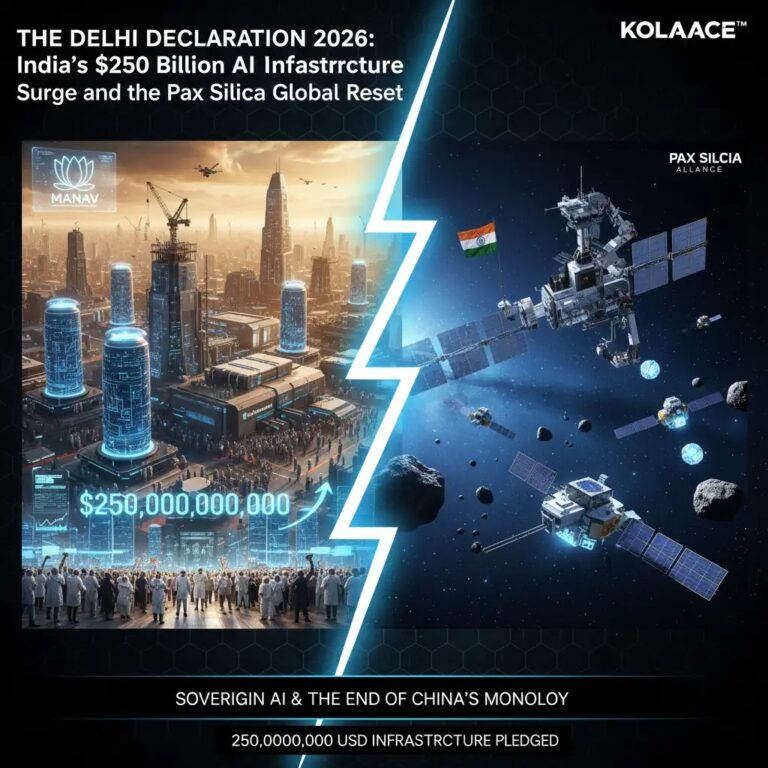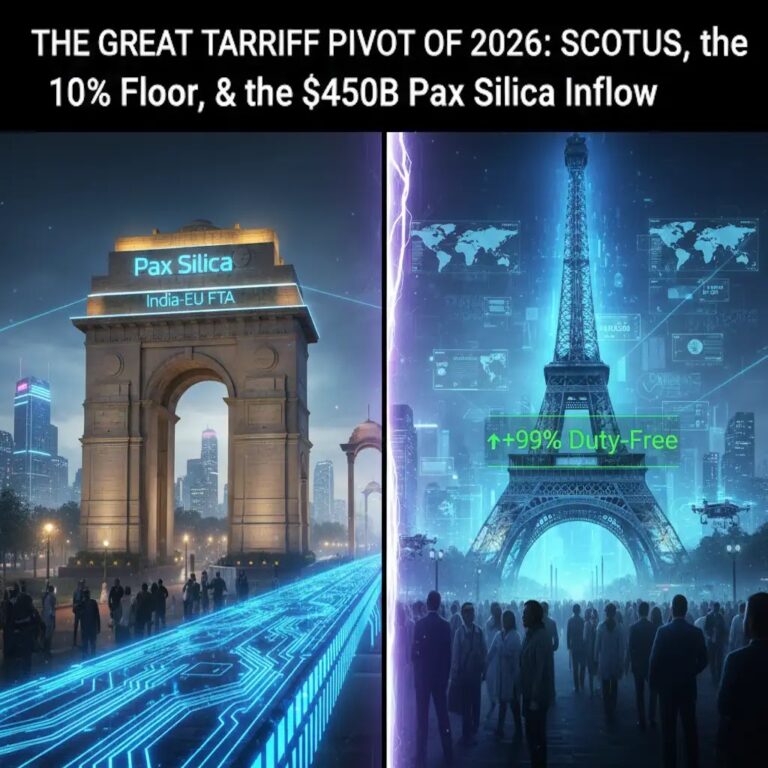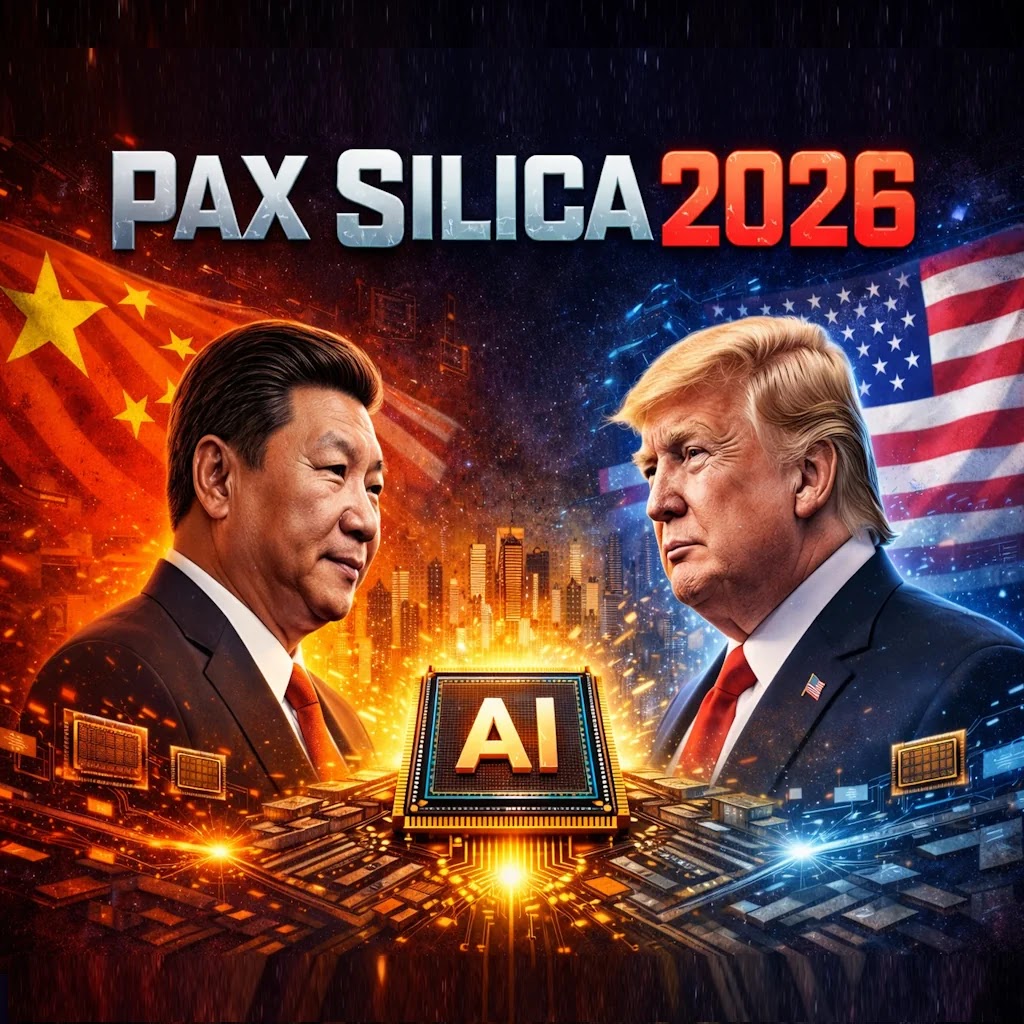
Today, February 20, 2026, the global geopolitical landscape has been permanently rewired. At the India-AI Impact Summit in New Delhi, India officially signed the Pax Silica Declaration. This US-led strategic alliance is no longer a mere proposal; it is a full-scale “Silicon Iron Curtain” designed to ringfence the world’s most advanced AI technologies and isolate the Chinese AI Ecosystem.
While the headlines focus on the $2.5 trillion AI spending forecast for 2026, the real story lies in the decoupling. By joining Pax Silica, India has chosen a side in the Tech Cold War, signaling a pivot away from the non-aligned “Global South” model and toward a high-trust, US-integrated silicon supply chain. For KOLAACE™ readers, this is the definitive signal to move capital into sovereign AI assets.
The China Factor: Beijing’s “Local-First” Counter-Strike
China is not sitting idly by. As Pax Silica attempts to block Beijing’s access to 2nm lithography and H200-class chips, China has accelerated its 15th Five-Year Plan (2026-2030). Their response is a “Local-First” AI mandate, forcing every domestic industry—from Shenzhen’s robotics labs to Shanghai’s biotech hubs—to run on 100% indigenous hardware like the Huawei Ascend 910C.
The “Silent Cartel” Strategy
China still controls over 90% of the world’s rare-earth refining. While Pax Silica nations (US, India, Japan, UK) build new plants, China is weaponizing its Right of First Refusal (ROFR) on mineral exports. This creates a “Mineral Squeeze” that could delay the Western AI build-out by 18–24 months, giving Beijing time to perfect its own frontier models.
Market Growth: The $2.5 Trillion Infrastructure War
The capital expenditure (CapEx) for 2026 is staggering. We are seeing a move from “Software-as-a-Service” to “Infrastructure-as-Sovereignty.” Large-scale data centers are being constructed at a rate of three per week across the Pax Silica member states.
AI Infrastructure Spending Projection (Billions USD)
*Global CapEx surge following the India-AI Impact Summit signing.*
Pax Silica vs. China: The 2026 Comparison Table
The divergence between these two ecosystems is the most critical metric for global business strategy this year.
| Feature | Pax Silica (US-India-EU-Japan) | China (Sovereign Ecosystem) |
|---|---|---|
| Chip Access | 2nm / 3nm Frontier Lithography | 7nm Indigenous Scaling (Huawei) |
| Supply Chain | Resilient “China Plus One” | Total Rare-Earth Monopoly (60%+) |
| AI Philosophy | Reasoning-First (GPT-5.3) | Deployment-at-Scale (Industrial) |
| Data Privacy | Quantum-Resistant Sovereignty | State-Mediated Local-First |
India’s Watershed Moment: Why Now?
India’s accession to Pax Silica follows the Union Budget 2026, which unlocked massive subsidies for the India Semiconductor Mission. By partnering with US giants like Micron and Applied Materials, India isn’t just a consumer; it is becoming the primary manufacturing alternative to China. With 10 semiconductor plants already under construction, the “Silica Dividend” for Indian youth is estimated at 5 million high-tech jobs by 2030.
Conclusion: The Architecture of the New World
The signing of Pax Silica signals the end of globalized technology as we knew it. We are moving into a “Gated Hierarchy” where compute power is the ultimate currency. To thrive in this environment, you must move beyond being a user and become an AI Architect.
Whether you are building on the Pax Silica stack or navigating the Chinese supply chain, the priority remains the same: Infrastructure Sovereignty. Ensure your systems are Quantum-Resistant and ready for the 2026 pivot.