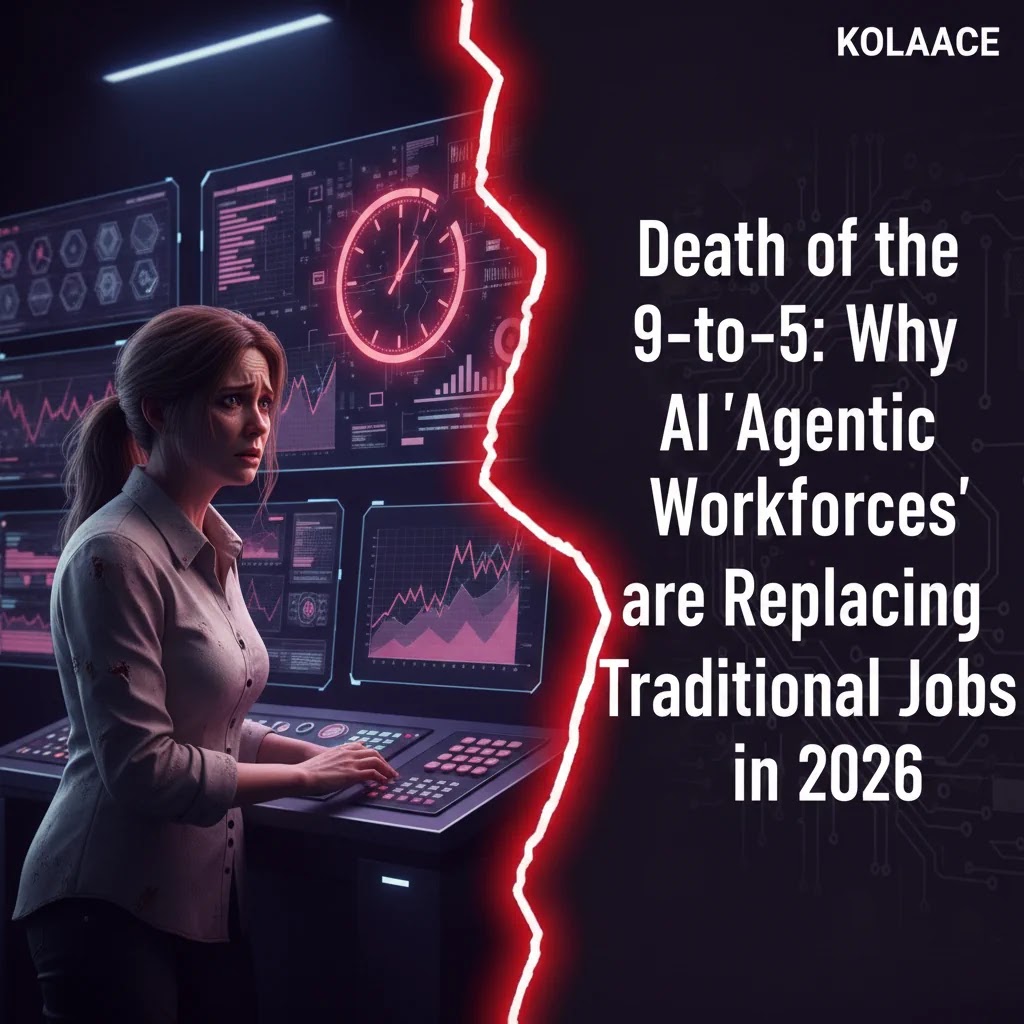
If you still believe that a stable 9 to 5 job is the safest career path in 2026, you are already behind the curve. Businesses are no longer asking how to hire more employees. They are asking how to replace repetitive workflows with intelligent systems that work 24 hours a day.
This shift is not loud or dramatic. It is happening quietly inside companies where teams are shrinking but output is increasing. The reason is simple. Agentic AI Workforces are now capable of handling end to end business processes with minimal human input.
For individuals, this creates two very different outcomes. Those who depend only on execution based skills face declining demand. Those who understand how to control and deploy AI systems are building what can be called a Solo Corporation, a business run by one person with the power of a full team.
What is an Agentic Workforce in Practical Terms
An Agentic Workforce is not just automation. It is a system where multiple AI agents perform specialized roles and collaborate to complete complex workflows. Each agent has a defined responsibility such as research, communication, execution, or optimization.
For example, instead of manually running a marketing campaign:
- An AI agent identifies trending topics
- Another agent writes optimized content
- A third agent publishes and tracks performance
- A fourth agent adjusts the strategy based on data
This entire loop can run continuously without waiting for human input. That is the real difference between traditional tools and agentic systems.
Why This Model is Scaling So Fast
From real world observation across startups and digital businesses, three factors are driving adoption:
- Cost efficiency, businesses reduce fixed salary expenses
- Speed of execution, tasks that took days now complete in hours
- Consistency, systems do not get tired or distracted
Market Reality: Why Companies Are Moving Fast
The AI economy is expanding rapidly because it directly impacts profitability. Companies are not adopting agentic systems for innovation alone. They are doing it to survive competition.
Global Agentic AI Market Growth (Billions USD)
Growth is driven by full workflow automation, not just tools.
In simple terms, companies that adopt early gain a massive advantage in cost and speed. Those who delay struggle to compete even in local markets.
Step by Step: Building Your Own AI Driven System
Step 1: Define One Clear Business Outcome
Do not start with tools. Start with a goal such as generating leads, selling a product, or creating content. A focused objective makes your system effective.
Step 2: Assign Roles to AI Agents
Break the process into parts and assign each part to an agent:
- Research agent
- Execution agent
- Monitoring agent
- Optimization agent
Step 3: Connect the Workflow
The real power comes from connecting agents in a loop. Output of one agent becomes input for another. This creates a continuous improvement cycle.
Step 4: Monitor and Refine
Even though systems are autonomous, human oversight is still important. Track performance weekly and refine instructions for better results.
Real World Use Cases for Small Businesses
From practical observation, these are the most impactful applications:
Local Service Business
A small coaching center or consultancy can use AI agents to handle inquiries, schedule appointments, and follow up with leads automatically.
Content Creators
YouTubers and bloggers can automate research, scripting, and SEO optimization while focusing on creativity and strategy.
Ecommerce Stores
AI agents can manage product listings, customer support, and pricing adjustments based on competitor analysis.
Human vs Agentic Workforce Comparison
| Feature | Traditional Workforce | Agentic AI Workforce |
|---|---|---|
| Cost | Fixed monthly salaries | Pay per usage |
| Working Hours | Limited working hours | Continuous operation |
| Scaling | Slow hiring process | Instant scaling |
| Consistency | Varies by individual | Predictable output |
Pros and Limitations You Should Understand
Advantages
- Lower operational cost over time
- Faster execution of repetitive tasks
- Ability to scale without hiring
Limitations
- Initial setup requires learning and experimentation
- Quality depends on how well you design the system
- Not suitable for highly creative or emotional tasks
Who Should Use This Model
This approach is ideal for:
- Freelancers who want to scale income
- Small business owners aiming to reduce costs
- Content creators building digital assets
It may not be suitable for:
- People unwilling to learn new systems
- Roles that rely heavily on human connection
Best Practices for Long Term Success
- Start small and scale gradually
- Focus on one workflow before expanding
- Continuously update your system based on results
- Maintain control over data and privacy
From experience, the biggest mistake is trying to automate everything at once. Focus brings better results.
Final Takeaway
The 9 to 5 job model is not disappearing overnight, but its importance is declining. The real opportunity lies in understanding how to design and control intelligent systems.
In the coming years, the highest earners will not be those who work the most hours. They will be those who build systems that work continuously for them.
Frequently Asked Questions