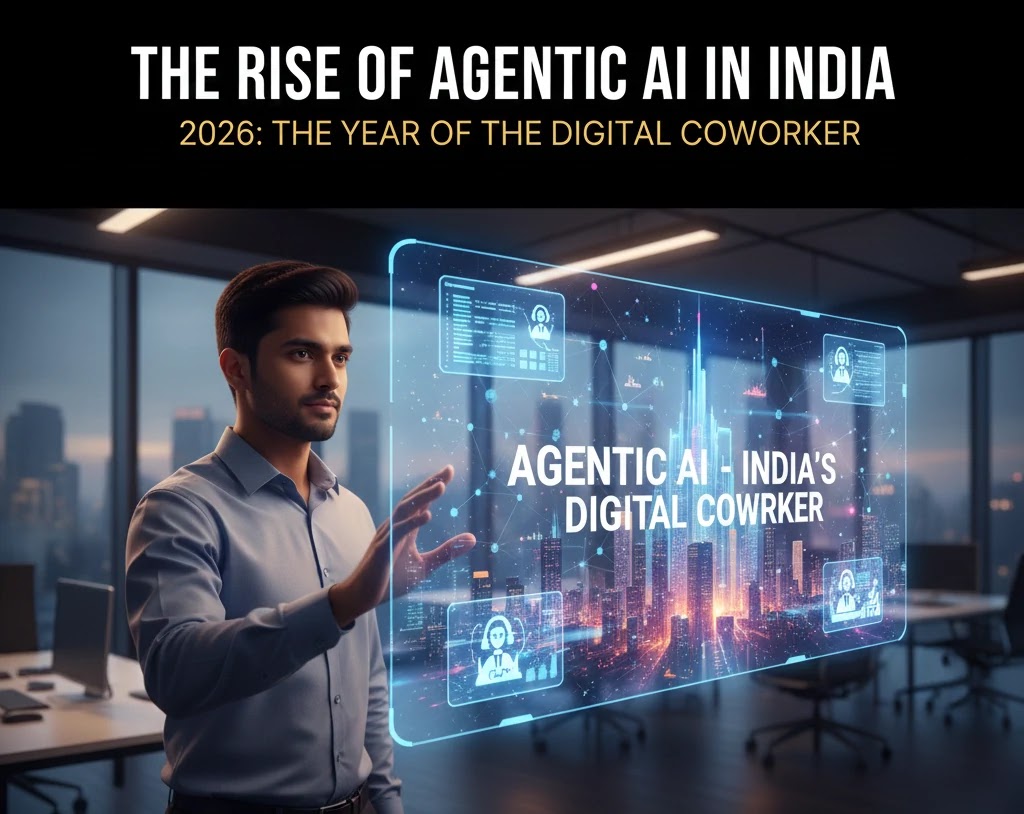
India’s AI landscape is changing faster than most people expected. Just two years ago, businesses were experimenting with chatbots and basic automation tools. In 2026, the conversation has shifted completely toward Agentic AI, systems that can independently plan tasks, make decisions, coordinate workflows, and execute actions with minimal supervision.
For professionals, creators, startups, and even small local businesses, this is no longer a futuristic concept. Digital coworkers powered by AI are already handling repetitive work, customer support, scheduling, reporting, inventory management, coding assistance, and research tasks. The biggest change is not that AI can answer questions better. The real shift is that AI can now take action.
Across India’s growing digital economy, businesses that learn how to work alongside AI agents may gain a major productivity advantage over those still relying only on manual workflows.
1. What is Agentic AI and Why Does It Matter in 2026?
Traditional AI systems were mostly reactive. You entered a prompt, and the software responded. Agentic AI works differently. These systems are designed to understand goals, break tasks into steps, make decisions, and complete actions with limited human involvement.
In practical terms, this means an AI agent can handle multi-step workflows instead of isolated commands. For example, instead of asking AI only to write an email, you can instruct an agent to analyze customer inquiries, prioritize urgent messages, draft replies, schedule follow-ups, and organize communication automatically.
How Agentic AI Differs from Traditional AI Tools
- Traditional AI responds to prompts. Agentic AI pursues goals.
- Older tools handled single tasks. Agents manage workflows.
- Reactive systems waited for instructions. Modern agents make contextual decisions.
- Basic automation followed rules. Agentic systems adapt dynamically.
This evolution matters because modern businesses no longer want isolated productivity tools. They want systems capable of reducing operational load continuously.
2. Why India is Becoming a Global Hub for Agentic AI Adoption
India is uniquely positioned for the rise of digital coworkers because of three major factors, a massive technology workforce, rapid digital infrastructure expansion, and strong demand for cost-efficient automation.
Unlike some markets where AI adoption is concentrated mainly inside large corporations, India’s growth is spreading across startups, freelancers, educational platforms, regional businesses, and service industries.
Key Reasons Behind India’s Agentic AI Boom
- Growing internet penetration in Tier II and Tier III cities.
- Government focus on digital transformation and AI accessibility.
- High demand for scalable business automation.
- Large developer ecosystem adapting quickly to AI workflows.
- Businesses looking to reduce repetitive operational costs.
Many Indian entrepreneurs are approaching AI with a practical mindset. Instead of chasing experimental technology trends, they are focusing on measurable efficiency improvements.
For example, local retailers are using AI agents to monitor inventory levels, reorder products automatically, track customer queries, and coordinate deliveries through messaging platforms. Small accounting firms are experimenting with AI-powered bookkeeping workflows. Educational creators are using agents for script drafting, scheduling, thumbnail generation, and audience analytics.
KOLAACE Insight: In India, the most successful AI adoption stories are often built around practical efficiency, not expensive experimentation. Businesses want systems that save time, reduce manual errors, and improve output consistency.
3. The Rise of the Digital Coworker Inside Modern Workplaces
One of the biggest misconceptions about Agentic AI is that it completely replaces human workers. In reality, most businesses are using AI agents as digital coworkers that assist teams rather than eliminate them.
The strongest productivity gains usually happen when humans and AI collaborate strategically. AI handles repetitive execution while humans focus on judgment, creativity, relationship building, and long-term planning.
Tasks AI Coworkers Are Already Handling in 2026
- Email organization and response drafting.
- Meeting scheduling and follow-up coordination.
- Customer support ticket prioritization.
- Data analysis and reporting summaries.
- Social media scheduling and optimization.
- Basic coding, debugging, and testing workflows.
- Research aggregation and document organization.
In software companies, developers increasingly supervise AI-generated code instead of writing every line manually. In marketing agencies, AI agents help analyze campaign performance and suggest adjustments automatically.
This shift changes the definition of productivity itself. The most valuable professionals are becoming those who can direct intelligent systems effectively instead of handling every operational detail personally.
4. Real-World Use Cases of Agentic AI in India
Agentic AI is no longer limited to large technology companies. Several industries in India are already integrating AI-driven workflows into daily operations.
E-Commerce and Retail
AI agents help manage stock levels, forecast demand, optimize pricing, and automate customer communication during sales periods.
Content Creation and Media
Creators use AI systems for script planning, thumbnail suggestions, SEO optimization, audience analysis, and publishing workflows. This allows more focus on creative quality and audience engagement.
Healthcare and Clinics
Some clinics are experimenting with AI-assisted appointment scheduling, patient follow-ups, and medical documentation management.
Small Businesses and Local Services
Small business owners are using AI agents to manage WhatsApp inquiries, invoice reminders, delivery coordination, and customer feedback tracking.
This widespread adoption shows that Agentic AI is not only a corporate trend. It is becoming part of mainstream business infrastructure.
5. The Skills That Will Matter Most in the Agentic AI Era
As AI systems become more capable, the nature of valuable human skills is changing. Routine execution is becoming less important than strategic thinking and system management.
Important Skills for 2026 and Beyond
- AI workflow management.
- Critical thinking and verification.
- Creative problem solving.
- Prompt engineering and instruction design.
- Data interpretation and decision-making.
- Human communication and negotiation skills.
Businesses are increasingly looking for professionals who can coordinate AI systems responsibly instead of simply performing repetitive tasks manually.
This is especially relevant for students and young professionals in India preparing for future careers. Understanding how to collaborate with AI may become as important as basic computer literacy once was.
6. Challenges and Risks of Agentic AI
Despite the excitement, Agentic AI also introduces serious challenges that businesses and governments must address carefully.
Major Concerns Around AI Agents
- Incorrect autonomous decisions.
- Privacy and data security risks.
- Overdependence on automation.
- Bias inside training data and outputs.
- Reduced human oversight in critical tasks.
- Workforce adaptation challenges.
Experts consistently recommend keeping humans involved in high-impact decisions, especially in finance, healthcare, legal systems, and public infrastructure.
Businesses adopting Agentic AI should focus on responsible implementation instead of blindly automating every workflow.
7. Best Practices for Working Effectively with AI Agents
Organizations seeing the best results from Agentic AI usually follow structured implementation strategies instead of rushing deployment.
Practical Best Practices
- Start with repetitive low-risk workflows first.
- Maintain human review for critical outputs.
- Use AI to support decision-making, not replace accountability.
- Train teams to supervise AI systems effectively.
- Continuously evaluate AI performance and accuracy.
- Protect sensitive business and customer data carefully.
Companies that treat AI as a collaborative productivity layer instead of a total replacement strategy are often seeing more stable long-term results.
Conclusion
India’s rise in the Agentic AI era is not happening because of hype alone. It is being driven by practical business demand, scalable digital infrastructure, and a workforce increasingly comfortable with AI-powered productivity systems.
The transition from passive software tools to active digital coworkers is already reshaping how businesses operate, how creators work, and how professionals manage daily tasks.
For students, entrepreneurs, developers, and business owners, the key challenge is no longer whether AI will become important. The real question is how effectively people can collaborate with intelligent systems while maintaining creativity, judgment, and strategic control.
In 2026, the professionals who understand how to direct AI agents efficiently may gain a significant advantage in productivity, scalability, and innovation.
Are you already using AI agents in your work or business? Share your experience and thoughts in the comments below.
Frequently Asked Questions
What is Agentic AI?
Agentic AI refers to intelligent systems capable of planning, decision-making, and executing multi-step tasks with limited human supervision.
Why is Agentic AI important in 2026?
Businesses are increasingly adopting AI agents to automate repetitive workflows, improve productivity, and support faster decision-making.
Can small businesses in India use AI agents?
Yes, many affordable AI tools now help small businesses manage customer communication, scheduling, inventory, and operational tasks efficiently.
Will Agentic AI replace jobs completely?
Most current implementations focus on augmenting human productivity rather than fully replacing workers. Human oversight and strategic thinking remain important.
What skills are important for working with AI agents?
Skills such as critical thinking, AI workflow management, communication, prompt design, and decision-making are becoming increasingly valuable.