A patient in Mumbai can book a doctor through an app, upload test reports instantly, and receive specialist guidance within hours. Meanwhile, in many rural districts across India, families still travel long distances just to meet a general physician. Delayed diagnosis, overcrowded clinics, and shortage of specialists remain common realities outside major cities.
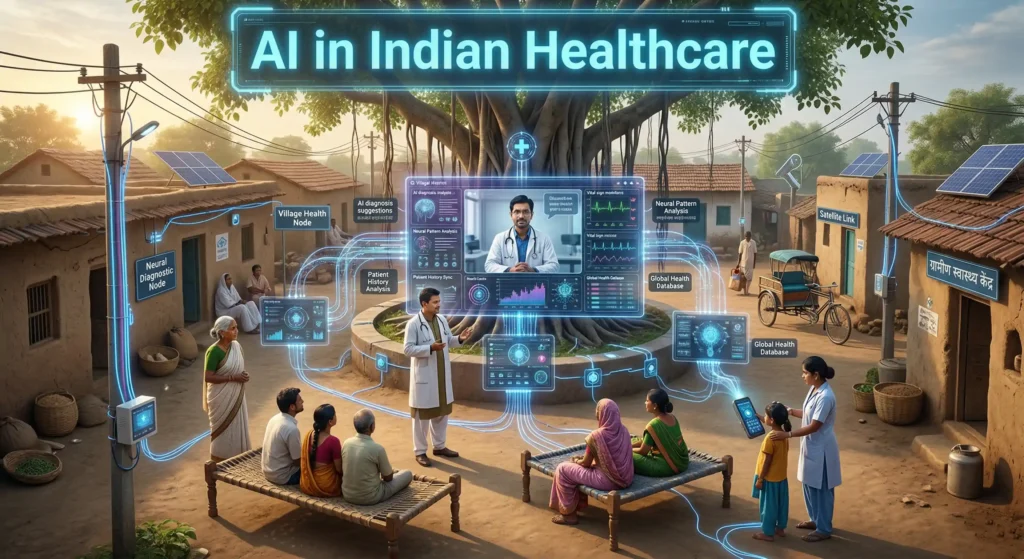
This healthcare gap has existed for decades, but a major shift is now happening quietly through artificial intelligence. AI is helping frontline health workers detect diseases faster, organize patient records digitally, and connect remote communities with doctors located hundreds of kilometers away.
What makes this transformation important is that it is not limited to large private hospitals anymore. AI tools are gradually becoming accessible through smartphones, portable diagnostic devices, telemedicine platforms, and regional language interfaces. In many cases, these systems are already improving healthcare delivery where traditional infrastructure is weak.
Instead of replacing doctors, AI in Indian healthcare is acting as a support layer that improves speed, accuracy, and accessibility.
→ Read: Top AI Startups in India to Watch in 2026
What AI in Indian Healthcare Actually Means
Many people still associate artificial intelligence with robots performing surgeries or futuristic hospital systems. In reality, most healthcare AI tools in India work quietly through software.
AI systems analyze large amounts of medical data and identify patterns much faster than manual review. These systems can process X rays, ECG reports, symptom descriptions, prescriptions, and patient history to support medical decisions.
For example, if an AI system has been trained using thousands of chest scans, it can quickly identify possible tuberculosis markers in a new scan. A doctor still reviews the case, but AI helps reduce screening time and highlights high risk patients faster.
This matters significantly in India because healthcare professionals are often overburdened, especially in government facilities and rural clinics.
- Doctors save time: AI handles repetitive analysis tasks.
- Patients receive faster screening: Early detection becomes easier.
- Language barriers reduce: Regional language support improves communication.
- Healthcare becomes more scalable: One specialist can guide multiple remote clinics digitally.
In practical terms, AI is becoming a digital assistant for healthcare systems rather than a replacement for human expertise.
The Urban and Rural Healthcare Gap in India
The urban rural healthcare divide in India is not only about hospitals. It involves infrastructure, staffing, awareness, affordability, and accessibility.
Most advanced medical facilities are concentrated in metro cities. Rural communities often face:
- Shortage of specialists
- Limited diagnostic equipment
- Long travel distances
- Slow laboratory access
- Paper based medical records
- Delayed emergency response
AI helps bridge these gaps by bringing digital medical intelligence closer to remote populations.
For example, instead of sending every patient to a city hospital, AI tools can help identify which cases need urgent referral and which can be treated locally.
This approach reduces unnecessary travel and improves resource allocation.
In states where telemedicine adoption has improved, healthcare workers are already using smartphones to upload patient symptoms, blood pressure readings, oxygen levels, and diagnostic images directly to centralized systems.
Doctors in cities can review these cases remotely while AI prioritizes urgent conditions.
→ Read: Digital India 2.0: The Role of AI in Modernizing Government Services
How AI Powered Rural Healthcare Works Step by Step
Step 1: Initial Health Data Collection
ASHA workers and local healthcare staff visit villages with smartphones or portable medical devices. Basic patient information such as symptoms, temperature, blood pressure, oxygen levels, and medical history is recorded digitally.
Step 2: Regional Language Input
Many patients explain their symptoms in Hindi, Marathi, Bengali, Tamil, or other regional languages. AI based speech systems convert these conversations into structured medical notes.
This reduces misunderstanding and improves documentation accuracy.
Step 3: Portable Diagnostic Testing
Portable ECG devices, digital stethoscopes, and AI assisted imaging tools allow quick health screening directly inside villages.
In some tuberculosis programs, mobile X ray vans equipped with AI software identify suspected cases within minutes.
Step 4: AI Based Risk Analysis
The collected data is analyzed by AI systems that compare patient patterns against large medical datasets.
The system flags potential high risk conditions such as:
- Tuberculosis
- Pneumonia
- Diabetes complications
- Heart abnormalities
- Pregnancy risks
Step 5: Specialist Consultation
If the system detects serious concerns, the case is forwarded to specialists through telemedicine platforms. Doctors review the information and guide local workers regarding medication, referral, or emergency care.
This process can significantly reduce delays in treatment.
Real World Use Cases Already Transforming Healthcare
AI Based Tuberculosis Screening
India continues to fight one of the world’s largest tuberculosis burdens. AI powered chest scan analysis is helping health teams identify possible TB cases faster, especially in remote regions where radiologists are unavailable.
Instead of waiting days for manual review, AI systems can prioritize suspicious scans almost instantly.
Maternal Health Monitoring
Pregnant women in rural areas often miss timely risk detection due to limited access to specialists. Portable ultrasound devices combined with AI support are helping frontline workers identify warning signs earlier.
This improves referral speed during high risk pregnancies.
Diabetic Eye Screening
Diabetic retinopathy can lead to blindness if untreated. AI powered eye screening systems can detect early retinal damage through image analysis before symptoms become severe.
This is especially valuable in areas with limited ophthalmologists.
AI Assisted Emergency Response
Some digital health systems now use AI to prioritize emergency calls based on symptom severity. This helps hospitals prepare before patients arrive.
Even small efficiency improvements can save lives in overloaded healthcare environments.
→ Read: Bio-Digital Convergence: The Synthetic Biology Revolution 2026
Benefits of AI in Indian Healthcare
Faster Diagnosis
AI systems process medical data quickly, helping doctors identify problems earlier. Early diagnosis often reduces treatment costs and improves recovery chances.
Lower Healthcare Costs
Travel expenses, repeated testing, and delayed treatment can financially damage rural families. Local AI assisted screening reduces unnecessary hospital visits.
Improved Specialist Access
Patients in remote regions can receive guidance from urban specialists without leaving their district.
Better Healthcare Management
Digital records reduce paperwork confusion and improve patient tracking.
Support for Overworked Doctors
Doctors spend less time on repetitive tasks and more time on complex patient care.
Comparison Table: Traditional vs AI Powered Rural Healthcare
| Healthcare Area | Traditional Rural System | AI Assisted Healthcare System |
|---|---|---|
| Diagnosis Speed | Days or weeks | Minutes or hours |
| Specialist Availability | Limited in villages | Accessible digitally |
| Medical Records | Paper based | Digital tracking systems |
| Disease Detection | Often delayed | Early risk identification |
| Travel Requirement | High | Reduced for basic consultations |
| Healthcare Efficiency | Manual processes | Automated support systems |
Challenges and Risks That Still Need Attention
Data Privacy Concerns
Healthcare information is highly sensitive. Strong cybersecurity practices and clear regulations are essential to protect patient records.
Dependence on Internet Infrastructure
Many rural areas still experience unstable connectivity and electricity issues. AI systems cannot function efficiently without reliable infrastructure.
Risk of Incorrect Predictions
AI tools are helpful, but they are not perfect. Poor quality data or biased training datasets can lead to inaccurate suggestions.
Human medical supervision remains necessary.
Digital Literacy Barriers
Some healthcare workers require additional training to operate advanced digital systems confidently.
Technology adoption becomes difficult if proper support is missing.
→ Read: The Evolution of Cybersecurity Insurance for Digital Assets in 2026
Who Should Use AI Healthcare Systems and Who Should Be Careful
Best Use Cases
- Rural health programs
- Primary healthcare centers
- Government telemedicine initiatives
- Diagnostic screening projects
- Preventive healthcare systems
- Chronic disease monitoring
Situations Requiring Extra Caution
- Complex surgeries
- Critical emergency diagnosis without human review
- Cases involving incomplete patient data
- Areas with weak digital infrastructure
AI works best as a support system combined with trained healthcare professionals.
Best Practices for Responsible AI Healthcare Implementation
- Keep doctors involved: AI should assist decision making, not replace medical professionals.
- Train healthcare workers properly: Field staff need practical digital training for accurate data collection.
- Use Indian healthcare datasets: AI systems perform better when trained using local patient data.
- Maintain cybersecurity standards: Protecting patient privacy must remain a priority.
- Focus on accessibility: Regional language support is essential for rural adoption.
Healthcare technology succeeds only when it fits real local conditions.
Future Trends in AI Healthcare Beyond 2026
The next stage of healthcare AI in India will likely focus on preventive and continuous care.
Wearable devices may continuously monitor:
- Heart activity
- Blood sugar trends
- Oxygen levels
- Sleep quality
- Stress indicators
Instead of waiting for symptoms to become severe, AI systems could warn users earlier.
Remote robotic assistance, AI supported ambulances, and predictive disease tracking may also improve healthcare planning at national scale.
India’s growing digital infrastructure and smartphone penetration are likely to accelerate this transformation further.
→ Read: Personalized Medicine: How 2026 CRISPR Home Kits are Changing Longevity
Conclusion
AI in Indian healthcare is not just about advanced technology. It is about solving practical problems that affect millions of people every day.
For rural communities, faster diagnosis, remote specialist access, and affordable digital healthcare can significantly improve quality of life.
While infrastructure gaps and privacy concerns still require attention, the progress already visible across telemedicine, AI diagnostics, and portable health systems shows real potential.
The most important point is this: healthcare innovation becomes meaningful only when it reaches people who need it most. AI is slowly helping India move closer to that goal.
Frequently Asked Questions (FAQs)
Can AI replace doctors in Indian healthcare?
No. AI is designed to support doctors by improving speed, organization, and data analysis. Human medical expertise is still essential.
How does AI help rural healthcare in India?
AI helps rural healthcare through telemedicine, faster diagnostics, multilingual communication, portable testing devices, and remote specialist access.
Is AI based medical diagnosis reliable?
AI systems can be highly accurate in specific tasks like medical imaging analysis, but doctor supervision remains necessary for final diagnosis and treatment decisions.
What diseases can AI detect effectively?
AI is commonly used for tuberculosis screening, diabetic eye disease detection, heart monitoring, cancer screening, and pregnancy risk assessment.
What are the biggest risks of AI in healthcare?
The main concerns include patient data privacy, infrastructure limitations, incorrect predictions, and overdependence on automated systems.
Will AI healthcare become common in villages?
Adoption is increasing steadily through government programs, telemedicine platforms, and smartphone based healthcare systems. Growth is expected to continue over the next few years.