The gaming industry is entering another major transition phase. Players no longer judge consoles only by graphics quality. In 2026, expectations are focused on instant loading, seamless cloud integration, AI assisted gameplay, and ultra fast memory systems capable of handling massive open world environments.
That is why recent PlayStation 6 leaks have attracted so much attention across the gaming and hardware community. Early reports suggest Sony may be preparing a console that pushes beyond traditional upgrades. Instead of improving one component at a time, the rumored PS6 architecture appears designed around high speed data movement, low latency processing, and hybrid cloud gaming.
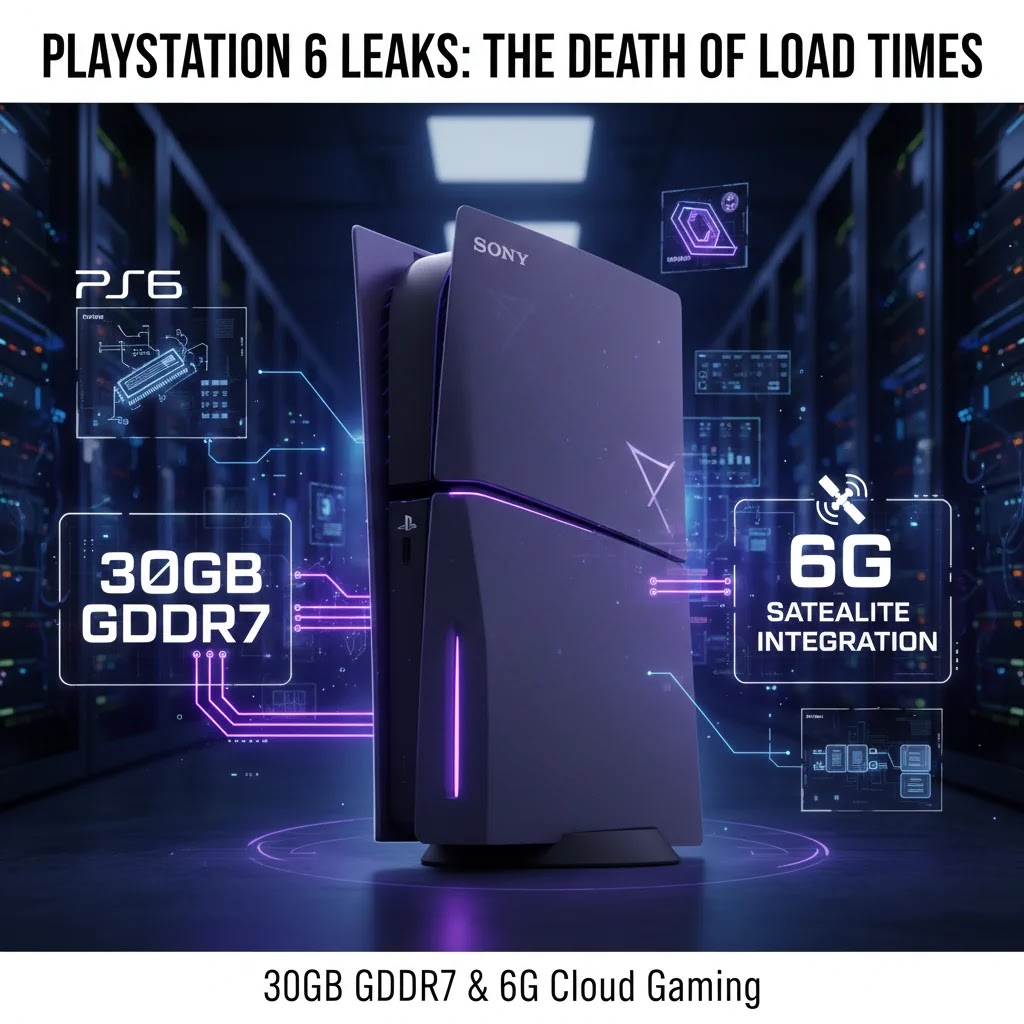
The biggest talking points include 30GB GDDR7 RAM, a possible 6G satellite connectivity layer, advanced Universal Compression technology, and near elimination of loading screens.
While Sony has not officially confirmed these specifications, the leaks align with broader industry trends already visible in AI computing, mobile chip development, and next generation network infrastructure.
1. Why the PlayStation 6 Matters More Than Previous Console Upgrades
Every console generation brings visual improvements, but the rumored PS6 changes appear focused on removing technical bottlenecks that players notice daily.
Current generation systems already deliver strong graphics performance. However, large games still struggle with:
- Long loading times
- Texture streaming delays
- Massive storage requirements
- Patch installation slowdowns
- Bandwidth limitations in cloud gaming
Modern games are becoming increasingly data heavy. Some AAA titles already exceed 150GB in size. Open world games continuously load textures, AI behaviors, environmental assets, and multiplayer synchronization in real time.
That is why memory architecture and storage efficiency are becoming more important than traditional processing upgrades alone.
Industry analysts believe Sony is trying to build a console ecosystem prepared for AI enhanced gaming, cloud streaming, and persistent online worlds instead of focusing only on local hardware rendering.
2. 30GB GDDR7 RAM Could Change Console Performance Standards
One of the most discussed leaks involves the rumored 30GB GDDR7 unified memory system. According to hardware speculation, Sony may use 3GB GDDR7 memory modules in a clamshell arrangement to achieve higher memory density and bandwidth.
If accurate, this would represent a significant jump from the PS5 architecture.
Why does this matter?
Game developers are facing growing memory demands because modern engines now support:
- High resolution textures
- Advanced ray tracing
- Real time AI behavior systems
- Larger open world environments
- Procedural generation
- Dynamic physics simulations
More memory bandwidth allows game assets to move faster between storage, RAM, and GPU systems. In practical gaming terms, that can reduce texture pop in, improve world streaming, and eliminate delays when transitioning between environments.
Gamers in regions with slower storage systems or inconsistent internet infrastructure already understand how frustrating long loading times can become during multiplayer sessions.
The rumored 640GB/s memory bandwidth could help Sony deliver smoother high resolution experiences while preparing for future AI driven game mechanics.
PlayStation Generational Specs 2020 to 2026
| Component | PS5 Original | PS6 Leak |
|---|---|---|
| RAM Type | 16GB GDDR6 | 30GB GDDR7 |
| Bandwidth | 448 GB/s | 640 GB/s |
| Architecture | RDNA 2 | RDNA 5 3nm |
| Storage Focus | Fast SSD | AI Assisted Compression |
3. Project Amethyst and the Push Toward Zero Loading Screens
One of the more interesting leaks revolves around a rumored Sony and AMD collaboration internally referred to as Project Amethyst.
The key idea behind this technology is Universal Compression. Instead of treating storage compression as a secondary process, the system reportedly analyzes and compresses data dynamically while assets move through the hardware pipeline.
This matters because game sizes are increasing faster than storage technology can comfortably support.
Compression systems can help:
- Reduce storage usage
- Speed up game loading
- Improve texture streaming
- Lower download sizes
- Reduce bandwidth pressure
Players often focus on GPU performance, but engineers increasingly view data movement as the real performance bottleneck.
Several modern games already hide loading screens behind elevators, tunnels, or cinematic transitions because asset streaming still creates delays. Advanced compression combined with faster memory bandwidth could make these tricks far less necessary.
This trend also connects with broader computing developments seen in AI infrastructure and data center optimization, where compression and bandwidth efficiency are becoming critical performance metrics.
4. 6G Integration and the Future of Cloud Gaming
Perhaps the boldest rumor surrounding the PS6 is the inclusion of a built in 6G satellite gaming modem.
While this may sound futuristic, the timing aligns with early global 6G testing and expanding low earth orbit satellite infrastructure.
If implemented correctly, this could significantly change how gaming content is delivered.
Potential Advantages of 6G Enabled Gaming
- Lower multiplayer latency
- Faster cloud streaming performance
- Reduced dependency on local downloads
- Access in remote or underserved regions
- Near instant game launching
For countries with uneven broadband quality, including many developing markets, satellite assisted gaming infrastructure could expand access to high performance cloud gaming.
Instead of downloading massive files, players may eventually stream portions of games dynamically while core systems run locally on the console.
That hybrid model could become especially important as game file sizes continue increasing.
5. AI Assisted Gaming Could Become a Core PS6 Feature
Another major industry trend influencing console design is artificial intelligence.
Gaming companies are increasingly investing in AI systems capable of:
- Generating smarter NPC behavior
- Improving procedural world creation
- Reducing development costs
- Enhancing voice interaction systems
- Upscaling graphics dynamically
High bandwidth memory and advanced compression systems are important because AI powered gaming workloads require extremely fast access to large data pools.
This is why many analysts believe future consoles will function more like compact AI optimized computing systems instead of traditional gaming hardware.
Developers are also exploring adaptive gameplay systems where game worlds react dynamically to player behavior instead of relying only on scripted sequences.
6. Potential Advantages and Concerns About the PS6
Potential Advantages
- Much faster loading performance
- Improved open world streaming
- Better cloud gaming integration
- Stronger AI processing capability
- Longer future relevance for developers
Possible Concerns
- Higher launch pricing
- Increased development complexity
- Potentially larger power consumption
- Dependence on advanced internet infrastructure
- Storage expansion costs
Historically, major hardware transitions often arrive with premium pricing during the first years after launch. If Sony introduces advanced networking and AI hardware, pricing could move beyond traditional console expectations.
7. Why the Gaming Industry is Investing Aggressively in Next Generation Hardware
Gaming has evolved far beyond physical console sales. Companies now generate revenue from subscriptions, cloud platforms, digital marketplaces, live services, and AI driven ecosystems.
That is one reason hardware innovation remains strategically important.
Faster consoles encourage:
- Higher digital engagement
- Longer player retention
- Expansion of cloud gaming services
- Growth of competitive multiplayer ecosystems
- Cross platform service integration
Console Market Valuation Forecast 2024 to 2030
Source: KOLAACE™ Engineering Analysis 2026
As AI, streaming, and cloud infrastructure improve, console ecosystems are increasingly becoming part of larger digital service networks instead of standalone gaming devices.
8. Who Should Pay Attention to These PS6 Leaks?
Gamers Who Will Benefit Most
- Competitive online players
- Fans of large open world games
- Cloud gaming users
- Players interested in AI driven experiences
- Content creators and streamers
Users Who May Prefer Waiting
- Casual players satisfied with current generation hardware
- Gamers with limited broadband access
- Players concerned about launch pricing
- Users waiting for a mature game library
As with previous console generations, the strongest value often appears once developers fully understand the hardware architecture and optimize games specifically for it.
9. Frequently Asked Questions
Is the PlayStation 6 officially confirmed?
Sony has not officially confirmed the leaked specifications discussed in recent reports. Most details currently come from industry leaks and hardware speculation.
Will PS6 really use 30GB GDDR7 RAM?
The 30GB GDDR7 memory configuration remains unconfirmed, but it aligns with growing memory demands in advanced gaming workloads.
What is Universal Compression technology?
Universal Compression refers to a rumored system designed to compress and stream data more efficiently during gameplay to reduce loading delays and improve bandwidth usage.
Could PS6 support 6G cloud gaming?
Industry leaks suggest Sony may explore advanced wireless and satellite connectivity options for future cloud gaming integration.
When could the PS6 launch?
Based on current speculation, many analysts expect a launch window around late 2027 or later.
Final Expert Take
If the current leaks are even partially accurate, the PlayStation 6 may represent one of Sony’s biggest architectural shifts since the original move toward SSD powered gaming. The focus appears centered on bandwidth efficiency, AI assisted processing, and seamless cloud integration instead of raw graphics improvements alone.
The most important long term change may not be visual quality. It could be the gradual disappearance of waiting itself. Faster memory systems, advanced compression, and next generation networking are all pushing gaming toward instant interaction, persistent online worlds, and continuous streaming experiences.
For gamers, developers, and technology investors, the PS6 leaks offer an early look at where the entire entertainment hardware industry may be heading during the next decade.