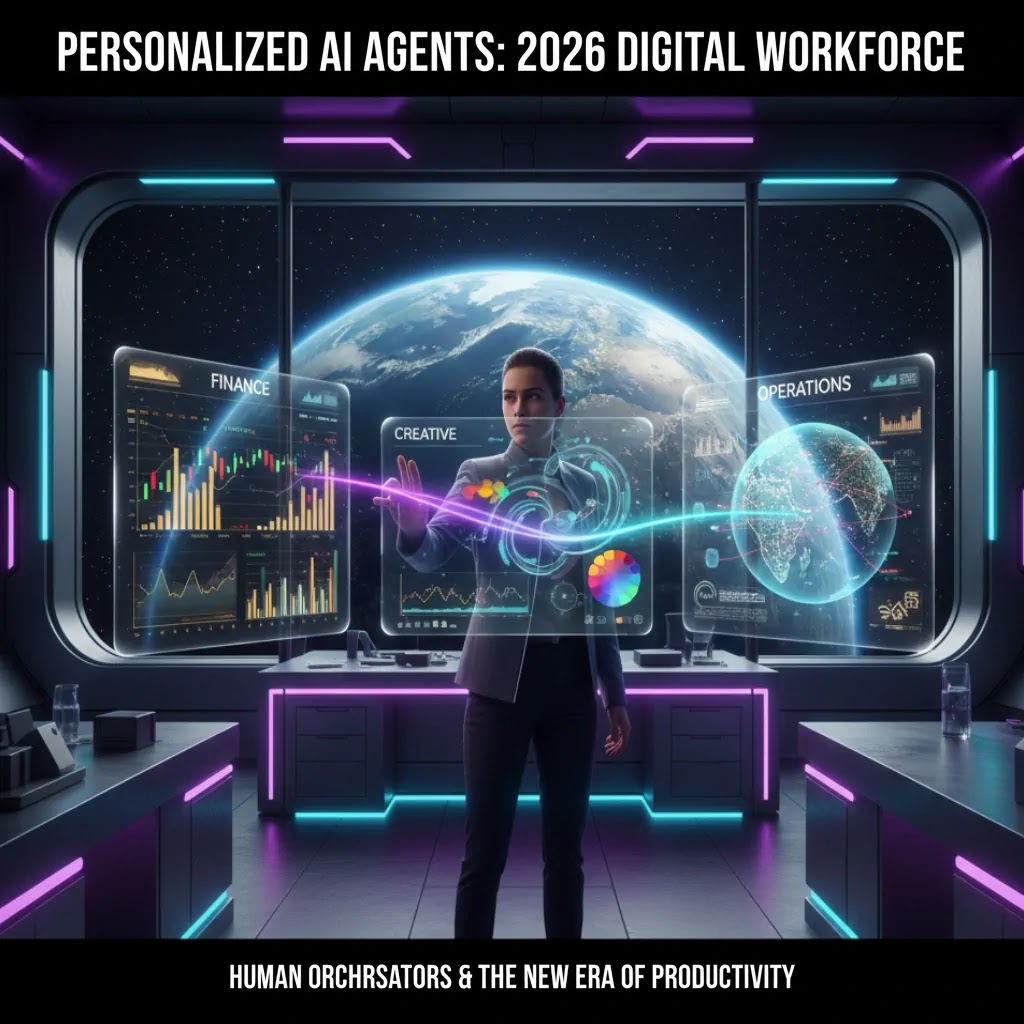
AI in 2026 is no longer limited to answering questions or generating text. Businesses are now using personalized AI agents as active digital workers that can manage tasks, communicate with customers, monitor operations, and even coordinate with other software tools automatically.
This shift is important because companies are facing growing pressure to reduce repetitive work while increasing speed and productivity. Small businesses especially are discovering that modern AI agents can operate like a lightweight digital team without the overhead costs of large departments.
Unlike traditional chatbots, modern AI agents are goal driven systems. They can remember context, interact with APIs, execute workflows, and continue tasks independently for hours. In practical terms, this means an AI agent can schedule meetings, prepare reports, monitor inventory, respond to support tickets, and analyze marketing data while the business owner focuses on strategy.
By early 2026, the conversation around artificial intelligence has clearly changed. The question is no longer whether businesses should use AI. The real question is how effectively they can manage and integrate their own digital workforce.
1. What Are Personalized AI Agents?
Personalized AI agents are intelligent software systems designed to perform tasks on behalf of individuals or businesses. Unlike simple automation tools, these agents can understand objectives, learn workflows, and make contextual decisions.
The key difference between older AI assistants and modern agentic systems is autonomy. Traditional assistants waited for commands. Personalized AI agents can actively monitor tasks and continue working without constant human prompting.
Core Capabilities of AI Agents in 2026
- Task planning and workflow execution
- Multi app integration through APIs
- Persistent memory and context awareness
- Automated reporting and analytics
- Customer communication management
- Content creation and distribution
- Scheduling and operational coordination
For example, a small ecommerce business can use one AI agent for customer support, another for inventory monitoring, and another for social media publishing. Together, these systems function like a coordinated virtual operations team.
2. From Chat Based AI to Autonomous Execution
The transition from conversational AI to autonomous AI execution became much more visible in 2026. Businesses no longer want systems that only generate suggestions. They want systems that can actually complete tasks.
Platforms inspired by tools such as AI coding assistants and enterprise workflow agents now allow users to assign long running objectives instead of isolated prompts.
Here is what this looks like in practice:
- A marketing agent monitors campaign performance and adjusts ad targeting automatically
- A coding agent reviews software bugs overnight and prepares patches
- A finance agent tracks invoices and flags unusual transactions
- A sales agent qualifies leads and schedules meetings
One major reason businesses are adopting these systems is time efficiency. Many repetitive operational tasks that previously consumed hours each day can now run continuously in the background.
Why Small Businesses Are Paying Attention
Large enterprises have used automation for years, but personalized AI agents are making advanced operational support accessible to smaller companies as well. A startup with five employees can now operate with the productivity level that once required a much larger team.
This is especially valuable for businesses handling:
- Online customer support
- Digital marketing operations
- Appointment scheduling
- Inventory coordination
- Data reporting
- Lead management
3. Multi Agent Systems and the Rise of the Virtual Team
One of the most important developments in 2026 is the growth of multi agent systems. Instead of relying on one general AI model, businesses are now assigning specialized agents to different responsibilities.
This approach is often described as a virtual digital department.
For example:
- One agent analyzes market trends
- Another writes content and marketing copy
- A third schedules social media publishing
- A separate agent monitors analytics and performance data
These systems communicate through shared memory and workflow protocols, creating coordinated operational pipelines. Businesses adopting this structure are reporting faster execution cycles and improved responsiveness.
The growth of the Model Context Protocol, commonly called MCP, has also improved interoperability between AI agents and external software platforms.
Workplace Evolution: 2025 vs. 2026 Roles
| Responsibility | 2025 Assistant AI | 2026 Agentic AI |
|---|---|---|
| Task Handling | Single prompt responses | Autonomous project workflows |
| Execution | Draft generation only | API actions and operational execution |
| Coordination | Human controlled sequences | Multi agent collaboration |
| Availability | On demand interaction | Continuous background operation |
4. Real World Use Cases for AI Agents in 2026
Personalized AI agents are no longer experimental tools used only by large tech companies. They are increasingly appearing in practical business operations across industries.
Ecommerce Businesses
Online stores are using AI agents to monitor abandoned carts, answer product questions, generate personalized recommendations, and manage stock alerts automatically.
Healthcare Operations
Some healthcare providers are testing AI agents for appointment scheduling, patient reminders, and administrative workflow management. However, sensitive medical decisions still require strong human oversight.
Content Publishing
Digital publishers are using AI agents to monitor search trends, prepare SEO briefs, optimize headlines, and coordinate publishing schedules.
Software Development
Development teams increasingly use coding agents for testing, bug tracking, documentation generation, and deployment monitoring.
Local Businesses
Small retail stores and service businesses are beginning to adopt AI powered appointment booking systems and automated customer engagement tools that work around the clock.
5. The $8.8 Billion AI Agent Market
The AI agent market has expanded rapidly as businesses move beyond experimentation and toward operational deployment. By 2026, the global market value is estimated at approximately $8.81 billion.
Several factors are driving this growth:
- Increasing enterprise automation demand
- Improved AI reasoning capabilities
- Lower infrastructure costs
- Expansion of Edge Computing infrastructure
- Better API connectivity across platforms
- Growth of remote and hybrid work environments
Another important trend is the integration of AI agents into existing enterprise software rather than standalone AI products. Many businesses may soon use AI agents daily without even thinking of them as separate tools.
AI Agent Market Valuation ($ Billions)
6. Pros and Cons of Personalized AI Agents
Advantages
- Improved operational efficiency
- 24 hour workflow support
- Reduced repetitive manual tasks
- Faster data analysis and reporting
- Scalable support for growing businesses
- Better response times for customers
Challenges and Limitations
- Requires careful oversight and governance
- Potential privacy and data security concerns
- Incorrect automation can create operational mistakes
- Complex integrations may require technical expertise
- Businesses still need human review for critical decisions
One important reality often overlooked in online discussions is that AI agents are not magic replacements for human judgment. The most successful businesses in 2026 are using AI agents to support employees, not eliminate strategic thinking.
7. Best Practices for Businesses Using AI Agents
Companies planning to integrate AI agents should focus on structured adoption instead of rushing deployment.
Recommended Best Practices
- Start with repetitive low risk workflows
- Keep human approval for critical actions
- Monitor AI outputs regularly
- Use role based access permissions
- Protect customer and business data carefully
- Choose platforms with transparent logging systems
- Train employees to work alongside AI systems
Businesses that gradually integrate AI agents usually adapt more successfully than organizations attempting full automation immediately.
8. Who Should Use AI Agents and Who Should Be Careful?
Businesses Likely to Benefit
- Digital first startups
- Ecommerce companies
- Marketing agencies
- Software development teams
- Customer support operations
- Content publishing businesses
Businesses That Should Adopt Carefully
- Organizations handling highly sensitive personal data
- Companies with strict regulatory requirements
- Businesses lacking internal technical oversight
- Operations requiring complex human emotional judgment
AI agents work best when combined with clear workflows, responsible oversight, and realistic expectations.
9. Frequently Asked Questions
What is a personalized AI agent?
A personalized AI agent is an autonomous software system that can perform tasks, manage workflows, and interact with digital tools on behalf of a user or business.
How are AI agents different from chatbots?
Traditional chatbots mainly respond to questions. AI agents can plan, execute, monitor, and complete tasks independently.
Can small businesses use AI agents effectively?
Yes. Many small businesses are using AI agents for customer support, scheduling, marketing automation, and operational management.
Do AI agents replace employees?
Most businesses are using AI agents to reduce repetitive work and improve productivity rather than fully replacing employees.
What is the biggest challenge with AI agents?
The biggest challenge is maintaining proper oversight, data security, and workflow accuracy while integrating autonomous systems into daily operations.
KOLAACE™ Verdict
Personalized AI agents represent one of the biggest operational shifts in modern business technology. In 2026, companies are moving beyond experimental AI tools and building coordinated digital workforces capable of handling real business functions.
The long term winners will likely be businesses that learn how to combine human creativity with AI driven execution effectively. As technologies such as Physical AI systems, intelligent automation, and multi agent coordination continue evolving, digital workers may soon become a standard part of everyday operations.
For businesses willing to adapt carefully, personalized AI agents are no longer just productivity tools. They are becoming a competitive advantage.