Businesses in 2026 are facing a major operational challenge. Teams are overloaded with repetitive tasks, customer expectations are rising, and traditional automation tools often break when workflows become more complex. Many companies already use AI for content generation or basic support tasks, but the real competitive advantage is now shifting toward systems that can independently plan, execute, monitor, and improve workflows.
This is where Agentic AI is changing business operations. Unlike older AI systems that simply respond to prompts, agentic systems can work toward goals autonomously. They can make decisions, coordinate tasks, interact with software tools, and adapt when situations change.
For startups, online businesses, agencies, and enterprise teams, the biggest opportunity in 2026 is not just using AI tools individually. The real advantage comes from deploying connected AI agents that operate like a digital workforce.
What is Agentic AI and How Does It Work?
Agentic AI refers to autonomous AI systems that can complete multi-step tasks with minimal human supervision. Instead of waiting for constant instructions, these agents can interpret goals, create plans, execute actions, evaluate outcomes, and adjust strategies when necessary.
Traditional AI systems are usually reactive. They generate responses when prompted. Agentic AI systems are proactive. Once given an objective, they can operate continuously until the task is completed.
Core Capabilities of Agentic AI
- Task planning and prioritization.
- Decision-making based on real-time data.
- Integration with APIs and software tools.
- Autonomous workflow execution.
- Error detection and self-correction.
- Continuous learning from outcomes.
For example, an autonomous marketing agent can identify trending topics, generate content drafts, schedule social posts, monitor engagement metrics, and optimize future campaigns automatically.
In practical business environments, the most successful deployments combine human oversight with AI-driven execution rather than removing humans completely.
1. Why Agentic AI is Becoming Essential in 2026
The shift toward agentic workflows is happening because businesses need more than isolated automation tools. Modern operations involve connected systems, constant updates, customer interactions, analytics, inventory management, communication platforms, and dynamic decision-making.
Manual coordination between these systems consumes time and creates bottlenecks. Agentic AI helps reduce this operational friction.
Key Drivers Behind the Agentic AI Boom
- Rising operational complexity in digital businesses.
- Need for 24/7 workflow execution.
- Growth of API-connected business ecosystems.
- Demand for faster decision-making.
- Pressure to scale without expanding teams aggressively.
- Improved AI reasoning and orchestration models.
Businesses are increasingly realizing that AI becomes far more valuable when multiple systems collaborate together instead of operating independently.
For many startups, agentic automation also creates leverage. Smaller teams can manage workloads that previously required large operational departments.
Strategic Insight: The strongest businesses in 2026 are not necessarily the ones with the largest teams. They are often the ones with the most efficient autonomous workflows.
2. Understanding Agentic Loops and Multi-Agent Systems
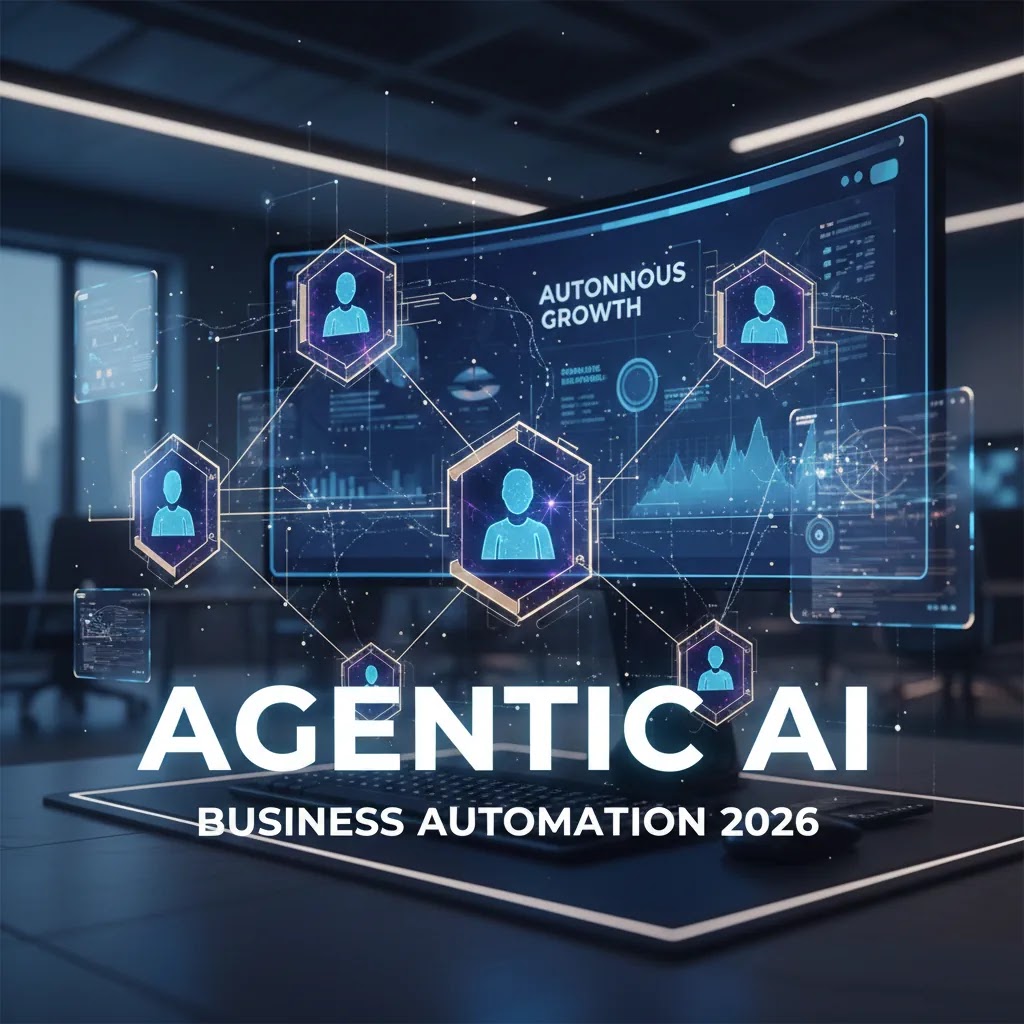
One of the defining concepts behind modern autonomous systems is the idea of the Agentic Loop. Instead of stopping after producing an output, AI agents continuously evaluate their own performance and refine actions based on results.
In advanced environments, businesses deploy multiple agents working together inside coordinated systems.
Common Multi-Agent Roles
- Manager Agents: Coordinate workflows and assign tasks.
- Research Agents: Collect and analyze information.
- Execution Agents: Perform operational tasks.
- Monitoring Agents: Track performance and detect issues.
- Optimization Agents: Improve workflows continuously.
For example, an e-commerce company might use one agent to monitor inventory, another to manage supplier communication, and another to optimize marketing campaigns based on sales trends.
This layered structure allows businesses to automate complex operations while maintaining centralized oversight.
3. High-Impact Business Use Cases for Agentic AI
Agentic AI adoption is expanding rapidly across industries because autonomous systems can improve speed, consistency, and scalability.
Autonomous Lead Generation
AI agents can identify potential customers, analyze public business data, verify contact details, personalize outreach, and track responses automatically.
Self-Healing Supply Chains
Advanced systems can detect inventory shortages, evaluate suppliers, predict delays, and coordinate procurement workflows with minimal human involvement.
AI-Powered Customer Support
Agentic systems can manage customer conversations, escalate complex issues, update CRM records, and monitor customer satisfaction continuously.
Dynamic Content Operations
Content-focused businesses use AI agents to track trends, create drafts, optimize SEO structure, schedule publishing, and monitor engagement metrics.
Financial Workflow Automation
Finance teams increasingly use agents for invoice processing, anomaly detection, expense analysis, and automated reporting.
4. Step-by-Step Guide to Deploying Agentic AI
Businesses often fail with AI automation because they attempt overly complex deployments too early. Successful implementation usually starts with focused workflows.
Step 1. Identify Repetitive Operational Bottlenecks
Start by identifying workflows that consume excessive time or require constant manual coordination.
- Lead qualification.
- Email management.
- Reporting tasks.
- Inventory tracking.
- Support ticket routing.
Step 2. Define Clear Agent Objectives
AI agents perform better when goals are measurable and structured clearly.
Instead of vague instructions like “improve sales,” define outcomes such as “identify and contact 20 qualified leads daily.”
Step 3. Connect Business Systems
Most autonomous workflows require integration with CRMs, analytics tools, communication systems, databases, and APIs.
Step 4. Add Human Oversight Layers
Critical business decisions should still involve human review, especially in financial, legal, or customer-sensitive areas.
Step 5. Monitor and Optimize Continuously
Agentic systems improve over time through monitoring, evaluation, and workflow refinement.
5. Pros and Cons of Agentic AI Deployment
Advantages
- Scales operations without proportional hiring.
- Reduces repetitive manual work.
- Enables faster business execution.
- Improves workflow consistency.
- Provides continuous operational monitoring.
Challenges and Risks
- Poorly configured agents may create workflow errors.
- Complex integrations require technical planning.
- Over-automation can reduce human oversight.
- Security and privacy concerns must be managed carefully.
- AI systems still require monitoring and refinement.
The businesses achieving the best results usually treat agentic AI as an operational assistant rather than a fully independent replacement for human judgment.
6. Best Practices for Building Autonomous Workflows
Long-term success with agentic AI depends heavily on workflow design and operational discipline.
Recommended Best Practices
- Start with narrow, measurable automation goals.
- Maintain human approval for critical actions.
- Monitor AI outputs regularly.
- Use secure integrations and access controls.
- Document workflows clearly.
- Continuously refine prompts, logic, and orchestration rules.
Businesses should also avoid building overly complicated systems too quickly. Simpler workflows are often easier to maintain and optimize.
Operational reliability matters more than flashy automation demonstrations.
Conclusion: Building the Autonomous Business Stack
Agentic AI is becoming one of the most important operational technologies of 2026 because it moves automation beyond simple task execution into intelligent workflow management.
Businesses that successfully deploy autonomous agents can improve scalability, reduce repetitive workload, accelerate decision-making, and operate more efficiently with smaller teams.
However, long-term success depends on thoughtful implementation. The most effective companies combine AI-driven execution with strong human oversight, security controls, and continuous optimization.
As agentic ecosystems become more advanced, the future of business operations may increasingly revolve around how effectively humans and AI agents collaborate together.
Would you trust autonomous AI agents to handle core business operations? Share your perspective in the comments below.
Frequently Asked Questions
What is Agentic AI?
Agentic AI refers to autonomous AI systems that can plan, execute, monitor, and optimize tasks with minimal human supervision.
How is Agentic AI different from Generative AI?
Generative AI mainly creates content or responses, while Agentic AI can independently perform multi-step workflows and operational tasks.
Can small businesses use Agentic AI?
Yes, many low-code automation platforms now allow startups and small businesses to deploy AI agents for customer support, marketing, reporting, and operations.
What are the risks of autonomous AI workflows?
Potential risks include workflow errors, security issues, poor oversight, inaccurate outputs, and excessive dependence on automation.
What industries benefit most from Agentic AI?
Industries such as e-commerce, marketing, finance, logistics, customer support, manufacturing, and SaaS operations are adopting agentic workflows rapidly.