Investing in technology in 2026 is no longer about chasing random hype or buying into every trending startup. Capital is flowing toward sectors solving real infrastructure, energy, automation, and productivity problems. Investors who understand where long term demand is building are positioning themselves early while valuations are still reasonable in selected niches.
One noticeable shift this year is that institutional investors are focusing less on consumer excitement and more on durable ecosystems. Markets connected to AI infrastructure, robotics, energy storage, and digital health are attracting serious attention because they support future economic systems rather than short term trends.
Investor Insight: The strongest tech opportunities in 2026 are not always the most viral ones. In many cases, the highest long term value is being created in infrastructure, automation, energy efficiency, and specialized AI ecosystems that quietly power the digital economy.
Why Emerging Tech Markets Matter in 2026
Many traditional industries are entering a transformation phase. Businesses now rely heavily on AI, cloud systems, predictive analytics, automation, and decentralized infrastructure to stay competitive. This creates investment opportunities across multiple sectors, especially for investors looking beyond standard blue chip assets.
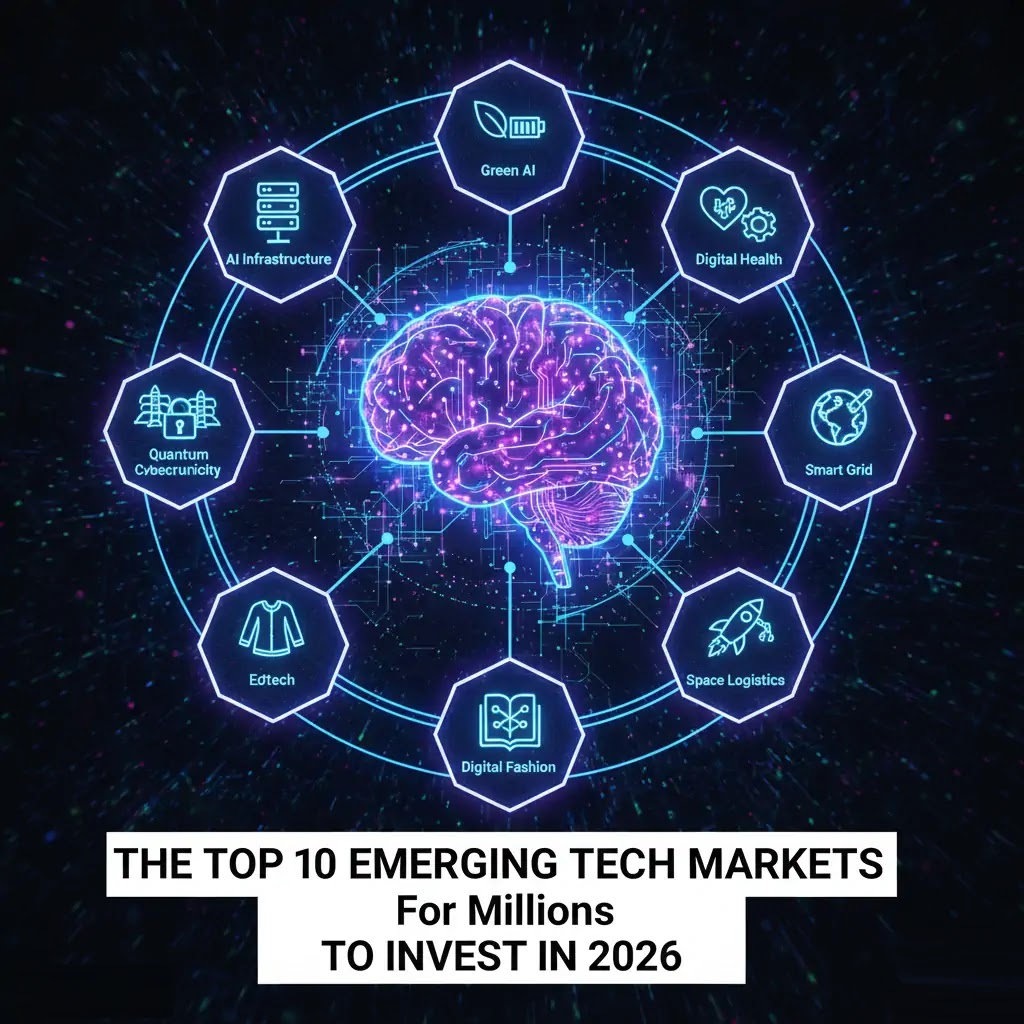
After reviewing market behavior, funding patterns, enterprise adoption, and infrastructure demand, several technology segments stand out as high potential markets for the next growth cycle.
- AI infrastructure and specialized chips
- Energy storage and smart grids
- Healthcare automation and preventive biotech
- Robotics and physical AI
- Spatial computing and immersive systems
- Quantum cybersecurity
- Digital education ecosystems
- Autonomous software agents
- Climate focused technology
- Satellite and space logistics services
1. AI Infrastructure and Compute Systems
Artificial Intelligence is driving massive demand for computing power. Every advanced AI model depends on data centers, cooling systems, GPUs, networking hardware, and energy efficient infrastructure. Many investors are now focusing on these foundational systems because they benefit regardless of which AI application becomes dominant.
One trend becoming obvious in 2026 is that infrastructure providers often generate more stable revenue than consumer AI startups. Companies building server architecture, AI chips, edge computing systems, and data pipelines are becoming critical parts of the digital economy.
Why Investors Like It
AI demand continues rising across finance, education, healthcare, logistics, and manufacturing sectors.
Key Opportunity
Data centers, semiconductor manufacturing, and AI cloud infrastructure are expanding rapidly worldwide.
2. Green AI and Energy Storage
As AI systems consume more electricity, energy efficiency is becoming a major business priority. Green AI focuses on reducing computational waste while improving performance. At the same time, battery storage systems are receiving heavy investment because renewable energy depends on reliable storage capacity.
Several analysts underestimated how closely AI growth and energy demand would become connected. In practice, the relationship is now impossible to ignore. Every expansion in AI infrastructure also increases demand for smart energy management.
- Grid scale battery systems
- AI optimized energy management
- Cooling technologies for data centers
- Solar storage infrastructure
- Smart grid software
3. Digital Health and Preventive Biotech
Healthcare technology is shifting toward early detection, personalized treatment, and AI assisted diagnostics. Wearables now track health patterns continuously, helping users monitor sleep, stress, heart rate variability, and metabolic changes before problems become serious.
Investors are showing strong interest in companies using AI for drug discovery, remote diagnostics, personalized nutrition, and preventive healthcare systems. In India, digital healthcare adoption is also expanding quickly due to affordable smartphones and growing telemedicine usage.
Real World Trend
Many hospitals and clinics now use AI systems to assist with imaging analysis, patient scheduling, and risk prediction. This improves efficiency while reducing operational costs.
4. Agentic AI and Autonomous Software Ecosystems
One of the fastest growing markets in 2026 involves autonomous AI agents capable of completing tasks independently. These systems are moving beyond simple chat functions and entering workflow automation, customer service, research, analytics, and content operations.
Businesses increasingly prefer AI systems that can operate continuously with minimal supervision. This reduces staffing pressure while improving execution speed. Startups building marketplaces, orchestration tools, and AI automation infrastructure are attracting large funding rounds.
Market Observation: Investors are paying close attention to businesses that build recurring revenue around AI automation rather than one time AI products.
5. Quantum Cybersecurity
Quantum computing research is accelerating, and this creates serious concerns for existing encryption systems. Governments and enterprises are preparing for future cybersecurity threats by investing in quantum resistant encryption and advanced security infrastructure.
Companies developing post quantum security protocols, encrypted communication systems, and AI powered threat detection are gaining strategic importance. This market may remain specialized for several years, but the long term demand potential is substantial.
6. Physical AI and Robotics
Physical AI combines robotics with machine learning to create systems capable of interacting with real environments. Warehouses, factories, healthcare centers, and logistics companies are increasingly deploying intelligent robots to improve efficiency.
Unlike previous robotics cycles, newer systems are becoming more adaptive and commercially practical. Even small manufacturing businesses are beginning to automate repetitive tasks using affordable robotic solutions.
- Warehouse automation
- Industrial robotics
- Healthcare assistance robots
- Autonomous delivery systems
- AI assisted manufacturing tools
7. Spatial Computing and Web 4.0
Spatial computing is changing how users interact with digital information. Instead of traditional screen based interfaces, immersive systems now integrate digital objects into physical environments using augmented and mixed reality technologies.
Education, retail, gaming, architecture, industrial training, and healthcare are all experimenting with immersive experiences. Investors are monitoring companies building 3D collaboration tools, wearable interfaces, and spatial commerce systems.
8. EdTech and AI Learning Platforms
Education technology remains one of the most scalable digital markets. AI powered tutoring systems can now personalize lessons based on learning speed, strengths, and weaknesses. This improves retention while making education more accessible.
Many students in smaller cities are now using online learning systems to access high quality education that was previously unavailable locally. Investors see long term value in platforms offering practical skills, career focused learning, and multilingual education.
9. Space Logistics and Satellite Services
The space economy is expanding beyond government programs. Satellite imaging, communication systems, navigation services, and orbital logistics are becoming commercial industries with growing enterprise demand.
Businesses now rely on satellite data for agriculture, weather monitoring, shipping routes, defense analysis, and infrastructure planning. This sector remains volatile, but several niche opportunities are emerging as launch costs decrease.
10. Climate Technology and Smart Infrastructure
Climate technology is attracting investment because governments and enterprises are under pressure to improve sustainability. Smart water systems, carbon monitoring platforms, sustainable construction materials, and environmental analytics are receiving more funding.
One practical trend worth watching is infrastructure modernization. Cities need better traffic systems, efficient energy distribution, and digital monitoring tools to handle growing urban populations.
Long Term Perspective: Many climate focused businesses may not produce explosive short term gains, but they often benefit from regulatory support and consistent infrastructure demand.
Pros and Risks of Investing in Emerging Tech Markets
Advantages
- Strong long term growth potential
- Exposure to future industries
- Global scalability
- Innovation driven demand
- Institutional capital participation
Risks
- High volatility in early stages
- Regulatory uncertainty
- Rapid competition shifts
- Overvaluation during hype cycles
- Technology adoption risks
Who Should Focus on These Markets?
Emerging technology sectors are generally better suited for investors comfortable with long term volatility and research driven decisions.
- Growth focused investors
- Technology entrepreneurs
- Long term portfolio builders
- Investors seeking future industry exposure
- Professionals interested in innovation cycles
Conservative investors who prefer stable income and low volatility may want balanced exposure rather than concentrating heavily in speculative sectors.
Best Practices Before Investing in Tech Markets
- Study business fundamentals instead of social media hype
- Track enterprise adoption, not just retail excitement
- Diversify across multiple sectors
- Watch infrastructure trends closely
- Understand regulatory developments
- Focus on long term scalability
- Avoid investing based purely on viral narratives
Conclusion: Positioning for the Next Technology Cycle
The biggest investment opportunities in 2026 are forming around infrastructure, automation, energy, healthcare innovation, and intelligent systems. Many of these sectors are still developing, which means early positioning can create significant long term advantages if approached carefully.
Successful investing in emerging technology markets requires patience, research, and realistic expectations. Instead of chasing every trend, focus on industries solving meaningful problems with scalable solutions. Over time, those sectors usually attract the strongest capital flows and create more sustainable growth.
Follow our blog for more high-value digital, AI, and future investment insights.
Frequently Asked Questions
Which tech sector has the highest growth potential in 2026?
AI infrastructure, energy storage, and autonomous AI systems are currently among the fastest growing sectors because they support multiple industries simultaneously.
Are emerging tech investments risky?
Yes. Emerging technology markets can be volatile because industries evolve quickly. Diversification and research are important before investing.
Why are investors focusing on infrastructure instead of only apps?
Infrastructure businesses often provide more stable long term demand because many applications depend on them to operate.
Is India becoming important in future tech markets?
India is gaining attention due to its large digital population, expanding startup ecosystem, growing data infrastructure, and strong developer community.
Should beginners invest heavily in emerging technology sectors?
Beginners should usually start with balanced exposure and focus on learning market behavior before making aggressive investment decisions.