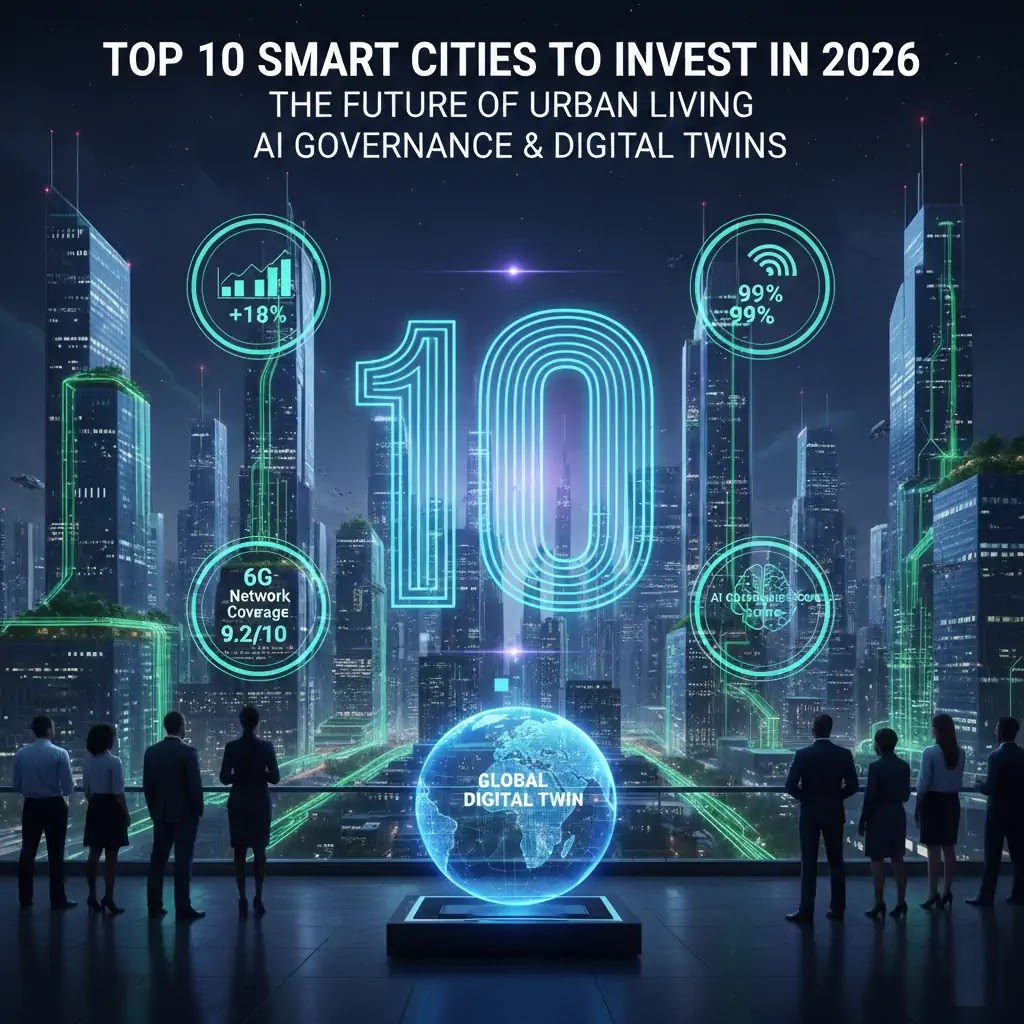
Most investors still look at cities the old way, population growth, rental demand, and infrastructure projects. But in 2026, that approach is no longer enough. The real shift is happening in how cities function internally. The smartest urban markets are now powered by data, automation, and predictive systems that directly influence property value, livability, and long term returns.
This is where smart cities stand out. These are not just tech enabled locations, they are environments where transport, energy, governance, and housing operate in sync. For investors, this means better efficiency, lower risk, and stronger growth potential. If you are evaluating global opportunities or exploring emerging market opportunities, understanding where smart infrastructure is truly working can give you a major advantage.
Smart City ROI: 2024 vs. 2026 Metrics
| Investment Driver | 2024 Baseline | 2026 Verified |
|---|---|---|
| Property Yield | 4% to 6% Traditional | 12% to 18% Smart Ready |
| Tech Backbone | Partial 5G Adoption | Ubiquitous 6G and Edge AI |
| Governance | Manual Permitting | AI Driven Digital Systems |
What Makes a City Truly Smart in 2026
A smart city today is defined by how efficiently it solves real problems. It is not about having apps or sensors everywhere. It is about measurable improvements in daily life and economic performance.
- Data driven planning that predicts traffic, energy usage, and housing demand
- Digital governance that reduces paperwork and speeds up approvals
- Integrated infrastructure where transport, utilities, and housing work together
- Sustainability systems that lower long term operational costs
From an investor perspective, these factors directly impact occupancy rates, maintenance costs, and resale value.
Global Smart City Market Valuation ($ Billions)
Top 10 Smart Cities to Invest in for 2026
1. Singapore
Singapore remains one of the most advanced smart cities globally. Its digital twin infrastructure allows developers to simulate projects before construction. This reduces risk and improves accuracy in planning.
Why it stands out: Strong governance, predictable policies, and tech driven real estate planning.
2. Zurich
Zurich focuses on quality of life combined with efficient digital services. It attracts high income remote professionals and stable long term tenants.
Investor insight: Premium rental demand with low volatility.
3. Dubai
Dubai is rapidly digitizing governance and financial systems. From property registration to payments, everything is streamlined.
Use case: Ideal for investors targeting fintech driven urban growth and digital economy expansion.
4. Seoul
Seoul operates on a deeply connected ecosystem where buildings, transport, and services communicate in real time.
Opportunity: Demand for tech enabled housing and automation ready infrastructure.
5. Oslo
Oslo leads in green mobility and sustainable infrastructure. Electric transport and clean energy reduce long term operational costs.
Best for: Investors focused on sustainability and future regulatory alignment.
6. London
London uses open data systems to improve urban services and tenant experience. It continues to attract startups and global professionals.
7. Copenhagen
Copenhagen is moving toward full carbon neutrality. Smart grids and efficient systems improve long term value stability.
8. Tokyo
Tokyo focuses on resilience. Its infrastructure is designed to handle natural risks while maintaining efficiency.
9. New York City
New York uses urban analytics to improve neighborhoods. Smart lighting and data driven planning enhance property values.
10. Barcelona
Barcelona integrates IoT into everyday systems like waste management and parking. These improvements enhance livability and efficiency.
Pros and Cons of Investing in Smart Cities
Advantages
- Higher rental yields due to better infrastructure
- Lower maintenance costs through automation
- Stronger long term appreciation
- Attracts high quality tenants and businesses
Challenges
- Higher initial investment cost
- Dependence on technology and policy stability
- Limited availability in early stage markets
Who Should Invest and Who Should Avoid
Ideal for:
- Long term investors looking for stable growth
- NRIs and global investors targeting premium markets
- Investors interested in tech driven real estate
Not ideal for:
- Short term speculative investors
- Those unfamiliar with global property regulations
Best Practices Before Investing
- Analyze government policies and tech infrastructure
- Focus on cities with proven implementation, not just plans
- Evaluate tenant demand and economic drivers
- Diversify across regions instead of relying on one city
In practical terms, investors who combine smart city insights with broader strategies like diversified investment portfolios tend to perform better over time.
Final Investment Takeaway
Smart cities are not just a trend. They represent a structural shift in how urban economies operate. The real opportunity lies in identifying cities where technology is already improving efficiency, not just being planned. Focus on long term fundamentals, governance quality, and real world usability.
Frequently Asked Questions
1. Are smart cities safer investments?
They can be, because data driven systems reduce inefficiencies and improve planning. However, policy stability still matters.
2. Do smart cities guarantee higher returns?
No investment is guaranteed. Smart cities increase the probability of better returns due to stronger infrastructure and demand.
3. Can Indian investors invest in global smart cities?
Yes, through REITs, international funds, or direct property investments, depending on regulations.
4. What is the biggest risk?
Overestimating future potential without checking current implementation. Always verify real progress.
5. Is it better than traditional real estate?
For long term growth and sustainability, smart city investments often outperform traditional markets when chosen carefully.