Indian cities have struggled with traffic congestion for years. Long signal waits, sudden jams, fuel waste, and delayed emergency response became normal parts of daily travel in metro cities. In 2026, that situation is slowly beginning to change as AI-powered traffic systems become active across major urban areas.
If you recently travelled through Delhi, Mumbai, Bengaluru, Pune, or Hyderabad, you may have noticed traffic lights behaving differently. Signals are now reacting to real-time vehicle movement instead of following fixed timers. This transformation is part of India’s growing Integrated Traffic Management System (ITMS), a large-scale smart mobility initiative designed to improve road efficiency and public safety.
Unlike older traffic systems that depended heavily on manual monitoring, the new setup combines AI software, CCTV analytics, GPS tracking, cloud-based databases, and automated enforcement. The goal is simple, reduce congestion, improve emergency movement, lower fuel wastage, and create smarter urban transportation networks.
1. What is ITMS and How Does It Work?
The Integrated Traffic Management System, commonly called ITMS, is an AI-supported traffic monitoring and control network used by Indian smart cities in 2026. Instead of isolated traffic signals operating independently, multiple intersections are connected to a central command center.
This central system receives live traffic data from sensors, CCTV cameras, radar devices, and vehicle tracking systems. AI algorithms then analyze congestion patterns and automatically optimize signal timing.
How Traditional Signals Worked Earlier
- Fixed timers operated regardless of traffic volume.
- Heavy traffic often remained stuck even when nearby lanes were empty.
- Emergency vehicles struggled to cross intersections quickly.
- Traffic police had to manually manage congestion during peak hours.
How AI-Based Smart Signals Work Now
- Traffic density is monitored continuously using sensors and cameras.
- Signals dynamically adjust based on real-time congestion.
- Low-traffic lanes receive shorter green times.
- High-volume roads are prioritized automatically.
- Traffic control rooms monitor the entire network live.
In practical use, commuters are already noticing smoother traffic movement in several pilot smart corridors. During office rush hours, the system can redistribute green signal time more intelligently compared to older fixed-cycle systems.
This is especially important in high-density cities where even small reductions in waiting time can save thousands of liters of fuel daily.
2. Adaptive Traffic Control System, The Brain Behind Smart Signals
The most important component of modern traffic management is the Adaptive Traffic Control System (ATCS). This technology acts like the decision-making brain of the city’s traffic network.
ATCS continuously studies vehicle flow patterns and predicts congestion before traffic becomes severe. Instead of reacting after a jam forms, the system attempts to prevent bottlenecks early.
What Makes ATCS Different?
- It reacts to live traffic conditions instead of fixed schedules.
- It improves traffic flow during festivals, rain, or accidents.
- It reduces unnecessary idle time at junctions.
- It supports pollution reduction by minimizing stop-and-go traffic.
From an urban planning perspective, this technology also supports India’s environmental goals. Continuous traffic idling increases fuel consumption and emissions. AI-managed flow helps reduce both.
Many transport analysts believe adaptive signal systems may become standard infrastructure in most Indian metro cities within the next few years.
3. ANPR Cameras and Automatic E-Challans in 2026
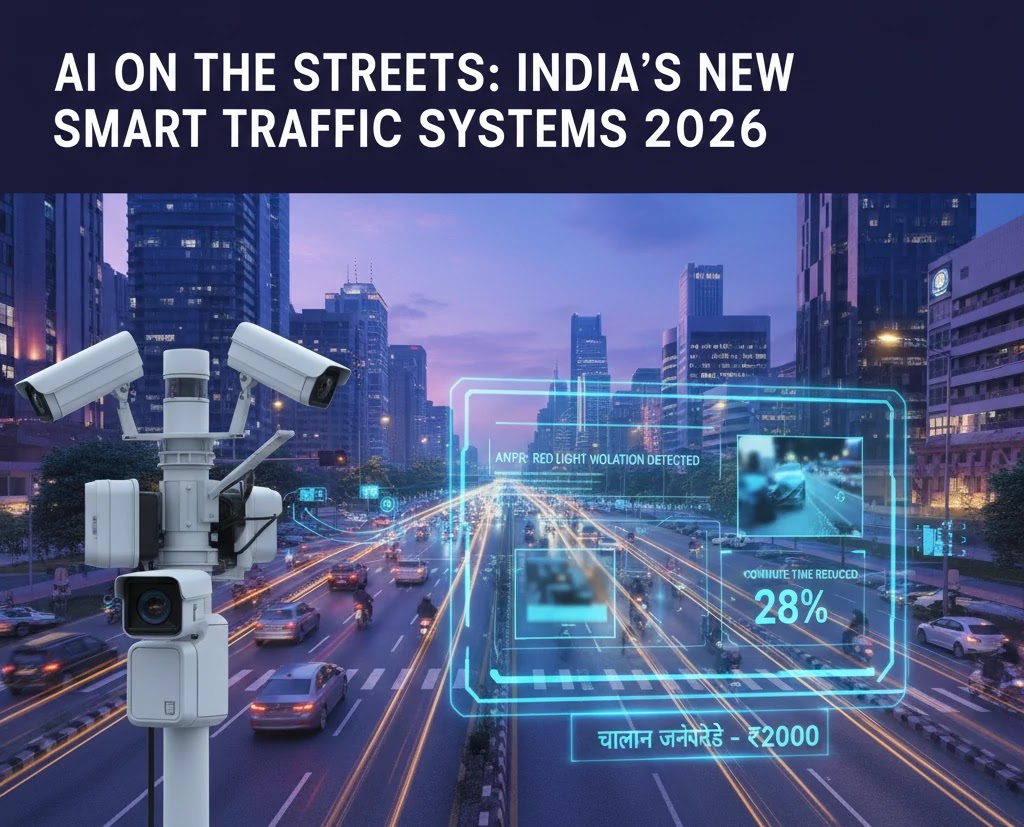
One of the most visible changes on Indian roads is the growing use of Automatic Number Plate Recognition (ANPR) cameras. These high-resolution AI cameras can detect traffic violations automatically without requiring manual intervention.
Instead of relying entirely on physical traffic checks, the system now identifies violations digitally and generates electronic challans almost instantly.
Violations Commonly Detected by ANPR Systems
- Signal jumping
- Crossing stop lines
- Wrong-side driving
- Illegal parking
- Triple riding on two-wheelers
- Helmet and seatbelt violations
- Overspeeding in monitored zones
The system is integrated with FASTag databases, Vahan registration records, insurance information, and pollution certificate verification. This allows authorities to process violations more efficiently than before.
For drivers, this means road discipline is becoming increasingly technology-driven. In many smart city zones, violations are detected within seconds even without visible police presence.
KOLAACE Road Safety Tip: Keep your HSRP plate clean, undamaged, and properly mounted. AI-based ANPR systems depend heavily on accurate number plate visibility. Dust, bends, stickers, or reflective damage can sometimes create identification issues and unnecessary challan disputes.
Online Challan Review and Dispute System
In 2026, several Indian states have also improved digital challan dispute systems. Drivers can now review evidence images online and challenge incorrect fines within a specified period. This creates better transparency compared to older manual enforcement systems.
4. Green Wave Technology for Ambulances and Emergency Vehicles
One of the most practical features introduced under India’s smart traffic modernization is the Green Wave system. This technology prioritizes emergency vehicles such as ambulances, fire trucks, and police response units.
Using GPS tracking, RFID communication, and centralized traffic coordination, the system detects approaching emergency vehicles and temporarily adjusts signals along the route.
Why Green Wave Systems Matter
- Ambulances can move faster during emergencies.
- Critical medical response times improve.
- Traffic confusion at intersections reduces.
- Emergency drivers avoid risky signal violations.
In cities with heavy congestion, even a few minutes saved during emergency movement can directly affect patient survival rates. Several metro city pilot projects have already reported smoother ambulance movement after Green Wave implementation.
5. How Small Businesses and Delivery Services Benefit from Smart Traffic Systems
AI-based traffic systems are not only helping governments. They also create practical benefits for businesses that depend on urban transportation.
Real-World Business Benefits
- Faster delivery movement in optimized corridors.
- Reduced fuel expenses for logistics operators.
- More predictable travel times for ride-sharing drivers.
- Improved fleet management using GPS-linked traffic data.
- Lower idle time for commercial vehicles.
Food delivery platforms, courier companies, and e-commerce logistics teams especially benefit from smoother urban movement. Even small reductions in congestion can improve daily delivery efficiency at scale.
For local businesses operating multiple delivery vehicles, traffic optimization may eventually reduce operational costs significantly over time.
6. Challenges and Concerns Around AI Traffic Monitoring
While smart traffic systems offer many advantages, there are also valid concerns that citizens and experts continue to discuss.
Potential Challenges
- Privacy concerns related to large-scale surveillance.
- Incorrect challans caused by camera errors.
- High infrastructure and maintenance costs.
- System failures during technical outages.
- Dependence on stable internet and electricity networks.
Experts also point out that AI systems work best when road markings, lane discipline, and infrastructure quality are maintained properly. Poorly maintained roads or inconsistent traffic behavior can reduce system efficiency.
Technology alone cannot solve traffic issues completely. Public discipline, urban planning, and road infrastructure still play a major role.
7. Best Practices for Drivers in India’s Smart Traffic Era
As Indian cities continue expanding AI-based monitoring, drivers should adapt to the new enforcement environment.
Important Tips for Daily Commuters
- Maintain proper lane discipline at intersections.
- Keep number plates clean and visible.
- Ensure FASTag details are updated correctly.
- Avoid sudden lane changes near AI-monitored junctions.
- Regularly check insurance and PUC validity.
- Review online challan portals periodically.
Many drivers still assume violations are only recorded when police officers are physically present. In reality, modern AI systems monitor continuously in several smart corridors.
Conclusion
India’s AI-powered traffic systems represent a major shift in urban mobility management. What started as isolated smart city experiments is now becoming part of broader transportation infrastructure across major metro regions.
The combination of adaptive traffic signals, ANPR enforcement, centralized command systems, and emergency Green Wave technology is slowly creating smarter and more responsive roads.
While challenges such as privacy, maintenance, and infrastructure gaps still exist, the long-term direction is clear. Indian cities are moving toward data-driven traffic management where AI helps improve efficiency, safety, and public convenience.
For everyday commuters, understanding how these systems work is no longer optional. It directly affects driving habits, challan enforcement, travel planning, and overall road experience in 2026.
Have you already experienced AI-managed traffic signals or automatic e-challan systems in your city? Share your experience and observations in the comments below.
Frequently Asked Questions
What is ITMS in India?
ITMS stands for Integrated Traffic Management System. It combines AI software, sensors, CCTV cameras, and traffic analytics to improve traffic flow and enforcement in cities.
How do ANPR cameras work?
ANPR cameras use image recognition technology to read vehicle number plates automatically and identify traffic violations digitally.
Can drivers challenge incorrect e-challans?
Yes, many Indian states now allow online challan review and dispute submission within a specified period after the violation notice is issued.
What is Green Wave technology?
Green Wave systems prioritize ambulances and emergency vehicles by coordinating traffic signals to create a smoother route through intersections.
Do smart traffic systems reduce pollution?
Yes, adaptive signal systems can reduce unnecessary idling and stop-and-go congestion, which may help lower fuel consumption and emissions.