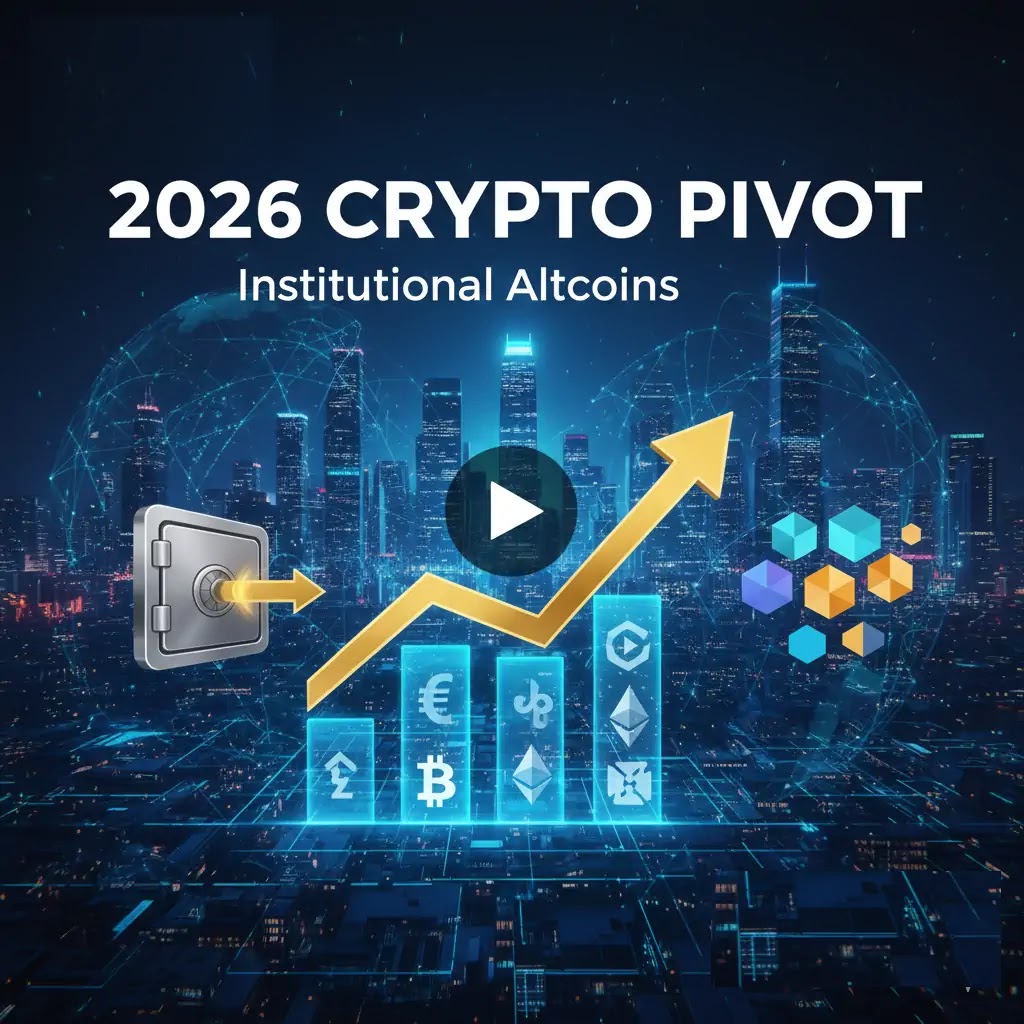
The crypto market in 2026 looks very different from the speculative cycles of earlier years. Institutional investors are no longer treating digital assets as experimental side bets. Instead, major funds, family offices, and fintech firms are allocating serious capital into niche altcoins with measurable utility, strong ecosystems, and scalable infrastructure.
Bitcoin still dominates as a long-term reserve asset, but a major shift is happening beneath the surface. The real momentum is moving toward specialized blockchain projects solving practical problems in areas like tokenized assets, AI infrastructure, decentralized finance, and cross-chain payments.
This institutional pivot is changing how the crypto economy operates. In previous cycles, hype alone often pushed prices higher. In 2026, capital is increasingly flowing toward ecosystems with sustainable revenue models, developer activity, and long-term adoption potential.
Market Observation: The biggest winners in 2026 are not necessarily the largest cryptocurrencies. Many institutional investors are focusing on niche blockchain sectors where utility, scalability, and real-world integration are easier to measure.
Why Institutional Capital is Moving Beyond Bitcoin
Large investors traditionally prefer predictable assets with long-term growth potential. Bitcoin achieved this position over time because of its liquidity, global recognition, and limited supply model. However, as the digital asset industry matured, institutions began searching for additional sectors capable of delivering stronger growth and broader utility.
One major reason for this shift is diversification. Many institutional portfolios already hold exposure to Bitcoin and Ethereum. To improve returns, investors are now exploring altcoin ecosystems tied to emerging technologies and infrastructure development.
Another important factor is revenue generation. Modern blockchain protocols are increasingly producing income through transaction fees, staking systems, tokenized financial products, and enterprise integrations. This creates stronger long-term investment narratives compared to speculative meme-driven assets.
- Institutions want scalable blockchain infrastructure
- Utility-based ecosystems attract long-term capital
- Regulatory clarity improves investor confidence
- Tokenized assets create new financial opportunities
- AI integration increases interest in smart blockchain systems
1. The Rise of Institutional Altcoin ETFs
One of the most important developments in 2026 is the expansion of institutional altcoin ETFs. These regulated investment products allow large funds to gain exposure to niche crypto sectors without directly managing digital wallets or private keys.
Earlier, many institutions avoided smaller crypto assets because of operational risks and unclear compliance structures. ETF frameworks changed that environment significantly. With regulated custodians and simplified access, institutional investors can now allocate capital more comfortably into specialized blockchain ecosystems.
Several sectors are receiving the majority of this attention:
- Layer 2 scaling networks
- AI-integrated blockchain protocols
- Decentralized finance infrastructure
- Tokenized real-world asset platforms
- Cross-border payment ecosystems
From an investment perspective, ETFs reduce entry friction and improve liquidity. This creates a more stable environment compared to earlier retail-driven crypto cycles.
Strategic Insight: Institutions generally avoid chaotic ecosystems. Capital tends to flow toward projects with transparent governance, strong developer communities, and clear revenue models.
2. Real-World Asset Tokenization is Expanding Fast
Real-world asset tokenization has become one of the strongest narratives driving institutional interest in niche altcoins during 2026. This process converts ownership rights of physical or financial assets into blockchain-based digital tokens.
Instead of relying on traditional paperwork-heavy systems, investors can now access tokenized versions of commercial property, government bonds, private credit, commodities, and infrastructure assets through blockchain platforms.
For institutions, this creates several advantages:
- Faster settlement times
- Fractional ownership opportunities
- Improved liquidity
- Lower transaction costs
- Transparent transaction tracking
In India and other growing economies, tokenization is attracting attention because it lowers the barrier to entry for smaller investors. Instead of requiring large capital for direct ownership, people can participate through smaller allocations.
Institutional investors see this as a long-term infrastructure trend rather than a short-term market cycle. Many analysts now compare tokenization to the early growth of electronic trading systems in traditional finance.
3. AI-Integrated Blockchain Protocols
The convergence of artificial intelligence and blockchain technology is creating a completely new category of digital infrastructure. In 2026, AI-powered blockchain protocols are attracting institutional attention because they improve efficiency, automation, and scalability.
Traditional blockchain systems often struggle with congestion, inefficient resource allocation, and static smart contracts. AI-integrated systems attempt to solve these problems through adaptive decision-making.
Examples of AI integration include:
- Automated transaction optimization
- Predictive fraud detection
- Smart liquidity management
- Dynamic fee adjustments
- AI-enhanced security monitoring
Large investors are especially interested in blockchain ecosystems that support enterprise-level AI operations. As AI demand grows globally, infrastructure projects capable of supporting decentralized AI computation are becoming increasingly valuable.
Many venture-backed crypto projects are now positioning themselves as infrastructure layers for the AI economy rather than simply payment networks.
4. Regulatory Clarity is Reducing Institutional Fear
One major difference between earlier crypto cycles and 2026 is the increasing level of regulatory clarity. While rules still vary across countries, institutional investors now have better frameworks for understanding compliance requirements.
Large funds typically avoid uncertain legal environments. As governments introduced clearer reporting standards, custody guidelines, and tax structures, institutional participation increased steadily.
This does not mean the market is risk-free. Crypto remains volatile compared to traditional assets. However, clearer regulations reduce operational uncertainty and encourage longer-term investment behavior.
Positive Impact
- Higher institutional trust
- Improved market stability
- Better investor protection
- Safer custody solutions
- More transparent reporting
Ongoing Challenges
- Global rules remain inconsistent
- Some altcoins face compliance uncertainty
- Tax reporting complexity still exists
- High-risk projects continue entering the market
How Smart Investors are Evaluating Niche Altcoins
Institutional investors are becoming more selective. Instead of blindly chasing hype, they increasingly evaluate blockchain projects using measurable indicators similar to traditional technology investing.
Some of the most important factors include:
- Developer activity and ecosystem growth
- Transaction volume consistency
- Enterprise partnerships
- Revenue generation capability
- Token utility inside the network
- Security infrastructure quality
- Regulatory positioning
This shift toward data-driven evaluation is slowly reducing the influence of purely speculative narratives. Projects with weak fundamentals often struggle to attract serious institutional interest for long periods.
Investment Perspective: In 2026, institutional capital is rewarding blockchain ecosystems that behave more like sustainable technology platforms and less like short-term trading experiments.
Who Benefits Most From This Market Shift
This evolving environment creates opportunities for several categories of investors and businesses:
- Long-term crypto investors focusing on utility projects
- Fintech startups building blockchain infrastructure
- Developers working in AI and decentralized systems
- Businesses exploring tokenized asset models
- Content creators educating emerging crypto audiences
However, investors looking for guaranteed returns or overnight profits should approach the market carefully. Even with institutional participation, crypto remains a high-risk asset class that requires strong research and disciplined risk management.
Best Practices for Navigating the 2026 Crypto Market
- Focus on projects with real utility and active ecosystems
- Diversify instead of concentrating in one asset
- Study token economics carefully
- Track institutional adoption trends regularly
- Avoid emotional decision-making during volatility
- Research compliance and regulatory factors
- Use secure storage and trusted platforms
Experienced investors often spend more time researching infrastructure quality than following short-term price movements. Long-term performance usually depends on ecosystem strength rather than temporary hype cycles.
Conclusion: Understanding the Institutional Crypto Pivot
The crypto market of 2026 is entering a more mature phase where institutional capital increasingly shapes long-term trends. Bitcoin remains important, but the strongest growth narratives are expanding into specialized altcoin ecosystems with practical applications and scalable infrastructure.
Real-world asset tokenization, AI-integrated blockchain systems, decentralized finance infrastructure, and regulated investment products are changing how digital assets are viewed globally.
For investors, the biggest opportunity may not come from chasing every new token. Instead, it comes from understanding which sectors are attracting sustainable institutional attention and why those ecosystems continue growing.
As the market evolves further, disciplined research, strategic diversification, and long-term thinking will remain far more valuable than speculation alone.
Follow our blog for more high-value digital finance, crypto, and investment insights.
Frequently Asked Questions
Why are institutions investing in niche altcoins instead of only Bitcoin?
Many institutions already hold Bitcoin exposure and are now seeking higher-growth opportunities in sectors like AI infrastructure, tokenized assets, and decentralized finance platforms.
What are institutional altcoin ETFs?
These are regulated investment products that allow institutions and traditional investors to gain exposure to altcoin ecosystems without directly managing crypto wallets or private keys.
Is tokenized real estate becoming popular in 2026?
Yes. Tokenized real estate and other real-world assets are attracting attention because they improve accessibility, liquidity, and operational efficiency for investors.
Are AI-based blockchain projects a long-term trend?
Many analysts believe AI-integrated blockchain infrastructure could become a major long-term sector because AI systems require scalable decentralized computing and data coordination networks.
What is the biggest risk in niche altcoin investing?
Smaller crypto projects can experience high volatility, lower liquidity, and regulatory uncertainty. Careful research and risk management remain essential.