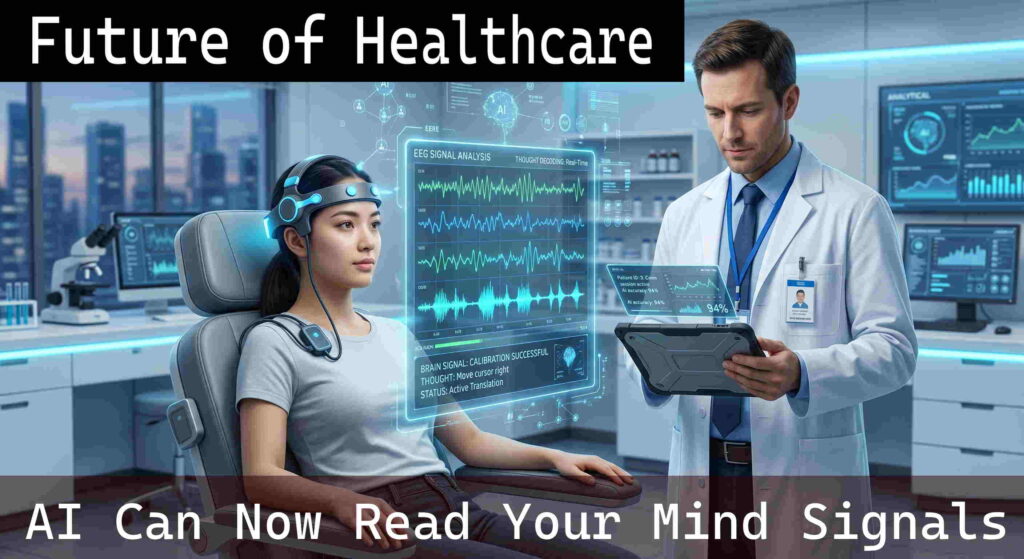
For decades, the human brain was considered one of the last impossible frontiers in medicine. Doctors could scan it, study it, and observe damage, but understanding thoughts in real time felt impossible. That reality is now changing faster than most people realize.
AI powered brain signal decoding systems are already helping patients communicate without speaking, move robotic limbs using thoughts, and interact with computers directly through neural activity. What once sounded like science fiction is now becoming a serious healthcare breakthrough.
The biggest impact is not entertainment or gadgets. It is healthcare. Patients suffering from paralysis, stroke, spinal injuries, and neurological disorders are now gaining new ways to communicate and recover through Brain Computer Interface technology combined with artificial intelligence.
This technology is still evolving, but researchers, hospitals, and neuroscience companies are moving rapidly toward practical medical applications. Understanding how this works is important because it may completely transform rehabilitation, disability support, and neurological treatment over the next decade.
→ Read: AI Detects Diseases Before Symptoms – Predictive Healthcare
What Does It Mean When AI Reads Brain Signals?
AI is not literally reading private thoughts like a movie scene. Instead, it analyzes electrical activity generated by the brain and identifies patterns linked to specific actions, intentions, or words.
The human brain contains billions of neurons communicating through electrical impulses. Every movement, memory, emotion, and decision creates measurable neural activity.
Special devices capture these signals and send them to AI systems trained to recognize patterns. Over time, machine learning models become better at understanding what certain patterns represent.
For example, if a patient repeatedly thinks about moving their hand, the AI system learns the signal pattern connected to that intention. Eventually, the system can predict the intended action almost instantly.
Simple Real World Analogy
Think of the brain like a crowded stadium where thousands of people are shouting at once. Older technology could hear the noise but could not understand individual voices clearly. AI acts like a smart interpreter that separates patterns and identifies meaningful signals.
This combination of neuroscience and machine learning is the foundation of modern Brain Computer Interfaces, often called BCIs.
How AI Brain Signal Technology Actually Works
The process behind AI powered brain communication is more advanced than many people assume. Several technologies work together at high speed to convert neural activity into digital actions.
Step 1: Capturing Brain Activity
The first stage involves collecting neural signals using specialized hardware. Depending on the system, this may include:
- EEG caps placed on the scalp
- Electrodes positioned on the brain surface
- Implanted neural chips inside the brain
Each method captures brain activity with different levels of accuracy.
Step 2: Cleaning the Signal Data
Brain signals are extremely noisy. Blinking, breathing, eye movement, and muscle activity all interfere with neural recordings.
AI systems first remove unnecessary noise to isolate meaningful patterns. Without this cleaning process, decoding accuracy would remain very low.
Step 3: Pattern Recognition Through Deep Learning
This is where artificial intelligence becomes essential.
Deep learning models analyze thousands of signal examples and learn relationships between neural activity and specific intentions. The more data the system receives, the better it becomes at recognizing patterns.
Modern AI models can now identify:
- Speech intentions
- Movement intentions
- Cursor control commands
- Basic emotional states
- Motor coordination signals
Step 4: Converting Thoughts Into Actions
Once the AI identifies a pattern, the signal can trigger a real action such as:
- Typing words on a screen
- Generating synthetic speech
- Moving a robotic arm
- Operating a wheelchair
- Controlling a computer cursor
For patients with severe paralysis, this process can restore a level of independence that was previously impossible.
→ Read: AI Predicting Your Next Move – Machine Learning Explained
Types of Brain Computer Interface Systems
Not all BCI systems work the same way. Different medical situations require different levels of accuracy, safety, and complexity.
1. Non Invasive BCI Systems
These systems use external devices like EEG caps placed on the scalp.
Advantages
- No surgery required
- Safer for patients
- Lower medical risk
- Suitable for research and rehabilitation
Limitations
- Weaker signal quality
- Lower precision
- Slower response speed
2. Semi Invasive Systems
Electrodes are placed on the surface of the brain but do not deeply penetrate brain tissue.
These systems balance safety and signal quality more effectively than traditional EEG systems.
3. Fully Invasive Brain Implants
These involve surgical implantation of electrodes directly into brain tissue.
Main Benefits
- Very accurate neural signals
- Fast response times
- Better movement control
- Improved communication accuracy
Main Concerns
- Surgical risks
- Infection possibilities
- Long term maintenance challenges
- High medical costs
Real Healthcare Applications Already Changing Lives
One reason this technology receives so much attention is because it is already helping real patients.
Communication for Locked In Syndrome Patients
Patients with locked in syndrome may remain mentally aware while losing almost all physical movement. AI powered BCIs are now helping some patients communicate using only brain activity.
In certain trials, patients have successfully formed sentences using neural signal decoding systems connected to digital keyboards.
Speech Restoration After Stroke
Stroke victims who lose speaking ability are now participating in experiments where AI recreates speech from neural activity patterns.
Some systems even generate synthetic voices based on recordings from before the patient lost speech capabilities.
Mind Controlled Prosthetic Limbs
Advanced prosthetic arms can now respond to neural signals directly from the brain.
Patients no longer need traditional mechanical controls. Instead, they attempt movement mentally, and AI interprets those signals in real time.
Neural Rehabilitation Therapy
AI systems are also helping therapists monitor recovery progress after neurological injuries. Brain activity tracking helps doctors understand whether rehabilitation exercises are improving neural function.
→ Read: AI Glasses That Can See, Hear and Think
Comparison Between Non Invasive and Invasive BCI Systems
| Feature | Non Invasive Systems | Invasive Systems |
|---|---|---|
| Surgery Needed | No | Yes |
| Signal Accuracy | Moderate | Very High |
| Medical Risk | Low | Higher |
| Setup Complexity | Simple | Complex |
| Best Use Case | Basic communication | Advanced control and medical recovery |
Major Benefits of AI Mind Reading Technology in Healthcare
- Restored Communication: Patients unable to speak may regain communication abilities through AI assisted neural decoding.
- Improved Independence: Brain controlled systems can help patients operate devices without physical movement.
- Faster Rehabilitation: AI monitoring systems may improve therapy precision after strokes or injuries.
- Better Neurological Research: Researchers can study brain disorders more effectively using AI powered analysis.
- Personalized Treatment: Future healthcare systems may adapt treatments based on real time neural feedback.
Risks, Ethical Concerns, and Privacy Challenges
Despite the medical benefits, this technology raises serious concerns that experts are actively debating.
Neuro Privacy
Brain activity data may become one of the most sensitive forms of personal information ever collected. Strong legal protections will be necessary to prevent misuse.
Cybersecurity Risks
Any internet connected medical device can potentially face cyber threats. Brain connected systems require extremely high security standards.
High Treatment Costs
Advanced neural systems remain expensive. Without broader accessibility, only wealthy healthcare systems may benefit initially.
Ethical Questions
Experts continue discussing where medical enhancement should stop. Using AI to restore lost abilities is widely supported, but cognitive enhancement creates more complicated debates.
→ Read: How AI Uses Your Data Without You Knowing
Best Practices for Safe AI Brain Interface Development
Researchers and healthcare regulators are focusing heavily on safety standards because brain related technologies require stronger protections than ordinary digital devices.
Important Safety Measures
- End to end encryption for neural data
- Strict medical testing and approval
- Offline emergency controls
- Transparent patient consent systems
- Independent ethics oversight
Healthcare experts increasingly believe regulation must evolve alongside AI development rather than after problems emerge.
Future Trends in AI Powered Healthcare and Brain Technology
The next phase of development will likely focus on making these systems safer, smaller, and more accessible.
What Experts Expect Over the Next Few Years
- Improved non invasive wearable devices
- Faster speech decoding systems
- More accurate robotic prosthetics
- AI assisted mental health monitoring
- Advanced rehabilitation programs
- Smarter neurological diagnostics
Some researchers are also working on closed loop systems that not only read brain activity but send feedback back into the nervous system. This could eventually help patients regain sensory experiences such as touch.
→ Read: AI Is Quietly Changing Life in India
Who Should Follow This Technology Closely?
Most Relevant For
- Healthcare professionals
- Neurology researchers
- Rehabilitation specialists
- Medical technology investors
- Families supporting neurological patients
- AI and neuroscience students
Why It Matters Beyond Hospitals
The long term impact of neural AI systems may eventually extend into education, accessibility tools, communication devices, and assistive technologies for aging populations.
Conclusion: Healthcare Is Entering a Neural Era
AI powered brain signal decoding represents one of the most important medical technology shifts of this generation. It is already helping people communicate, regain movement, and reconnect with the world after devastating injuries and neurological conditions.
At the same time, the rise of brain connected technology introduces serious privacy, ethical, and regulatory responsibilities that society cannot ignore.
The future of healthcare is becoming increasingly connected to neuroscience, machine learning, and intelligent rehabilitation systems. While the technology is still developing, one thing is already clear. AI is beginning to transform how humans interact with their own minds.
Frequently Asked Questions
Can AI really read human thoughts?
AI cannot fully read private thoughts like science fiction movies suggest. Current systems mainly detect patterns linked to intentions, movement, or speech related brain activity.
Is Brain Computer Interface technology already available?
Yes. Several research hospitals and companies are already testing Brain Computer Interface systems for medical rehabilitation and communication support.
Are invasive brain implants dangerous?
Invasive implants involve surgical risks such as infection and complications. However, they also provide much higher signal accuracy compared to external systems.
How can AI help paralyzed patients?
AI systems can help patients communicate, control computers, operate wheelchairs, or move robotic limbs using brain signals.
Will this technology become common in the future?
Experts expect non invasive wearable systems and AI assisted rehabilitation technologies to become much more common over the next decade.