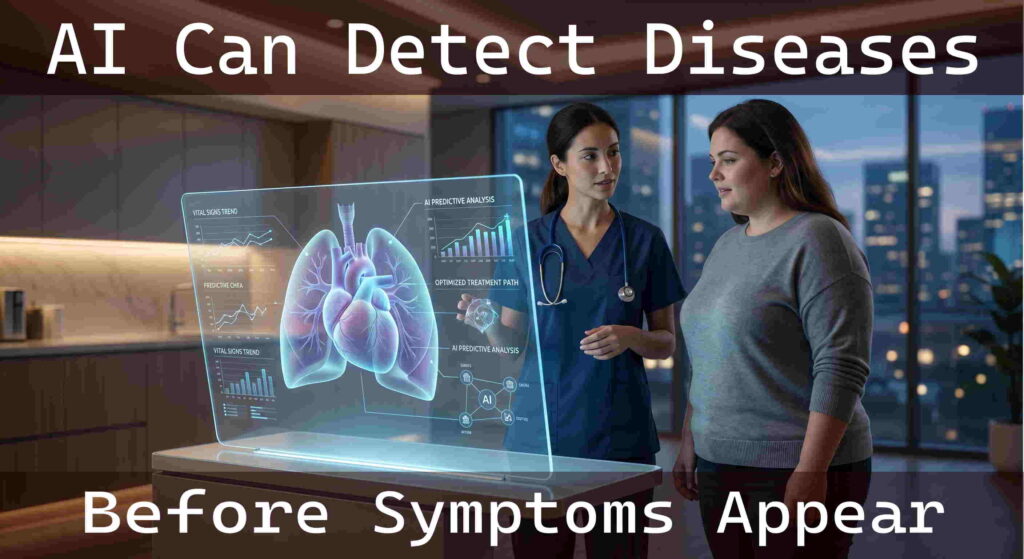
Most people visit a doctor only after symptoms appear. A headache becomes severe, chest pain starts suddenly, or constant fatigue begins affecting daily life. By that stage, many diseases have already progressed silently inside the body for months or even years. This delay is one of the biggest challenges in modern healthcare.
Artificial Intelligence is changing this model rapidly. Instead of waiting for visible symptoms, AI systems can now analyze subtle biological patterns long before humans notice anything unusual. Tiny changes in heart rhythm, sleep quality, speech patterns, blood chemistry, or medical imaging can now act as early warning signals.
Hospitals, diagnostic labs, wearable device companies, and medical researchers are increasingly using predictive healthcare AI to identify risks earlier than traditional methods. In many cases, this early detection gives doctors more time to intervene, reduce complications, and improve survival rates.
What makes this shift important is not just speed. It is the ability to detect patterns hidden inside enormous amounts of medical data that human observation alone may miss.
→ Read: The Evolution of Digital Healthcare and AI Systems
What Predictive Healthcare AI Actually Means
Predictive healthcare AI refers to systems trained to identify disease risks using large amounts of patient data. These systems study millions of historical cases to understand how illnesses develop over time.
Instead of looking only for obvious symptoms, AI focuses on hidden patterns called biomarkers. These can include:
- Small fluctuations in heart rate
- Changes in breathing during sleep
- Subtle abnormalities in blood tests
- Tiny tissue changes inside scans
- Speech irregularities linked to neurological decline
- Behavioral changes captured through wearable devices
For example, a smartwatch may detect an unusual heart rhythm weeks before a person feels any discomfort. AI compares that data against massive datasets and identifies whether the pattern matches known medical risks.
This approach shifts healthcare from reactive treatment to proactive prevention.
How AI Detects Diseases Before Symptoms Appear
The core strength of medical AI comes from machine learning and deep learning systems. These systems are designed to recognize patterns across enormous datasets much faster than humans can.
In traditional healthcare, doctors often depend on visible abnormalities. AI goes deeper by analyzing relationships between thousands of variables simultaneously.
For example, an AI model studying lung scans does not simply search for a visible tumor. It evaluates texture patterns, pixel density, tissue irregularities, and microscopic changes that may indicate disease development at an extremely early stage.
Similarly, AI systems monitoring wearable health devices continuously analyze:
- Resting heart rate
- Blood oxygen levels
- Sleep interruptions
- Stress patterns
- Physical activity recovery time
Individually, these changes may appear harmless. Combined together over time, they can reveal early signs of cardiovascular disease, diabetes, respiratory disorders, or neurological decline.
One of the most important developments is that AI can process multi-source data together. It can combine:
- Medical imaging
- Genetic information
- Electronic health records
- Lifestyle habits
- Wearable device data
- Doctor notes
This creates a far more complete understanding of patient health than isolated tests.
→ Read: How Deep Learning Systems Understand Patterns
Step-by-Step Process of AI Disease Prediction
1. Continuous Data Collection
The process starts with collecting medical information from various sources such as hospitals, wearable devices, diagnostic labs, and health apps.
Modern wearable devices already track large amounts of data passively without interrupting daily life.
2. Data Cleaning and Standardization
Medical data often contains inconsistencies. AI systems first organize and clean this information so it becomes usable for analysis.
This step is extremely important because inaccurate data can produce misleading predictions.
3. Pattern Detection
Machine learning models search for hidden similarities between current patient data and previous disease cases.
For instance, AI may identify that patients with certain sleep disturbances and inflammation markers later developed cardiac conditions.
4. Risk Scoring
The AI assigns probability scores based on detected risk patterns. These scores help doctors prioritize further testing or monitoring.
5. Human Medical Verification
AI does not replace doctors. Instead, it supports them with faster insights. Medical professionals still review results, conduct examinations, and make final decisions.
Major Types of AI Systems Used in Healthcare
Computer Vision AI
This technology analyzes medical images such as X-rays, MRIs, CT scans, and mammograms. AI can identify early abnormalities that may not be immediately visible during routine analysis.
Natural Language Processing
Healthcare systems contain huge amounts of written doctor notes and patient records. NLP systems read and organize this information to identify meaningful medical patterns.
Predictive Analytics
This category focuses on forecasting future health risks using historical data and ongoing monitoring.
Genomic AI
Genetic analysis systems study DNA patterns associated with inherited diseases and personalized treatment responses.
Wearable Health AI
Smartwatches and health bands continuously monitor body signals and feed real-time data into predictive systems.
Real-World Examples of AI Detecting Disease Early
Early Heart Disease Detection
AI-powered wearable devices can detect atrial fibrillation through irregular heartbeat patterns. Many users discover cardiovascular risks before major complications occur.
In practical testing environments, continuous monitoring often identifies issues that occasional hospital visits fail to capture.
Breast Cancer Prediction
Advanced imaging AI systems analyze mammograms and identify extremely subtle tissue changes associated with future cancer development.
Researchers have found that AI can sometimes detect risk patterns years before visible tumors fully develop.
Diabetic Retinopathy Screening
AI-powered retinal scanning tools help identify eye damage caused by diabetes at very early stages. This is especially useful in regions where specialist doctors are limited.
Neurological Disease Monitoring
AI can study voice patterns, typing behavior, walking patterns, and cognitive responses to detect early signs of neurological decline.
Small speech irregularities may sometimes indicate early cognitive impairment long before patients notice major memory issues.
→ Read: How Wearables Are Transforming Preventive Healthcare
Traditional Healthcare vs AI Predictive Healthcare
| Healthcare Factor | Traditional Healthcare | AI Predictive Healthcare |
|---|---|---|
| Approach | Treats illness after symptoms | Detects risks before symptoms |
| Monitoring Frequency | Occasional hospital visits | Continuous monitoring |
| Data Usage | Limited patient history | Large multi-source datasets |
| Detection Speed | Slower manual analysis | Rapid automated analysis |
| Preventive Capability | Limited | Strong proactive detection |
Benefits of AI Disease Detection Systems
- Earlier Intervention: Detecting disease earlier improves treatment outcomes significantly.
- Reduced Healthcare Costs: Preventive care is usually less expensive than late-stage treatment.
- Faster Analysis: AI can process scans and patient records within seconds.
- Improved Rural Healthcare: AI screening tools help areas where specialist doctors are limited.
- Continuous Monitoring: Wearable devices provide ongoing health tracking instead of isolated testing.
- Better Resource Allocation: Hospitals can prioritize high-risk patients more effectively.
Risks and Ethical Challenges of Medical AI
Data Privacy Concerns
Medical information is highly sensitive. Strong encryption and secure storage systems are essential to protect patient data.
Algorithm Bias
If AI systems are trained using limited demographic data, predictions may become less accurate for certain populations.
False Positives
Incorrect predictions can create stress and lead to unnecessary medical testing.
Overdependence on Automation
AI should support doctors, not replace clinical expertise and patient interaction.
Cybersecurity Risks
Connected healthcare systems can become targets for cyberattacks if security standards are weak.
→ Read: Understanding Ethics and Privacy in AI Healthcare
Who Should Use AI Healthcare Tools
Best For:
- People with family history of chronic illness
- Patients needing continuous monitoring
- Individuals managing diabetes or heart conditions
- Healthcare providers handling large patient volumes
- Rural healthcare centers with limited specialists
Who Should Be Careful:
- Users relying only on apps without medical consultation
- People sharing health data with unverified platforms
- Patients assuming AI predictions are final diagnosis
Best Practices for Using AI Health Technology Safely
- Use trusted healthcare platforms with strong privacy policies.
- Keep wearable devices and apps updated regularly.
- Consult qualified doctors before making health decisions.
- Review app permissions carefully before sharing sensitive data.
- Use AI predictions as guidance, not absolute conclusions.
- Choose platforms connected with certified healthcare providers whenever possible.
Future of Predictive Healthcare AI in 2026 and Beyond
Healthcare is moving toward continuous, personalized monitoring. Instead of visiting hospitals only after illness appears, people may soon receive constant preventive support through AI systems integrated into daily life.
Smart mirrors could analyze facial indicators of fatigue or stress. AI-powered toilets may study biomarkers automatically. Voice assistants may detect emotional or neurological changes through speech analysis.
Another major trend is federated learning, where hospitals improve AI models collaboratively without directly sharing private patient data.
Researchers are also developing digital twin systems that create virtual health models of patients. Doctors could potentially simulate treatments digitally before applying them in real life.
While these technologies are still evolving, the direction is clear. Healthcare is becoming increasingly predictive instead of reactive.
→ Read: Why Privacy Matters in the Future of AI Healthcare
Conclusion
AI detecting diseases before symptoms appear represents one of the most important shifts in modern medicine. By analyzing massive amounts of health data continuously, predictive healthcare systems can identify hidden risks much earlier than traditional approaches.
This does not mean doctors are becoming unnecessary. In reality, AI works best when combined with experienced medical professionals who understand context, patient history, and human care.
The biggest advantage of predictive healthcare is time. Detecting problems earlier gives patients and doctors more options, lower treatment costs, and better chances of recovery.
As AI healthcare systems continue improving through 2026 and beyond, prevention may become the center of medicine rather than emergency treatment after illness has already progressed.
Frequently Asked Questions
Can AI really predict diseases accurately?
AI can identify patterns linked to disease risk with impressive accuracy in many areas, especially imaging and wearable health monitoring. However, it should support doctors rather than replace medical diagnosis.
Are AI healthcare systems safe for personal data?
Trusted healthcare providers use encryption and secure systems, but users should always review privacy policies carefully before sharing sensitive information.
Can smartwatches detect serious health problems?
Modern smartwatches can detect irregular heart rhythms, sleep disturbances, and other patterns that may indicate health risks. They are useful screening tools but not replacements for professional medical evaluation.
Will AI replace doctors in the future?
No. AI is designed to assist healthcare professionals by improving speed and pattern detection. Human doctors remain essential for diagnosis, treatment decisions, and patient care.
What diseases can AI detect early?
AI is currently being used to help identify risks related to heart disease, cancer, diabetes complications, neurological disorders, sleep disorders, and certain respiratory conditions.