Introduction: The Local Shops Winning with AI
Walk into a modern kirana store today and you may notice something unusual. The owner already knows which snacks sell faster on weekends. Milk stock is adjusted before heavy rain. Regular customers receive WhatsApp offers exactly when they are likely to shop. None of this happens by accident anymore.
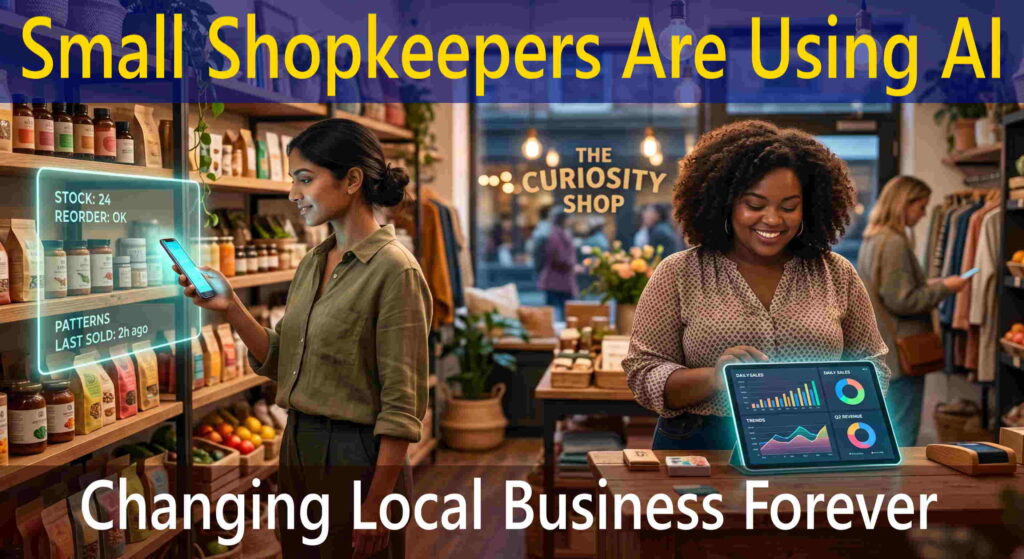
Artificial Intelligence is no longer limited to giant tech companies or expensive corporate systems. Small shopkeepers are now using affordable AI tools through billing apps, inventory software, payment systems, and smartphones. In many cases, they are adopting these tools faster than expected because the benefits are practical and immediate.
For local businesses, the biggest challenge has always been limited time, limited staff, and unpredictable demand. A wrong inventory decision can reduce profits for an entire week. AI helps solve these everyday problems by turning sales data into useful recommendations.
What makes this shift important is that it is changing how local retail competes with supermarkets and ecommerce platforms. Small shops are becoming smarter, faster, and more personalized while still keeping the human connection customers trust.
→ [Read: 10 Best AI Automation Tools for Small Businesses in 2026]
What AI Actually Means for Small Shopkeepers
When people hear the term Artificial Intelligence, they often imagine robots replacing workers. In small retail, AI works very differently. Most shopkeepers already use it without realizing it.
For example, many billing apps now suggest fast-selling products, warn about low inventory, track customer buying patterns, and generate automated sales reports. These features are powered by AI and machine learning.
At a basic level, AI studies patterns from business activity:
- Which products sell together
- What time customers visit most often
- Which items stay unsold for too long
- How weather or festivals affect demand
- What payment methods customers prefer
Earlier, experienced shopkeepers managed these things mentally through years of observation. AI speeds up that process and makes predictions more accurate.
The biggest advantage is not automation alone. It is decision support. AI helps small businesses make smarter daily choices with less guesswork.
How AI Is Transforming Everyday Retail Operations
Most successful small businesses are not using one large AI system. Instead, they are combining small practical tools that solve specific problems.
1. Smarter Inventory Management
Inventory mistakes are one of the biggest profit killers in retail. Too much stock increases waste. Too little stock sends customers elsewhere.
AI inventory systems study previous sales data and identify trends automatically. For example, a grocery store may discover that soft drink sales increase sharply during cricket matches or local festivals.
Some apps can now predict demand based on:
- Past sales history
- Weather conditions
- Local events
- Seasonal buying patterns
- Weekend foot traffic
This helps shopkeepers restock products before demand increases.
2. Automated Customer Communication
Many local businesses now use AI-powered WhatsApp marketing tools. These systems automatically send:
- Festival offers
- Back-in-stock alerts
- Loyalty rewards
- Personalized product suggestions
- Reminder messages for repeat purchases
The interesting part is personalization. A bakery customer who regularly buys birthday cakes may receive cake-related offers, while another customer gets snack recommendations.
This level of targeting was once available only to large ecommerce companies.
3. Faster Billing and Business Insights
Modern POS systems now generate automated reports that explain:
- Daily profit margins
- Top-selling items
- Peak sales hours
- Low-performing products
- Customer repeat rate
Instead of spending hours calculating manually, shopkeepers can check performance within seconds.
Step-by-Step: How a Small Shop Uses AI in Real Life
Many people assume AI adoption requires technical knowledge. In reality, most systems are designed for non-technical users. Here is how a typical AI-enabled shop operates daily.
- Step 1: Sales Data Collection. Every purchase made through the billing system is recorded automatically.
- Step 2: Pattern Analysis. The software studies customer behavior and sales trends in the background.
- Step 3: Smart Recommendations. The system suggests what products to reorder or promote.
- Step 4: Automated Customer Outreach. Customers receive offers through SMS or WhatsApp.
- Step 5: Performance Tracking. Shop owners review reports showing profit, demand, and inventory status.
What used to require spreadsheets, accountants, and manual tracking can now happen through a mobile app.
Real-World Examples of AI Helping Local Businesses
Mia’s Bakery Reduced Daily Waste
Mia runs a small bakery in a busy neighborhood. Earlier, she estimated production manually. Some days products sold out early. On other days, pastries remained unsold.
After adopting an AI-based sales forecasting tool, she noticed patterns she had never tracked before. Rainy evenings increased demand for hot snacks, while weekday mornings boosted sandwich sales.
Within three months, she reduced food waste significantly and improved daily profit consistency.
Chloe’s Boutique Improved Repeat Customers
Chloe owns a fashion boutique focused on ethnic wear and plus-size clothing. She started using AI-powered customer messaging integrated with WhatsApp.
The system automatically informed previous buyers when matching collections arrived. Customers appreciated the personalized experience because the messages felt relevant instead of spammy.
Her repeat customer rate improved because people returned more frequently for new arrivals.
Local Grocery Shops Competing with Delivery Apps
Several local grocery stores now use AI-assisted delivery systems. These tools predict which products are commonly ordered together and prepare delivery suggestions automatically.
This helps smaller shops compete with large online grocery platforms while maintaining faster neighborhood delivery.
Comparison Table: Traditional Retail vs AI-Powered Retail
| Business Function | Traditional Shopkeeping | AI-Powered Retail |
|---|---|---|
| Inventory Decisions | Based mostly on experience | Based on predictive sales analysis |
| Customer Communication | Manual and inconsistent | Automated and personalized |
| Sales Reporting | Paper records and manual calculations | Real-time business dashboards |
| Stock Management | Reactive restocking | Predictive inventory planning |
| Customer Experience | Generic for all customers | Customized offers and recommendations |
Why Small Businesses Are Adopting AI Faster Than Expected
One major reason is affordability. Earlier, advanced business software was expensive and complicated. Today, many AI tools are subscription-based and designed specifically for small businesses.
Another reason is competition. Local retailers now compete not only with nearby shops but also with ecommerce marketplaces and delivery apps. AI helps them operate more efficiently without hiring large teams.
Many shopkeepers also realize that digital records improve access to loans and business financing. Banks and financial companies are more likely to trust businesses with clear transaction history and sales reports.
From practical observation, businesses that adopt digital systems early usually become more organized over time. Even basic automation reduces stress during busy seasons.
Pros and Cons of AI for Local Retailers
Advantages
- Better inventory accuracy: Reduced stock shortages and waste.
- Faster customer service: Automated communication saves time.
- Higher profit margins: Smarter pricing and demand prediction improve revenue.
- Improved customer retention: Personalized offers increase repeat visits.
- Reduced manual workload: Less paperwork and fewer repetitive tasks.
Challenges
- Internet dependency: Some systems stop functioning properly during connectivity issues.
- Monthly subscription costs: Small shops must choose tools carefully.
- Learning curve: Older business owners may initially struggle with digital systems.
- Privacy concerns: Customer data must be protected responsibly.
- Over-automation risks: Excessive automation can reduce the personal touch customers value.
Who Should Use AI and Who Should Be Careful
AI Is Especially Useful For:
- Kirana stores
- Clothing shops
- Bakeries
- Medical stores
- Electronics retailers
- Businesses with repeat customers
- Shops handling large inventory
Businesses That Should Start Slowly
- Very small stores with limited digital knowledge
- Businesses without stable internet access
- Owners unwilling to maintain digital records
- Shops with extremely low daily transaction volume
For many businesses, starting with one simple tool is better than trying to automate everything immediately.
Best Practices for Small Shopkeepers Using AI
- Start with inventory management first. This usually delivers the fastest visible results.
- Choose simple software. Complicated systems often remain unused.
- Keep customer trust strong. Do not misuse personal phone numbers or customer data.
- Train staff properly. Even simple tools work better when employees understand them.
- Review reports weekly. AI insights only matter if the business owner acts on them.
- Maintain a human connection. Technology should support relationships, not replace them.
Future Trends: What Local Retail Could Look Like by 2026
The next stage of AI in retail will move beyond recommendations into action-based automation.
Future systems may automatically reorder products, compare supplier prices, and schedule deliveries without manual intervention. Voice assistants in regional languages will also become more common.
Imagine a shopkeeper asking in Marathi or Hindi:
“Which products gave the highest profit this week?”
The AI system could instantly answer using real business data.
Another important trend is hyper-local personalization. Shops will increasingly use AI to create neighborhood-specific offers instead of generic promotions.
Small retailers who combine technology with trusted customer relationships may become stronger competitors than many people expect.
→ [Read: The Rise of Agentic AI: Why Autonomous AI Agents are the Future]
Conclusion: AI Is Helping Local Retail Stay Relevant
For years, people assumed large corporations would dominate retail completely because they had better systems, better analytics, and larger budgets. AI is beginning to level that gap.
Today, even small shopkeepers can access smart business tools through affordable apps and smartphones. They can understand customer behavior better, reduce waste, improve efficiency, and compete more effectively.
The most successful businesses will not be the ones using the most technology. They will be the ones using technology wisely while still keeping trust, relationships, and local understanding at the center of their business.
AI is not replacing local shops. In many cases, it is helping them survive and grow in a rapidly changing market.
Frequently Asked Questions
Can small shops really afford AI tools?
Yes. Many modern AI-powered billing and inventory apps are available at affordable monthly pricing. Some even offer free starter plans for small businesses.
Do shopkeepers need technical knowledge to use AI?
No. Most retail AI tools are designed for non-technical users and work through simple mobile apps and dashboards.
Is AI replacing workers in local shops?
In most cases, AI is helping workers become more efficient rather than replacing them completely. It reduces repetitive tasks and improves business management.
What is the biggest benefit of AI for small retailers?
Better inventory management is usually the biggest advantage because it directly reduces losses and improves profit margins.
Is customer data safe in AI-powered retail systems?
It depends on the software provider. Shopkeepers should always use trusted platforms, enable security features, and avoid sharing unnecessary customer information.