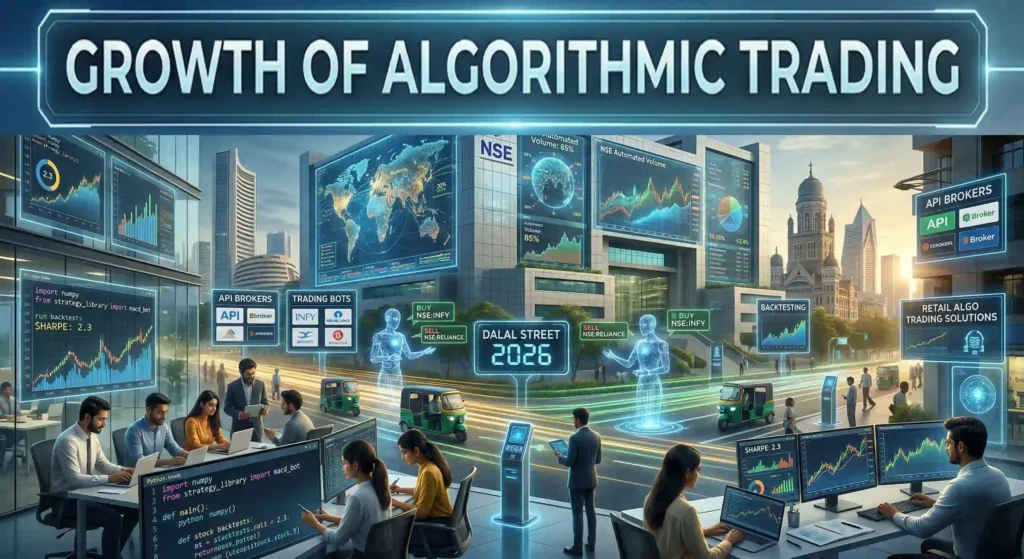
Imagine trying to manually place a trade during a sudden market breakout. Prices move every second, news updates flash across screens, and emotions begin to influence decisions. Many traders in India have experienced buying too late, exiting too early, or freezing during volatility. In 2026, this is exactly where algorithmic trading is changing the game. Instead of relying purely on speed and emotion, traders are increasingly using automated systems that follow predefined logic with discipline and consistency.
The Indian stock market has evolved rapidly over the last few years. Retail participation has increased, APIs have become more accessible, and cloud computing has reduced the cost of automation. What was once limited to institutional firms and hedge funds is now available to independent traders, software developers, finance students, and even working professionals managing trades part-time.
Algorithmic trading is no longer just a trend in India. It is becoming a major part of how modern markets operate. Understanding how it works, where it succeeds, and where risks exist is now essential for anyone serious about trading or investing in the Indian stock market.
Basic Concepts: What Exactly is Algorithmic Trading?
Algorithmic trading, often called algo trading, refers to using computer programs to automatically execute trades based on predefined conditions. Instead of manually clicking buy or sell buttons, traders create rules that the software follows automatically.
These rules may involve:
- Price movements
- Technical indicators
- Volume spikes
- Time-based entries
- Risk management conditions
- Market volatility patterns
For example, a trader may create a strategy that buys Nifty futures whenever the 20-period moving average crosses above the 50-period moving average and exits if losses exceed 1%.
The key point is that the computer does not think emotionally. It simply follows instructions exactly as programmed.
This discipline is one of the biggest reasons why automated trading is growing rapidly in India.
Another major advantage is consistency. Human traders often struggle to follow their plans during stressful market conditions. Algorithms remove hesitation and execute trades immediately when conditions match.
→ [Read: The Rise of Agentic AI in Finance and Wealth Management]
The Core Explanation: Why Algorithmic Trading is Growing Rapidly in India
Several important developments have accelerated the growth of algorithmic trading in the Indian stock market.
Affordable Broker APIs
Earlier, automated trading required expensive infrastructure and institutional-level access. In 2026, many Indian brokers provide APIs that allow traders to connect their software directly with the exchange.
This has significantly lowered the entry barrier for retail traders.
A trader sitting in Solapur, Jaipur, or Guwahati can now automate strategies using a laptop and cloud hosting instead of needing a professional trading desk in Mumbai.
Rise of Retail Investors
After 2020, India saw a massive increase in demat accounts and retail market participation. As traders gained experience, many realized that emotional trading often leads to inconsistent performance.
Automation became attractive because it helps maintain discipline during volatile conditions.
Better Internet and Cloud Infrastructure
India’s digital infrastructure has improved significantly. Faster internet speeds, affordable cloud servers, and mobile connectivity have made automation more practical even for smaller traders.
Availability of No-Code Platforms
One major shift in 2026 is the popularity of no-code algo trading platforms. Earlier, programming knowledge was essential. Now traders can build strategies visually using drag-and-drop tools.
This has expanded algo trading adoption beyond software engineers and quantitative analysts.
→ [Read: Top Emerging Markets for Investors in 2026]
How Algorithmic Trading Works Step by Step
Although the concept sounds technical, the workflow behind algorithmic trading follows a structured process.
Step 1: Strategy Development
The trader begins with an idea based on observation or market behavior.
For example:
- Buy Bank Nifty when volatility decreases after a strong opening move
- Sell when a predefined target or stop-loss is reached
- Avoid trading during major news events
The strategy must be converted into clear mathematical rules.
Step 2: Backtesting on Historical Data
Before risking real money, traders test strategies on past market data.
This helps answer important questions:
- Would the strategy have worked historically?
- How large were the drawdowns?
- What was the win rate?
- How volatile were returns?
Step 3: Paper Trading
Experienced traders rarely deploy a strategy immediately with real capital.
Instead, they run the algorithm in live markets using simulated money to verify execution quality and stability.
Step 4: API Integration
The algorithm connects with the broker through APIs. This allows trades to be executed automatically without manual intervention.
Step 5: Risk Monitoring
Good algorithmic systems always include safety mechanisms such as:
- Daily loss limits
- Maximum trade limits
- Emergency shutdown rules
- Position size restrictions
Professional traders focus heavily on risk management because even profitable systems can fail during unusual market conditions.
→ [Read: The 2026 Guide to AI-Powered Asset Management]
Popular Types of Algorithmic Trading Strategies in India
Not all trading algorithms work the same way. Different traders use different approaches depending on market conditions and risk appetite.
Trend Following Algorithms
These systems attempt to capture ongoing market momentum. They buy during uptrends and sell during downtrends.
Common indicators include:
- Moving averages
- Breakout levels
- Momentum indicators
Mean Reversion Strategies
These strategies assume prices eventually return to average levels after extreme movements.
For example, if a stock falls sharply without major news, the algorithm may expect a temporary rebound.
Arbitrage Trading
Arbitrage systems look for small price differences between markets.
Examples include:
- NSE and BSE price differences
- Cash and futures price gaps
- ETF and underlying asset discrepancies
Options Selling Algorithms
In India, automated option-selling strategies have become extremely popular among retail traders.
These systems manage entries, hedging, and stop-losses automatically while monitoring volatility throughout the day.
VWAP and Institutional Execution Algorithms
Large institutions use algorithms to split large orders into smaller trades to avoid affecting market prices.
This helps achieve better execution quality.
Features and Benefits of Algorithmic Trading
1. Faster Trade Execution
Markets move quickly. Algorithms execute trades within milliseconds, reducing delays caused by manual actions.
2. Emotional Discipline
Fear and greed are major reasons traders lose money.
Algorithms remove emotional decision-making and follow predefined rules consistently.
3. Simultaneous Market Monitoring
A human trader can monitor only a limited number of stocks. Algorithms can track hundreds or thousands of instruments simultaneously.
4. Time Efficiency
Many working professionals in India use automated systems because they cannot monitor charts throughout the trading session.
Automation allows them to participate without constant screen time.
5. Better Risk Control
Algorithms can instantly trigger stop-losses and risk management actions without hesitation.
This becomes extremely important during highly volatile market conditions.
→ [Read: Top AI Trading Bots for Market Automation]
Real World Use Cases in the Indian Market
Algorithmic trading is no longer limited to institutional traders in Mumbai.
Consider a software engineer in Hyderabad who works full-time but wants exposure to intraday trading. Instead of watching charts during office hours, he deploys a low-risk automated strategy that trades index options with predefined limits.
Now consider a finance student in Pune who builds a Python-based arbitrage strategy between futures and spot prices. Using a low-cost cloud server, she runs the strategy during market hours while continuing her studies.
Small proprietary trading firms across India are also increasingly adopting automation for:
- Options scalping
- Index arbitrage
- Intraday momentum trading
- Market-making strategies
Even wealth management firms are using algorithms to rebalance portfolios automatically based on risk models and market conditions.
Comparison Table: Manual Trading vs Algorithmic Trading
| Feature | Manual Trading | Algorithmic Trading |
|---|---|---|
| Execution Speed | Slow and reaction-based | Instant and automated |
| Emotional Influence | High | Very low |
| Market Monitoring | Limited | Large-scale scanning |
| Consistency | Depends on trader discipline | Rule-based execution |
| Time Requirement | Continuous attention needed | Mostly automated after setup |
| Scalability | Difficult | Easier to scale |
| Backtesting Ability | Limited | Advanced historical testing |
Risks and Challenges Traders Must Understand
Algorithmic trading offers advantages, but it also introduces important risks.
Over-Optimization
Many beginners create strategies that perform perfectly on historical data but fail in live markets.
This happens because the strategy becomes too tailored to the past.
Technical Failures
Internet failures, broker API outages, or cloud server crashes can interrupt execution.
Without proper safeguards, losses can increase rapidly.
Market Volatility
During major events, slippage and sudden price gaps can affect even well-designed strategies.
False Expectations
One common misconception is that algorithmic trading guarantees profits.
In reality, successful algo trading still requires:
- Research
- Testing
- Risk management
- Continuous monitoring
Automation improves execution, but it does not eliminate market risk.
→ [Read: How Technology is Reshaping Personal Finance Risks]
Who Should Use Algorithmic Trading and Who Should Avoid It
Best Suited For
- Traders who prefer systematic decision-making
- Working professionals with limited trading time
- Data-driven investors
- Programmers and quantitative analysts
- Options traders managing multiple positions
May Not Be Suitable For
- Traders expecting guaranteed profits
- People unwilling to test strategies properly
- Users with poor risk management habits
- Beginners trading without understanding market basics
Many experienced traders recommend learning manual trading fundamentals before fully automating strategies.
Best Practices for Indian Algo Traders in 2026
- Start with Paper Trading: Always test strategies in live market conditions before deploying real capital.
- Use Strict Risk Controls: Include maximum loss limits and emergency shutdown mechanisms.
- Keep Strategies Simple: Overly complex systems often fail during real market conditions.
- Use Reliable Cloud Hosting: Stable infrastructure is essential for uninterrupted execution.
- Track Performance Regularly: Markets evolve continuously, so strategies require periodic review.
- Follow SEBI Guidelines: Ensure compliance with exchange and regulatory requirements.
Advanced Concepts: AI Trading, HFT, and Quantitative Systems
Beyond traditional rule-based systems, Indian markets are increasingly moving toward AI-assisted trading models.
Machine learning systems can analyze:
- Market sentiment
- News headlines
- Global economic signals
- Social media activity
- Volatility patterns
Large institutional firms also use High-Frequency Trading, commonly called HFT.
These systems execute thousands of trades within extremely short durations. At this level, speed becomes critical, which is why institutional firms often use colocation services near exchange data centers.
Retail traders generally do not compete directly in HFT, but understanding its influence helps explain modern market behavior and sudden price spikes.
→ [Read: The Shift in Private Banking and High-Speed Wealth Management]
Future Trends in Indian Algorithmic Trading
The future of algorithmic trading in India is likely to become even more technology-driven.
Some major trends expected beyond 2026 include:
- AI-driven adaptive strategies
- No-code automation platforms
- Voice-controlled trading dashboards
- Cloud-native retail trading systems
- Advanced retail analytics tools
- Real-time sentiment analysis integration
As automation tools become simpler, adoption among retail investors is expected to increase significantly.
At the same time, regulatory oversight will also become stricter to ensure market stability and fair participation.
→ [Read: Top Decentralized Finance Trends Dominating the Markets]
Conclusion
Algorithmic trading is transforming how the Indian stock market operates in 2026. What once required institutional infrastructure is now accessible to independent traders and retail investors across the country.
The biggest advantage of automation is not magical profit generation. It is consistency, discipline, and the ability to execute strategies efficiently in fast-moving markets.
However, success still depends on proper research, testing, risk management, and realistic expectations. Technology can improve execution quality, but it cannot eliminate uncertainty in financial markets.
For traders willing to learn systematically, algorithmic trading offers a powerful way to participate in modern markets with greater structure and less emotional stress.
Frequently Asked Questions
Is algorithmic trading legal in India?
Yes, algorithmic trading is legal in India when done according to SEBI and exchange regulations. Many brokers now officially support API-based trading systems.
Do I need coding skills for algo trading?
No. Many platforms now provide no-code strategy builders. However, learning basic coding can provide more flexibility and customization.
Can beginners start with algorithmic trading?
Yes, but beginners should first understand market basics, risk management, and paper trading before deploying real capital.
How much capital is required for algo trading in India?
The required capital depends on the strategy type. Some retail traders start with relatively small amounts, while advanced strategies may require larger capital and infrastructure.
Is algorithmic trading completely risk-free?
No. Market volatility, technical failures, and poor strategy design can still lead to losses. Proper testing and disciplined risk management remain essential.