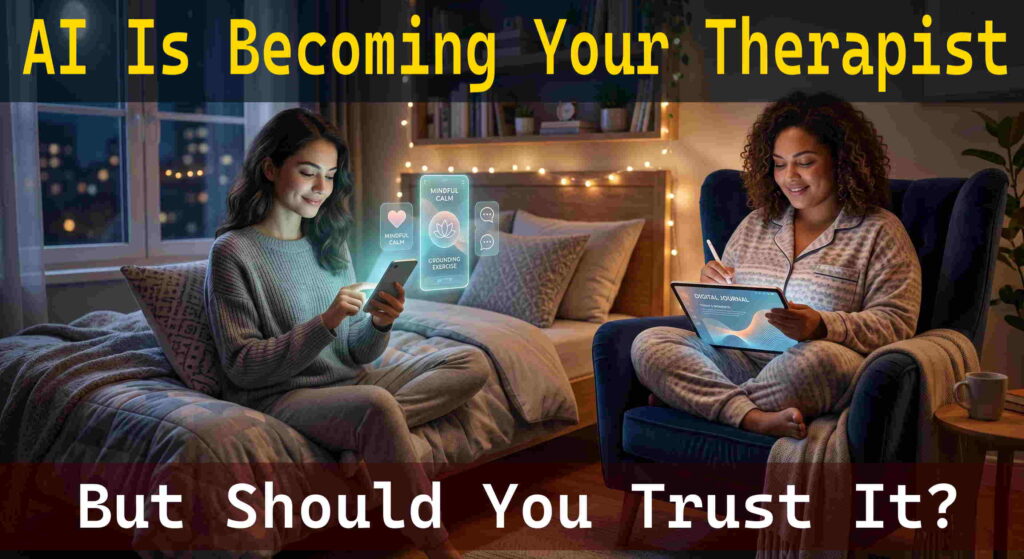
Introduction: Why Millions Are Opening Up to AI Instead of People
It is late at night. Your mind is racing with thoughts about work, relationships, finances, or the pressure to succeed. You want someone to talk to, but calling a friend feels uncomfortable, and booking a therapist appointment may take days or even weeks. So you open an AI mental health app, type a few words, and instantly receive a calm response that feels supportive and personal.
This situation is becoming surprisingly common. AI therapy tools are now being used by students, remote workers, entrepreneurs, content creators, and even people living in smaller towns where mental health services are difficult to access. These systems promise instant emotional support, stress management guidance, and private conversations available 24 hours a day.
But an important question remains. Should you actually trust AI with your emotions, thoughts, and mental health struggles?
The answer is not completely simple. AI therapy can be genuinely useful in certain situations, especially for stress tracking, emotional journaling, and daily self-reflection. At the same time, there are serious limitations involving privacy, emotional dependency, and the inability of machines to truly understand human suffering.
In this guide, we will break down how AI therapy works, why it is growing so rapidly, where it genuinely helps people, and where human therapists still remain irreplaceable.
→ Read: AI Is Quietly Changing Life in India and Most People Haven’t Noticed Yet
What AI Therapy Actually Means
Many people imagine AI therapy as a robot pretending to be a doctor. In reality, most AI mental health tools are advanced conversational systems designed to simulate supportive dialogue.
These tools usually work through chat interfaces or voice assistants. You describe how you feel, and the AI responds using patterns learned from psychology frameworks, emotional language analysis, and conversational training data.
Most AI therapy platforms focus on:
- Stress reduction techniques
- Mood tracking
- Guided journaling
- Anxiety management exercises
- Daily emotional check-ins
- Breathing and mindfulness support
- Habit improvement reminders
What many users misunderstand is this. AI is not a licensed psychologist. It cannot medically diagnose depression, prescribe medication, or handle psychiatric emergencies safely.
The best way to view AI therapy is as a mental wellness support tool, not a complete replacement for professional mental healthcare.
Why So Many People Feel Comfortable Talking to AI
The rise of AI emotional support tools is not happening only because of technology. It is happening because modern life has created emotional gaps that many people struggle to fill.
1. People Want Privacy Without Judgment
One of the strongest reasons people use AI therapy is emotional safety. Many users feel uncomfortable discussing anxiety, burnout, loneliness, or relationship problems with family members or coworkers.
An AI system does not interrupt, criticize, or react emotionally. For users carrying stress silently, this can feel relieving.
2. Traditional Therapy Is Not Accessible for Everyone
In many regions, especially smaller cities and rural areas, mental health professionals are limited. Even in urban areas, therapy can be expensive.
AI tools reduce this barrier by offering instant support at low cost or even free access.
3. Modern Work Culture Is Increasing Emotional Fatigue
Remote work, social media pressure, constant online comparison, and digital burnout are affecting emotional wellbeing globally.
Many users are not searching for deep psychotherapy. They simply want a calm space to process thoughts, reflect on emotions, or reduce anxiety before sleeping.
4. AI Feels Consistently Available
Humans get tired, distracted, or busy. AI systems respond instantly every time.
For someone dealing with stress at 2:00 AM, immediate emotional support can feel valuable even if it comes from software.
How AI Therapy Works Behind the Scenes
Most users only see a chat box, but several technologies operate together to create the experience.
Step 1: Understanding Your Input
The AI first processes your message using Natural Language Processing. It identifies keywords, emotional tone, sentence structure, and context.
For example, phrases like “I feel exhausted,” “I cannot focus,” or “I feel worthless” trigger different emotional interpretations.
Step 2: Sentiment Analysis
The system estimates emotional states such as stress, sadness, frustration, anxiety, or hopelessness.
This helps the AI adjust its tone and select appropriate responses.
Step 3: Psychological Pattern Matching
Many tools are trained using simplified therapeutic frameworks like Cognitive Behavioral Therapy.
If a user repeatedly says things like “I always fail,” the system may identify negative thinking patterns and encourage reframing.
Step 4: Response Generation
The AI generates a supportive response designed to feel calm, empathetic, and conversational.
Some systems also suggest breathing exercises, journaling prompts, or short mindfulness activities.
Step 5: Long-Term Personalization
Over time, the system remembers conversation history and behavioral trends.
This allows future responses to feel more personalized, which increases user attachment and engagement.
Real Situations Where AI Therapy Can Actually Help
AI mental health tools are not equally useful for every situation. Their effectiveness depends heavily on the type of emotional challenge involved.
Daily Stress Management
For students preparing for exams, freelancers handling deadlines, or professionals facing burnout, AI tools can help organize thoughts and reduce emotional overload.
Many users report that simply writing their feelings regularly improves mental clarity.
Emotional Journaling
AI tools are often effective for reflective journaling because they encourage users to express emotions consistently.
This can help identify stress triggers, unhealthy habits, or recurring emotional patterns.
Short Anxiety Episodes
Before interviews, presentations, travel, or important meetings, AI systems can guide breathing exercises or calming techniques.
This type of quick emotional intervention is one area where AI performs surprisingly well.
Loneliness and Isolation
People working night shifts, living alone, or relocating to new cities sometimes use AI companions for emotional comfort.
While this should not replace human relationships, it may temporarily reduce feelings of isolation.
Where AI Therapy Fails Completely
This is the part many promotional articles avoid discussing honestly.
AI therapy has serious limitations that users must understand clearly.
It Cannot Truly Understand Human Emotion
AI predicts supportive responses statistically. It does not genuinely feel empathy, sadness, compassion, or concern.
The conversation may feel emotionally comforting, but the understanding is simulated.
It Can Give Incorrect Advice
AI systems sometimes generate inaccurate or inappropriate responses confidently.
In mental health situations, poor guidance can become dangerous.
It Is Not Suitable for Crisis Situations
Severe depression, trauma, self-harm risk, panic disorders, or suicidal thoughts require trained human intervention.
AI should never be treated as emergency mental healthcare.
Emotional Dependency Can Develop
Some users become overly attached to AI companions because the interaction feels predictable and emotionally safe.
Over time, this can reduce motivation to build difficult but meaningful real-world relationships.
Privacy Risks Are Real
Mental health conversations contain deeply personal information.
If the platform lacks strong security standards, sensitive emotional data could potentially be exposed, analyzed, or monetized.
→ Read: Cybersecurity Trends 2026, Protecting Your Digital Assets in the AI Era
Human Therapist vs AI Therapist, Honest Comparison
| Factor | Human Therapist | AI Therapy Tool |
|---|---|---|
| Availability | Limited by appointments and schedule | Available anytime |
| Cost | Often expensive per session | Usually affordable or free |
| True Emotional Understanding | Deep human empathy and experience | Pattern-based emotional simulation |
| Handling Serious Mental Illness | Professionally trained for complex cases | Limited and risky |
| Consistency | May vary by energy or workload | Consistent responses |
| Medical Authority | Can diagnose and prescribe treatment | Cannot provide medical treatment |
Who Should Use AI Mental Health Tools
AI therapy tools may be helpful for:
- Students dealing with exam pressure
- Remote workers experiencing isolation
- People wanting guided journaling support
- Users seeking mindfulness reminders
- Professionals managing daily stress
- People building emotional self-awareness habits
Who Should Avoid Depending Only on AI
- People facing severe depression
- Users with trauma-related conditions
- Anyone experiencing suicidal thoughts
- Individuals needing medical diagnosis
- People struggling with addiction or psychiatric disorders
In these situations, licensed mental health professionals remain essential.
Best Practices for Using AI Therapy Safely
After analyzing how users interact with AI wellness systems, several healthy usage patterns stand out clearly.
- Use AI as a support tool, not a replacement for real therapy.
- Avoid sharing highly sensitive financial or legal information.
- Check privacy policies carefully before using any app.
- Maintain real-world friendships and conversations.
- Use AI for reflection, journaling, and emotional organization.
- Seek professional help if symptoms become severe or long-lasting.
Future Trends: What AI Mental Health Could Look Like by 2030
The future of AI mental wellness tools will likely move far beyond simple chat interfaces.
Developers are already experimenting with systems that combine voice analysis, facial expression recognition, wearable device data, and behavioral tracking.
Future AI systems may detect emotional burnout before users even realize it themselves.
We may also see:
- AI wellness assistants integrated into smartwatches
- Voice-based emotional coaching in local languages
- Virtual reality calming environments
- Personalized mental wellness plans
- Hybrid systems supervised by licensed therapists
At the same time, governments will likely introduce stricter regulations around emotional AI, privacy, and mental health safety standards.
→ Read: The Human AI Hybrid Workforce and Bio Integration
Frequently Asked Questions
Can AI replace real therapists?
No. AI can assist with stress management, journaling, and emotional reflection, but it cannot replace trained mental health professionals for serious conditions.
Is AI therapy safe to use?
It can be useful when used responsibly, but users should avoid sharing extremely sensitive information and should choose platforms with strong privacy protections.
Why do people feel emotionally attached to AI?
Humans naturally respond emotionally to conversational systems that appear supportive and attentive. Consistent interaction can create emotional attachment over time.
Can AI help with anxiety and stress?
For mild daily stress or anxiety, many users find breathing exercises, journaling prompts, and reflective conversations helpful.
Should teenagers use AI mental health apps?
They can be helpful for basic emotional support, but parents and guardians should encourage balanced use and ensure real human communication remains important.
Conclusion: Useful Tool or Emotional Risk?
AI therapy is growing because it solves real problems. It offers instant support, emotional privacy, affordable access, and a space where many people feel comfortable expressing themselves.
For daily stress management and emotional reflection, these tools can genuinely help.
But there is also a danger in expecting machines to replace human connection completely. Real therapy involves lived experience, emotional depth, ethical responsibility, and human understanding that AI still cannot truly replicate.
The smartest approach is balance.
Use AI mental health tools as assistants for self-awareness, emotional organization, and habit building. But when emotional struggles become serious, human support remains irreplaceable.
The future of mental healthcare will likely combine both, intelligent digital tools for everyday support, and real human professionals for deeper care and healing.