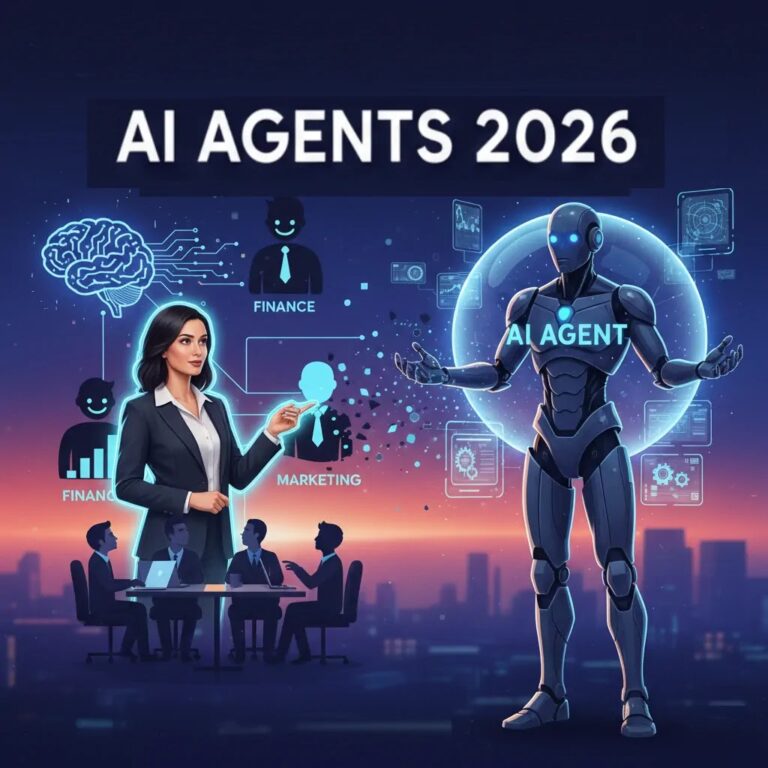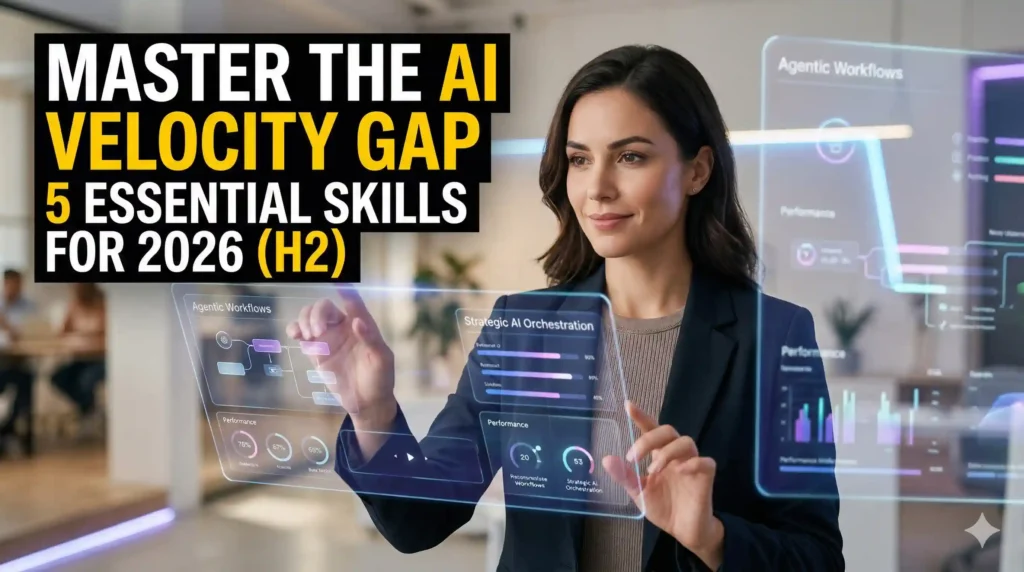
By the second half of 2026, the global workforce has split into two distinct tiers: those who use AI as a tool, and those who orchestrate AI as a workforce. This is the AI Velocity Gap. At KOLAACE™, we’ve observed that small businesses failing to bridge this gap aren’t just slowing down—they are becoming operationally invisible.
The “Survival Guide” for H2 2026 is no longer about learning how to write a prompt. It is about Systems Orchestration. If your employees are still manually drafting emails and scheduling posts, they are operating at 2024 speeds in a 2026 economy.
KOLAACE™ Case Study: The “AI-First” Hiring Pivot
The Challenge: A traditional marketing firm with 12 employees was struggling with a 60% overhead cost. They were “using AI” but seeing no increase in profit margins.
Fatima’s Data Audit: “I analyzed their workflow and found they were using AI to do manual tasks faster, rather than using AI to eliminate the tasks entirely. They had a ‘Usage’ mindset, not an ‘Orchestration’ mindset.”
Slim’s Implementation: “We slimmed their team structure. We coached the lead account manager to stop being a ‘doer’ and start being an ‘Architect.’ By H2 2026, they replaced three manual coordination roles with one AI Orchestrator managing a fleet of 20 autonomous agents.”
The 2026 Skills Heatmap: Value Shift Analysis
To survive the next shift, you must understand where human value is skyrocketing and where it is being commoditized by Agentic AI.
| Manual Task (Replaced) | Automation Level | Strategic Skill (Skyrocketing) | Human Value |
|---|---|---|---|
| Content Drafting / Editing | 100% (Agentic) | Brand Narrative & Voice Design | Extremely High |
| Data Entry & Sorting | 100% (Autonomous) | Algorithmic Decision Auditing | Critical |
| Basic Customer Support | 95% (LLM-Agents) | Emotional Intelligence (EQ) Escalation | Premium |
| Technical SEO Updates | 90% (Auto-Crawlers) | Domain Strategy & Entity Authority | High |
| Project Scheduling | 100% (Recursive Planning) | Workflow Architecture | Ultra-High |
The 5 Essential Skills for H2 2026
1. Agentic Orchestration
In 2025, you prompted an AI. In 2026, you manage a Swarm. This skill involves knowing how to connect different autonomous agents—one for research, one for drafting, one for SEO—into a single seamless pipeline. As Slim says, “An orchestrator doesn’t play the instruments; they make sure the whole orchestra is in sync.”
2. Ethical AI Governance & Auditing
Small businesses are now legally responsible for the outputs of their autonomous agents. Employees must master the ability to “Audit the Black Box.” Fatima emphasizes that knowing why an AI made a financial or hiring decision is more important than the decision itself.
3. Recursive Problem Solving
When an autonomous agent hits a “logic wall,” it requires a human to redefine the target vector. This is recursive thinking—the ability to look at a broken automated process and restructure the underlying goal to allow the AI to find a new path to execution.
4. EQ Escalation & High-Stakes Empathy
As 95% of basic customer interactions are handled by autonomous agents in H2 2026, the value of human Emotional Intelligence (EQ) has shifted from a soft skill to a premium commodity. Employees must master “EQ Escalation”—the ability to take over a conversation when an AI detects complex human frustration or high-stakes nuance.
In the KOLAACE™ framework, we call this the “Human Buffer.” When the automation hits a wall of human emotion, the employee must be able to pivot the narrative, build genuine rapport, and solve problems that logic-based algorithms cannot grasp. If an agent is the engine, EQ is the steering wheel that ensures the business doesn’t drive off a reputational cliff.
5. Workflow Architecture & “Slim-Stack” Design
The final and most critical skill for the H2 2026 workforce is Workflow Architecture. This moves beyond using tools to actually building the bridges between them. As Slim often demonstrates, a “Slim-Stack” architect knows how to prune redundant AI subscriptions and consolidate them into a single, high-velocity pipeline.
This skill requires a deep understanding of APIs, data flow, and “Logic Triggering.” An employee with this skill can take a manual business process that takes 40 hours and architect an agentic system that does it in 40 seconds. This is the ultimate “Force Multiplier” that bridges the AI Velocity Gap.
The Velocity ROI: Impact of Skill Mastery in 2026
Small businesses that have transitioned their teams to these five skills are seeing a dramatic shift in their operational capacity.
Conclusion: Bridging Your Personal Velocity Gap
The H2 2026 economy does not wait for those who are “still learning the tools.” It rewards those who have mastered the orchestration of those tools. Whether you are a business owner or an employee, your value is now measured by your ability to manage AI swarms with ethics, logic, and extreme empathy.