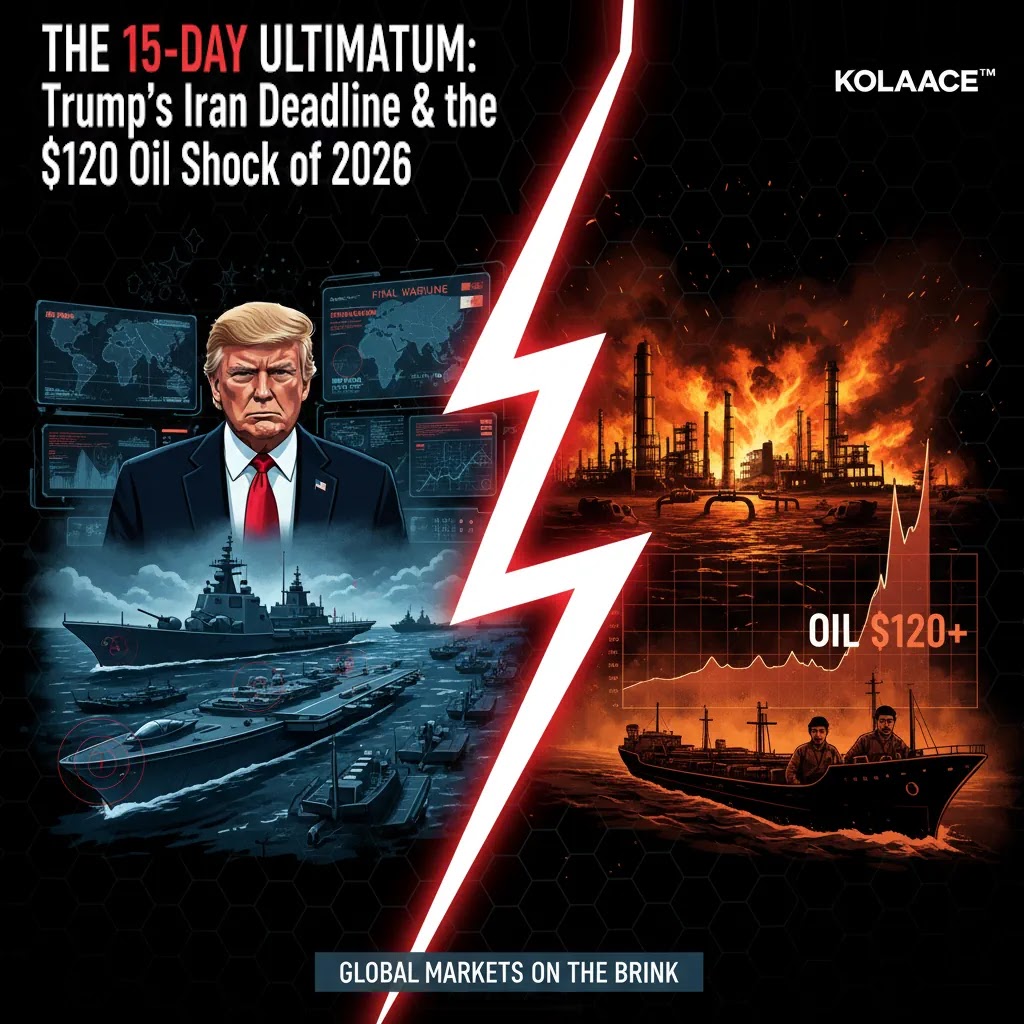
Today, February 20, 2026, the world stands on the precipice of a regional conflict that could redefine the global energy map. From the India-AI Impact Summit, President Donald Trump has issued a final 15-day ultimatum to Tehran: Sign the “New Comprehensive Nuclear Framework” or face a “decisive kinetic response” from the gathering US Armada currently positioned in the Gulf of Oman.
For the KOLAACE™ investor, this isn’t just a headline—it is a massive structural shift. Crude oil has already surged 5.74% in the last 12 hours, hitting $66.50, with analysts predicting a spike toward $120 if the Hormuz Strait experiences even a 24-hour closure. This crisis is the first real-world stress test for the newly signed Pax Silica Declaration.
The “US Armada” and the 15-Day Clock
The military buildup is the largest seen in the Middle East since 2003. The fleet includes the latest F-35C Lightning II squadrons and a saturation of Tomahawk-capable destroyers. The 15-day deadline is not arbitrary; it aligns with the conclusion of the Ramadan 2026 preparations, putting immense pressure on regional stability.
The Geopolitical Chessboard
- The US Position: Total de-nuclearization of Iran in exchange for “Economic Normalization” and inclusion in the secondary tier of the Pax Silica tech-sharing network.
- The Iranian Response: Tehran has formally warned the UN that any strike will result in the immediate targeting of “hostile assets” in the region, including US bases and partner infrastructure.
- The UK Stance: Prime Minister Keir Starmer has notably blocked the US from using RAF bases for offensive strikes, highlighting a rare rift in the “Special Relationship.”
Market Growth: The Energy & Defense Supercycle
While the broader markets falter, two sectors are entering a vertical growth phase. The “Security-as-a-Service” industry and deep-water energy exploration are seeing capital inflows unseen since the early 2010s.
Energy Sector Capital Inflow: 2026 Projections (Billions USD)
*Projected investment surge as geopolitical risk triggers strategic reserves reallocation.*
Strategic Comparison: Negotiation vs. Escalation
To navigate the next 15 days, KOLAACE™ readers must monitor these key indicators.
| Indicator | The “Diplomatic Path” (Deal Reached) | The “Kinetic Path” (Military Strike) |
|---|---|---|
| Oil Price (Brent) | Stabilizes at $60-$65 | Spikes to $120+ within 48h |
| AI Tech Stocks | Rally on “Pax Silica” inclusion | Short-term dip; Focus on Defense AI |
| Gold/Bitcoin | Neutral to Bearish | Safe-haven surge (BTC >$100k) |
India’s Role: The Neutral Hub No More?
As the host of the India AI Impact Summit, Prime Minister Modi finds himself in a delicate position. India’s dependency on Iranian oil via the Chabahar Port makes a regional war a direct threat to Indian energy security. However, the Pax Silica partnership with the US offers a long-term technology “shield” that may outweigh short-term energy shocks.
Conclusion: Positioning for Day 16
The 15-day ultimatum is a binary event. The world will either emerge with a landmark nuclear framework or enter a period of sustained regional warfare. For the Architects of Systems, the mission is clear: Hedge your energy exposure, double down on Quantum-Resistant infrastructure, and keep your AI agents locked on the Strait of Hormuz maritime data.
At KOLAACE™, we will provide daily updates on the “Ultimatum Clock” and real-time analysis of the US Armada’s movements.