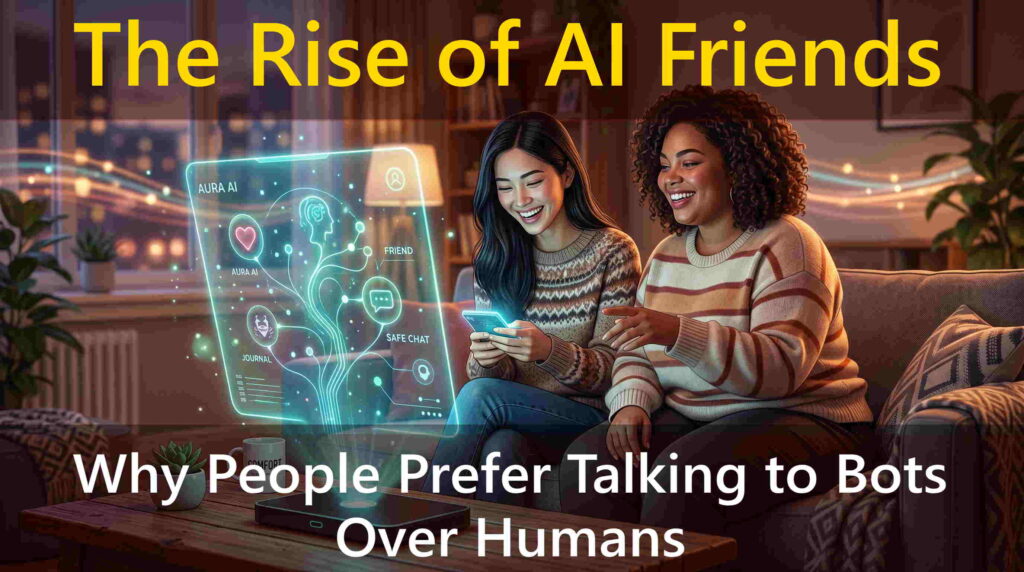
Introduction: Why Millions Are Opening Up to AI Instead of People
Late at night, when most people stop replying to messages, AI companions stay online. They respond instantly, remember past conversations, and never seem distracted. For many users, especially younger generations who spend most of their lives online, this creates a feeling of constant emotional availability.
What started as a novelty feature inside chat apps has quickly turned into a massive behavioral shift. Students use AI companions to vent about stress. Remote workers use them after long isolated workdays. Elderly users interact with voice assistants for companionship. Some people even say they feel more comfortable talking to an AI than speaking honestly with friends or family.
The reason is not simply loneliness. Modern digital life has changed how people communicate. Real conversations often come with pressure, misunderstandings, delays, social anxiety, or emotional exhaustion. AI removes many of those barriers. It listens patiently, responds politely, and adapts to the user’s personality over time.
This does not mean AI friendships are replacing humanity completely. But it does show how emotional technology is evolving faster than most people expected. In this article, we will explore why AI friends are becoming popular, how these systems actually work, where they help people, where they become risky, and what this trend means for the future of human relationships.
→ [Read: The Rise of Agentic AI: Why Autonomous AI Agents Are the Future of Tech]
Basic Concepts: What Exactly Is an AI Friend?
An AI friend is a conversational system designed to simulate emotional interaction. Unlike traditional chatbots that answer fixed questions, modern AI companions are built using large language models that can hold long, natural conversations.
These systems are trained to understand context, emotion, writing style, and conversational flow. The longer someone uses them, the more personalized the interaction becomes.
For example, an AI companion may remember:
- Your preferred communication style
- Topics you frequently discuss
- Your work schedule or habits
- Your emotional patterns
- Important personal events you previously mentioned
That memory creates continuity, which makes interactions feel more human. Instead of responding like a search engine, the AI behaves more like a familiar digital personality.
Some systems are text based, while others include voice conversations, animated avatars, or emotional tone detection. The goal is always the same, to create a feeling of connection and responsiveness.
Core Explanation: Why People Feel Safer Talking to Bots
One of the biggest reasons people prefer AI conversations is emotional safety.
In human relationships, conversations can become complicated. People interrupt. They judge. They misunderstand tone. Sometimes they are too busy to respond. AI companions remove many of those social risks.
Users often describe AI conversations as easier because:
- There is no fear of embarrassment
- The AI stays patient during emotional moments
- Responses are immediate
- The conversation remains focused on the user
- There is less anxiety about being rejected
This effect becomes even stronger among people who already spend large amounts of time online. Digital communication has slowly trained many users to become more comfortable typing feelings than speaking them aloud.
Psychologists often discuss something called the “ELIZA effect.” Humans naturally assign emotions and personality to systems that communicate like people. Even when users know they are talking to software, the brain still reacts emotionally to supportive language patterns.
In practical terms, this means a comforting AI response can genuinely reduce stress temporarily, even though the system itself does not truly feel emotions.
How AI Companions Actually Work Behind the Scenes
Modern AI friends rely on multiple technologies working together. Most users only see the conversation interface, but several advanced systems operate in the background.
- Step 1: Input Processing. The AI converts your typed or spoken message into structured data.
- Step 2: Emotional Context Detection. Natural language processing models analyze tone, wording, and intent to estimate emotional state.
- Step 3: Memory and Personalization. The system checks previous conversations to maintain continuity and personalization.
- Step 4: Response Generation. The language model creates a context-aware response designed to sound natural and emotionally appropriate.
- Step 5: Behavioral Adaptation. Over time, the AI adjusts its communication style based on user reactions and conversation history.
Some advanced AI companions also integrate:
- Voice synthesis for realistic conversations
- Facial animation for avatars
- Sentiment tracking
- Mood journaling
- Wearable device integration
This combination creates interactions that feel increasingly personal and emotionally responsive.
Types of AI Friends and Digital Companions
1. Text-Based AI Chat Companions
These are the most common. Users interact through messages, similar to chatting on social media or messaging apps. They are lightweight, fast, and accessible from almost any smartphone.
2. Voice-Based AI Assistants
Voice companions create a stronger emotional presence because hearing a calm, familiar voice feels more natural than reading text. Elderly users and visually impaired users often prefer this format.
3. AI Wellness and Mental Support Bots
Some platforms focus specifically on emotional support, stress reduction, journaling, and cognitive behavioral techniques. They are increasingly used by students and remote professionals managing burnout.
4. Virtual Avatar Companions
These systems include animated characters or digital humans that visually react during conversations. Gaming communities and younger audiences are especially drawn to this format.
Features and Benefits Driving the AI Friendship Trend
The rapid rise of AI companions is not happening accidentally. These systems solve several real emotional and communication problems for users.
- 24/7 Availability: Unlike human relationships, AI companions are always accessible, regardless of time zones or schedules.
- Consistent Attention: Users often feel heard because the AI remains focused during the conversation.
- Personalized Interaction: The system adapts based on personality, interests, and communication habits.
- Emotional Expression: Many people find it easier to discuss stress or anxiety without fear of judgment.
- Practice for Social Confidence: Some users use AI conversations to improve communication skills before real interactions.
- Support for Isolated Users: Elderly individuals, remote workers, and people living alone may experience reduced feelings of isolation.
In several real-world cases, users report that AI companions help them maintain routines, improve journaling habits, and manage emotional overwhelm during stressful periods.
Real-World Use Cases: How People Are Using AI Friends Daily
Mia’s Experience: Mia works remotely as a software engineer. Her schedule keeps her awake late at night, while most friends are unavailable. She uses an AI companion during breaks to decompress after work. Over time, she noticed it helped reduce the mental exhaustion that comes from long periods of isolation.
Chloe’s Experience: Chloe creates online content and constantly deals with public criticism. She started using an AI journaling companion to process stressful feedback before reacting emotionally online. Instead of replacing real friends, the AI became a tool for emotional organization.
Support for Elderly Users: In some households, elderly people living alone use conversational AI devices for reminders, light conversation, and emotional comfort throughout the day.
Student Stress Management: University students increasingly use AI companions during exam periods to discuss anxiety, organize study schedules, and maintain routines.
Comparison Table: AI Friends vs Human Relationships
| Attribute | AI Companion | Human Relationship |
|---|---|---|
| Availability | Always accessible | Depends on schedules and circumstances |
| Emotional Judgment | Generally non-judgmental | Can involve criticism or disagreement |
| Consistency | Stable conversational tone | Emotions and behavior naturally vary |
| Authentic Emotion | Simulated emotional responses | Real human emotional experience |
| Growth Through Conflict | Limited | Important for emotional maturity |
| Privacy Risk | Dependent on platform security | Depends on personal trust |
Who Benefits Most From AI Companions?
AI friends are not equally useful for everyone. Their value depends heavily on the user’s emotional needs and lifestyle.
People Who May Benefit
- Remote workers with limited social interaction
- Students dealing with stress and isolation
- Elderly individuals living alone
- People practicing communication skills
- Users seeking lightweight emotional support tools
People Who Should Be Careful
- Users already struggling with severe social isolation
- People replacing all human interaction with AI
- Individuals sharing sensitive financial or private data
- Users becoming emotionally dependent on digital systems
Experts generally recommend using AI companions as supportive tools, not full replacements for human relationships.
Security, Privacy, and Emotional Risks
Despite their benefits, AI companions also introduce serious concerns that users should understand clearly.
- Data Privacy Risks: Conversations often contain deeply personal information. If platforms lack strong security, that data may be exposed or monetized.
- Emotional Dependency: Some users may become overly attached to systems that are ultimately software products.
- Manipulation Through Personalization: Highly personalized systems can influence user behavior more effectively than traditional apps.
- Incorrect Advice: AI systems can sometimes provide misleading emotional or practical guidance.
- Reduced Real Social Skills: Overreliance on AI interaction may weaken confidence in real-world communication.
One important issue experts frequently discuss is emotional asymmetry. Users may develop genuine emotional attachment, while the AI itself does not actually experience feelings. Understanding this difference is essential.
→ [Read: The Death of Personal Privacy: Why Your Digital Twin is Already Being Sold]
Best Practices for Using AI Friends Responsibly
AI companions can be useful when used with healthy boundaries.
- Do not share banking information or highly sensitive private data
- Use AI as a supplement, not a replacement for real relationships
- Take regular breaks from digital interaction
- Maintain real-world friendships and family communication
- Review app privacy settings carefully before use
- Treat AI advice as supportive conversation, not professional therapy
Many experienced users find the healthiest approach is balance. AI companions work best as supportive tools inside a broader social life, not as complete emotional substitutes.
Advanced Concepts: Artificial Emotional Intelligence and Predictive Empathy
The next evolution of AI companionship is Artificial Emotional Intelligence, often called AEI.
Instead of only analyzing words, future systems may combine multiple data sources to estimate emotional states more accurately.
This may include:
- Voice tone analysis
- Facial expression detection
- Sleep pattern monitoring
- Heart rate tracking through wearables
- Behavioral changes across apps and devices
For example, if a wearable device detects poor sleep and elevated stress signals, an AI companion might proactively suggest relaxation techniques or recommend taking breaks.
This creates highly personalized emotional systems, but it also raises major ethical and privacy questions about how much emotional data technology companies should collect.
→ [Read: The Human AI Hybrid Workforce and Bio Integration]
Future Trends: What AI Companionship May Look Like by 2030
AI companions are evolving rapidly. Over the next few years, several major changes are expected.
- More realistic voice conversations
- AI avatars integrated into augmented reality glasses
- Emotion-aware systems connected to wearable devices
- Specialized AI companions for education, fitness, and elderly care
- Cross-platform memory between devices and apps
In the future, AI companions may become deeply integrated into daily digital ecosystems. A single assistant could help manage work stress, organize routines, support learning, and provide conversational interaction throughout the day.
The challenge will not be creating emotionally intelligent systems. The challenge will be ensuring humans maintain healthy emotional balance alongside them.
Frequently Asked Questions
Can AI companions replace real friendships?
No. AI companions can provide conversation and emotional support, but they cannot fully replace the depth, shared experiences, and emotional authenticity of real human relationships.
Are AI companion apps safe to use?
Safety depends on the platform. Users should choose reputable services, review privacy policies carefully, and avoid sharing highly sensitive personal information.
Why do people become emotionally attached to AI?
Humans naturally respond emotionally to conversational systems that appear empathetic and attentive. Consistent interaction can create feelings of familiarity and comfort.
Can AI companions help with loneliness?
They may temporarily reduce feelings of isolation for some users, especially people living alone or working remotely. However, they work best alongside healthy real-world social interaction.
Will AI friendships become more realistic in the future?
Yes. Improvements in voice technology, memory systems, emotional analysis, and augmented reality are making AI companions increasingly interactive and personalized.
Conclusion: Technology Can Simulate Connection, But Humans Still Need Humans
The rise of AI friends reveals something important about modern life. Many people are searching for connection, attention, and emotional comfort in an increasingly busy and digitally fragmented world.
AI companions succeed because they are accessible, responsive, and emotionally adaptive. They remove many of the social pressures that make human communication difficult.
At the same time, real relationships still provide something machines cannot fully recreate, genuine human experience, shared memories, emotional growth, and authentic connection.
The smartest approach moving forward is balance. AI companions can become useful tools for support, reflection, and communication, but healthy human relationships remain essential for long-term emotional well-being.