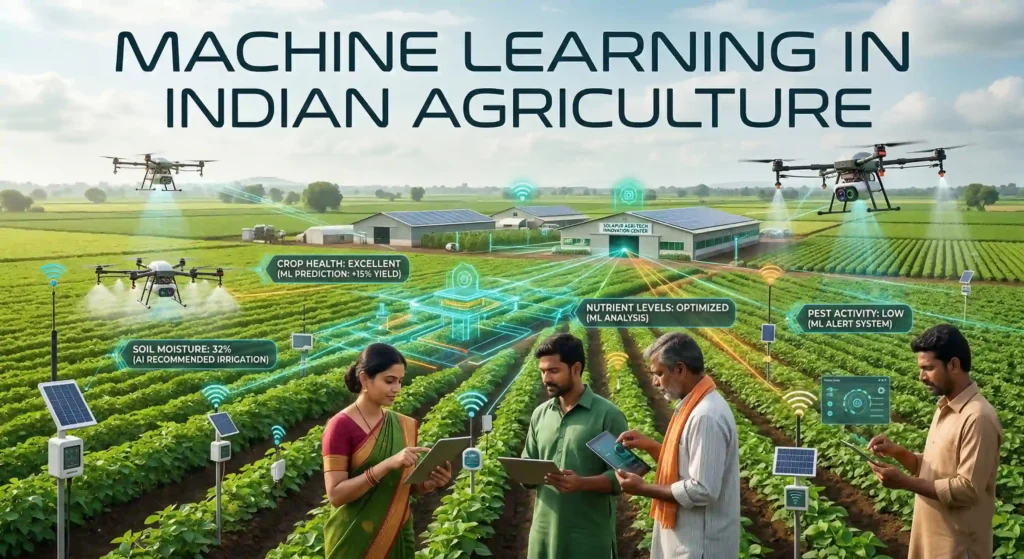
For generations, farming in India depended heavily on observation, instinct, and seasonal experience. Farmers watched cloud patterns, tested soil by touch, and relied on traditional knowledge passed through families. While this approach built deep agricultural wisdom, it also carried uncertainty. A delayed monsoon, unexpected pest attack, or sudden temperature change could damage months of hard work.
In 2026, Indian agriculture is entering a different phase. Farmers are still relying on experience, but now they are also using weather alerts, satellite data, smart irrigation systems, and machine learning powered farming apps to make faster and more informed decisions.
Machine learning is no longer limited to research labs or large technology companies. It is gradually becoming part of everyday agriculture through smartphones, drones, connected sensors, and regional language platforms. Even small farmers are starting to benefit from predictive tools that help improve crop planning, reduce waste, and lower input costs.
This shift matters because Indian agriculture faces growing pressure from climate change, rising fertilizer costs, shrinking landholdings, and water shortages. Machine learning is helping farmers respond to these challenges with data driven decision making instead of pure guesswork.
→ [Read: Digital India 2.0: The Role of AI in Modernizing Government Services]
What Machine Learning in Agriculture Actually Means
Many people imagine fully robotic farms when they hear terms like AI farming or smart agriculture. In reality, most machine learning systems in Indian agriculture are practical support tools designed to improve everyday decisions.
Machine learning is a type of software system that learns patterns from large amounts of data. Instead of following only fixed rules, it studies information such as:
- Weather history
- Soil conditions
- Crop disease patterns
- Water usage trends
- Market pricing data
- Satellite images
Based on these patterns, the system suggests actions that may improve farming outcomes.
For example, instead of watering crops on a fixed schedule, an ML based system can recommend irrigation based on real soil moisture and upcoming rainfall predictions.
Similarly, farmers can upload crop images through mobile apps to identify early disease signs before the damage spreads across the field.
In practical terms, machine learning works like a digital farming advisor that processes huge amounts of information faster than manual observation alone.
Why Indian Agriculture Needs Machine Learning in 2026
Indian farming is facing a combination of economic and environmental pressures.
- Climate conditions are becoming less predictable.
- Water resources are under pressure.
- Input costs continue increasing.
- Soil fertility is declining in many regions.
- Crop diseases spread faster due to changing weather patterns.
- Small landholdings make profit margins tighter.
Traditional farming knowledge still remains valuable, but modern farming conditions require faster analysis and better forecasting.
This is where machine learning becomes useful.
Instead of reacting after damage happens, ML systems help farmers identify risks earlier and optimize decisions before losses become severe.
For example, a farmer receiving an early pest warning can apply treatment only where required instead of spraying the entire field unnecessarily.
This reduces cost, saves time, and lowers excessive pesticide use.
The Shift Toward Precision Agriculture
One of the biggest changes machine learning brings to farming is precision agriculture.
Traditional farming methods often treat the entire field uniformly. Equal amounts of water, fertilizer, and pesticides are applied across all areas, even though soil quality and crop health may differ within the same land.
Precision agriculture changes this approach by using real time data.
Sensors, drones, and satellite imagery help identify:
- Dry areas needing irrigation
- Sections with nutrient deficiency
- Early pest infection zones
- Uneven crop growth patterns
- Areas affected by soil degradation
Machine learning systems analyze this information and generate recommendations for targeted action.
This approach improves efficiency while reducing unnecessary resource usage.
Farmers using precision farming techniques are often able to:
- Reduce water waste
- Lower fertilizer costs
- Improve crop quality
- Increase yield consistency
- Protect long term soil health
In water stressed regions, even small efficiency gains can make a major financial difference.
How Machine Learning Works on Indian Farms Step by Step
Step 1: Data Collection
Information is collected through multiple sources such as soil sensors, weather stations, drones, and satellite images.
These systems monitor:
- Soil moisture
- Temperature
- Humidity
- Nutrient levels
- Crop growth patterns
- Leaf discoloration
Step 2: Cloud Based Data Processing
The collected information is sent to cloud servers through mobile networks. Farmers do not need expensive computers because the heavy processing happens remotely.
Step 3: Machine Learning Analysis
ML models compare incoming farm data with historical agricultural datasets.
For example, the system may identify that specific leaf color changes usually appear before a pest outbreak.
Step 4: Actionable Recommendations
The farmer receives simple guidance through mobile notifications or voice based apps.
Recommendations may include:
- Best irrigation timing
- Pest prevention alerts
- Fertilizer optimization
- Harvest timing suggestions
- Weather risk warnings
Step 5: Continuous Learning
The system keeps improving as more agricultural data becomes available. Over time, recommendations become more accurate for specific crops and local conditions.
→ [Read: Top AI Cloud Providers in India 2026: Compare Specs, GPU Costs, and Tax Savings]
Key Machine Learning Technologies Used in Farming
Computer Vision for Crop Disease Detection
Farmers can upload crop photos through apps to identify diseases early. The system compares the image with trained disease datasets and suggests possible treatments.
Hyper Local Weather Forecasting
Machine learning improves weather predictions at village level accuracy, helping farmers plan irrigation, sowing, and harvesting more effectively.
Yield Prediction Systems
ML models estimate future crop production based on weather conditions, soil quality, and historical trends. This helps farmers make better selling and storage decisions.
Smart Irrigation Systems
Automated irrigation systems use soil data and weather forecasts to deliver water only when required.
Market Price Prediction Tools
Some agritech platforms now help farmers track expected crop prices across different markets, reducing the risk of poor selling decisions.
Real World Use Cases from Indian Agriculture
Cotton Farming in Maharashtra
Cotton farmers are increasingly using machine learning based pest monitoring systems. Early alerts about bollworm activity allow preventive action before large scale crop damage occurs.
This reduces pesticide overuse and lowers production costs.
Rice Farming in Southern India
Smart irrigation systems help rice farmers optimize water usage during changing rainfall conditions.
Instead of overwatering fields, irrigation timing is adjusted based on actual soil conditions.
Vegetable Farming and Market Forecasting
Vegetable farmers often face sudden price crashes due to oversupply. ML based market prediction tools help farmers decide when and where to sell produce for improved returns.
Dairy and Livestock Monitoring
Machine learning is also being used in livestock management to monitor cattle health, feeding patterns, and milk productivity.
Early disease detection reduces veterinary costs and improves farm efficiency.
→ [Read: AI-Driven Credit Scoring: How Fintech is Changing Personal Loans in 2026]
Comparison Table: Traditional Farming vs ML Powered Smart Farming
| Feature | Traditional Indian Farming | ML Powered Smart Farming |
|---|---|---|
| Decision Making | Experience based estimates | Data driven recommendations |
| Water Usage | Fixed irrigation schedules | Optimized irrigation timing |
| Disease Management | Reaction after visible damage | Early detection and prevention |
| Fertilizer Application | Uniform field treatment | Targeted nutrient management |
| Yield Prediction | Manual estimation | Predictive forecasting models |
| Market Planning | Limited price visibility | Data assisted market insights |
Benefits of Machine Learning for Indian Farmers
Reduced Farming Costs
Targeted use of fertilizers, pesticides, and irrigation helps lower unnecessary expenses.
Better Crop Productivity
Early risk identification improves crop quality and overall yield stability.
Climate Change Adaptation
Machine learning tools help farmers adjust decisions based on changing weather patterns.
Improved Financial Access
Data driven farm records can help banks and financial institutions assess agricultural risk more accurately.
Long Term Soil Protection
Efficient resource usage reduces excessive chemical application and supports healthier soil conditions over time.
Challenges and Risks That Still Exist
Rural Internet Connectivity
Some farming regions still face unstable mobile networks and limited digital infrastructure.
Digital Literacy Gaps
Many farmers require training to use mobile apps and digital farming tools effectively.
Data Ownership Concerns
As farm data becomes more valuable, questions about ownership and privacy are becoming increasingly important.
Initial Equipment Costs
Advanced sensors and drone systems can still be expensive for small farmers without financial support.
Dependence on Accurate Data
Poor quality input data can reduce the reliability of machine learning recommendations.
→ [Read: The Rise of Agentic AI in India: Why 2026 is the Year of the Digital Coworker]
Best Practices for Farmers Adopting Agritech
- Start with simple mobile tools: Begin with weather apps and disease detection platforms before investing in advanced hardware.
- Work through Farmer Producer Organizations: Shared resources reduce technology costs for small farmers.
- Maintain accurate farm records: Better data improves ML recommendation accuracy.
- Combine traditional knowledge with digital insights: Technology works best when paired with local farming experience.
- Verify recommendations carefully: Farmers should evaluate AI suggestions according to local field conditions.
Future Trends in Smart Farming Beyond 2026
The next stage of Indian agriculture will likely involve deeper integration between machine learning, automation, and connected farming systems.
Expected developments include:
- Autonomous farming equipment
- AI powered drone spraying systems
- Advanced crop genetics analysis
- Real time supply chain tracking
- Offline edge computing for remote farms
- Integrated farm to market digital platforms
Edge computing will become especially important because it allows farm devices to process information locally without constant internet dependency.
This is highly relevant for remote agricultural regions.
→ [Read: Bio-Digital Convergence: The Synthetic Biology Revolution 2026]
Conclusion
Machine learning is gradually changing the way Indian agriculture operates. Farming decisions that once depended entirely on estimation are now increasingly supported by data, predictive analytics, and smart monitoring systems.
For Indian farmers, especially small and medium landholders, this shift can improve efficiency, reduce waste, and strengthen resilience against climate uncertainty.
Technology alone will not solve every agricultural challenge, but practical machine learning tools are already proving useful in disease detection, irrigation planning, weather forecasting, and market analysis.
The future of Indian farming will likely combine traditional agricultural knowledge with modern data driven systems. Farmers who adapt gradually and use these tools wisely may gain stronger stability and better long term productivity.
Frequently Asked Questions (FAQs)
How is machine learning used in Indian agriculture?
Machine learning is used for crop disease detection, weather forecasting, irrigation management, yield prediction, and market analysis through data driven systems.
Can small farmers benefit from smart farming tools?
Yes. Many agritech tools are now available through affordable smartphone applications and shared farming cooperatives.
Does machine learning replace traditional farming knowledge?
No. Machine learning works best when combined with practical farming experience and local agricultural understanding.
What is precision agriculture?
Precision agriculture uses data and technology to apply water, fertilizers, and pesticides more efficiently according to specific field conditions.
What are the biggest challenges in adopting ML farming systems?
The major challenges include internet connectivity, digital literacy, equipment cost, and reliable data collection.
Can machine learning help with climate change risks?
Yes. ML systems help farmers adapt to changing weather conditions through predictive alerts, water optimization, and early risk detection.