For many Indians, interacting with government services once meant long queues, repeated document submissions, and multiple visits to local offices. A simple certificate or subsidy application could consume an entire day, especially for people living in rural areas or working daily wage jobs. In some cases, delays happened not because officials were unwilling to help, but because the system itself was overloaded and heavily dependent on manual processes.
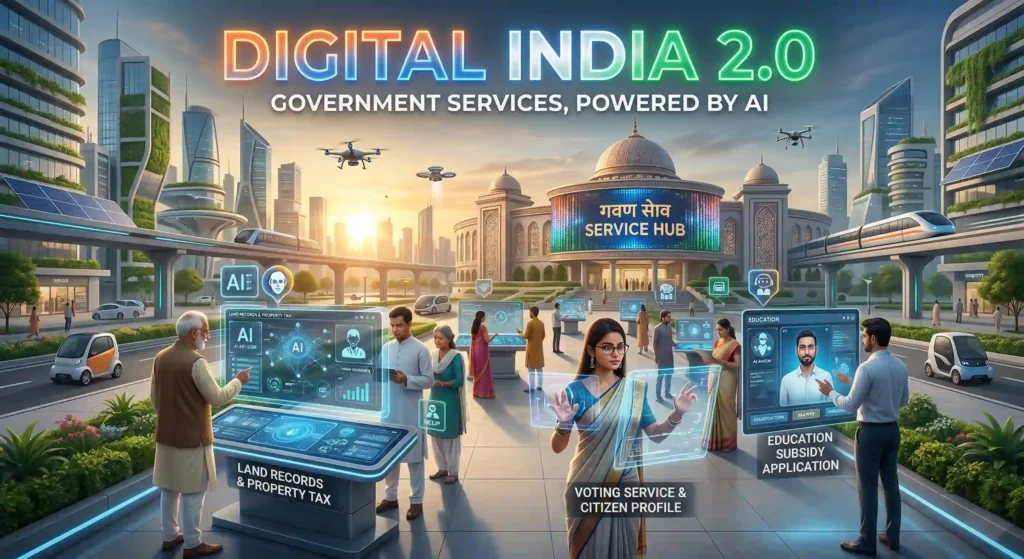
By 2026, that experience is changing rapidly. Artificial Intelligence is becoming one of the biggest forces behind the modernization of public services in India. Instead of only digitizing forms and websites, Digital India 2.0 is focused on making government systems smarter, faster, and more responsive to citizens.
Today, people can apply for schemes through mobile apps, receive multilingual support through AI chat systems, verify documents digitally, and access services without repeatedly visiting government offices. This transformation is especially important in a country as large and diverse as India, where public systems must serve millions of people across cities, towns, and villages.
What makes this shift significant is not just technology itself, but how practical it has become. AI is now helping governments reduce delays, improve transparency, detect fraud, and deliver services at scale.
Understanding Digital India 2.0 and AI Governance
The first phase of Digital India focused mainly on internet connectivity and digitization. Services that were once paper-based started moving online. Platforms such as Aadhaar, DigiLocker, FASTag, CoWIN, and UPI became part of daily life.
Digital India 2.0 builds on that foundation by introducing intelligence into government systems. Instead of simply storing information online, AI systems can now process data, understand citizen requests, identify patterns, and automate decisions where appropriate.
In practical terms, this means:
- Citizens receive faster responses to applications
- Government platforms support multiple Indian languages
- Fraudulent claims can be detected automatically
- Benefits can reach eligible users more efficiently
- Departments can analyze public issues in real time
One of the most important changes is that AI reduces dependence on repetitive manual verification. In many departments, officials previously spent hours checking documents, validating forms, and reviewing applications. AI tools now assist with these tasks, helping employees focus on more complex public service responsibilities.
KOLAACE Insight: The biggest achievement of Digital India 2.0 is not replacing human workers. It is reducing friction between citizens and government systems.
How AI-Powered Government Services Actually Work
Most citizens use AI-enabled services without even realizing it. The process often happens quietly in the background through connected databases, cloud systems, and machine learning models.
Here is a simplified step-by-step example of how a modern AI-powered public service workflow functions.
Step 1: Citizen Interaction Through Mobile or Voice
A user opens a government portal or chatbot and asks a question in their preferred language. Modern AI systems can process voice and text input in regional languages, improving accessibility for non-English users.
Step 2: Intent Recognition
The AI system identifies what the citizen wants, such as applying for a subsidy, checking pension status, downloading a certificate, or filing a complaint.
Step 3: Automated Verification
Uploaded documents are checked using AI-based OCR and verification tools. Information is matched against official databases to reduce manual processing time.
Step 4: Risk Analysis and Fraud Detection
Machine learning models analyze unusual patterns that may indicate fake claims or duplicate applications. This is especially useful in large-scale welfare programs.
Step 5: Fast Decision and Service Delivery
After validation, the request is processed quickly. Citizens receive updates through SMS, mobile apps, or email, often within hours instead of weeks.
Real-World Examples of AI in Indian Government Services
AI in governance is no longer experimental. Several use cases are already visible across India.
Smart Traffic Management
Major cities are using AI-powered traffic systems to monitor congestion and adjust traffic signals dynamically. Emergency vehicles can move more efficiently, and authorities can identify accident-prone zones using data analysis.
→ Read: How India’s New Smart Traffic Systems Work in 2026
AI in Welfare Distribution
In states affected by floods or droughts, AI systems can analyze satellite images and crop damage reports to identify eligible beneficiaries faster. This reduces delays in financial assistance.
Healthcare and Rural Diagnostics
AI tools are assisting frontline healthcare workers by analyzing reports and prioritizing high-risk cases. This is particularly valuable in regions where specialist doctors are limited.
Tax and Compliance Automation
Modern tax systems use AI to pre-fill data, detect inconsistencies, and reduce processing time. Small business owners benefit from fewer manual procedures and faster compliance workflows.
→ Read: Union Budget 2026 and AI-Based Tax Automation
Why AI is Improving Public Service Delivery
After analyzing the direction of Indian digital infrastructure over the past few years, one thing is becoming clear. AI is valuable in governance because it improves operational efficiency at massive scale.
- Faster Processing: Tasks that previously took days can now be completed in minutes.
- Better Accessibility: Multilingual support helps citizens interact in local languages.
- Reduced Corruption Risks: Automation lowers unnecessary human interference.
- Improved Transparency: Digital tracking makes applications easier to monitor.
- 24/7 Availability: Citizens no longer depend entirely on office hours.
- Scalability: Systems can handle millions of requests during peak demand.
For small businesses, startups, and independent workers, this matters significantly. Faster approvals, simplified registrations, and quicker tax processing reduce administrative burden and improve productivity.
Comparison Table: Traditional Governance vs AI-Driven Governance
| Aspect | Traditional Government Systems | AI-Driven Digital India 2.0 |
|---|---|---|
| Application Processing | Manual and time-consuming | Automated and faster |
| Language Support | Limited language accessibility | Multilingual AI interaction |
| Fraud Detection | Reactive investigations | Real-time pattern analysis |
| Citizen Support | Office-hour dependency | 24/7 chatbot and digital support |
| Document Verification | Physical checks and paperwork | AI-enabled digital verification |
| Scheme Delivery | Delayed distribution | Targeted and data-driven delivery |
Challenges and Risks That Still Exist
Despite the progress, AI in governance still faces several serious challenges.
Data Privacy Concerns
Government systems handle sensitive citizen information. Strong cybersecurity practices and data protection regulations are essential to prevent misuse.
Algorithmic Bias
If AI models are trained on incomplete or biased datasets, decisions may become unfair. Human oversight remains extremely important.
Digital Literacy Gaps
Many citizens are still unfamiliar with digital systems. Elderly users and rural populations may require additional assistance and awareness programs.
Connectivity Challenges
Some regions still struggle with stable internet access. Offline-compatible services and assisted digital centers remain necessary.
Who Benefits Most from Digital India 2.0?
AI-enabled governance has broad impact across different groups.
- Farmers: Faster access to subsidies, insurance, and crop support schemes.
- Small Businesses: Easier compliance, registrations, and digital payments.
- Students: Faster certificate verification and scholarship processing.
- Senior Citizens: Improved pension and healthcare access.
- Urban Professionals: Reduced paperwork and quicker online services.
However, people without digital access may still face difficulties. That is why assisted service centers and human support systems continue to play an important role.
Best Practices for Citizens Using AI-Based Government Platforms
- Use Official Platforms Only: Avoid fake apps or unofficial agents asking for sensitive information.
- Keep Documents Updated: Ensure Aadhaar, mobile number, and bank details are accurate.
- Verify Notifications: Double-check links and payment requests before responding.
- Learn Basic Digital Skills: Understanding simple online processes improves security and convenience.
- Track Application Status: Use official portals to monitor requests instead of depending on middlemen.
→ Read: How AI Fintech is Changing Personal Loans in 2026
Future Trends Beyond 2026
The next phase of AI-driven governance will likely focus on proactive and personalized public services.
Instead of citizens searching for schemes manually, systems may automatically identify eligibility and suggest relevant benefits. AI could also improve disaster management, environmental monitoring, and public healthcare forecasting.
Another major trend is the development of sovereign AI infrastructure within India. This includes local AI models, domestic cloud infrastructure, and secure data ecosystems designed specifically for Indian public systems.
→ Read: India’s AI Infrastructure Expansion in 2026
Conclusion
Digital India 2.0 is more than a technology upgrade. It represents a structural shift in how public services are delivered across the country.
Artificial Intelligence is helping government systems become faster, more scalable, and more citizen-focused. From document verification and multilingual support to welfare distribution and fraud detection, AI is improving efficiency in ways that directly affect daily life.
Challenges related to privacy, digital literacy, and infrastructure still need careful attention. But the overall direction is clear. Government services in India are becoming increasingly intelligent, accessible, and data-driven.
For citizens, businesses, and rural communities alike, this transformation could significantly reduce the gap between public systems and the people they are meant to serve.
Frequently Asked Questions (FAQs)
What is Digital India 2.0?
Digital India 2.0 is the next phase of India’s digital transformation strategy, focused on using AI, cloud infrastructure, automation, and multilingual systems to improve government services.
How is AI improving government services in India?
AI helps automate document verification, support regional languages, detect fraud, process applications faster, and improve public service delivery across sectors such as healthcare, taxation, and welfare schemes.
Is AI replacing government employees?
No. In most cases, AI works as a support system that reduces repetitive manual work. Human supervision is still necessary for decision-making, public interaction, and policy implementation.
Can rural citizens benefit from AI-powered public services?
Yes. AI-powered multilingual apps, voice systems, and digital assistance tools are helping rural populations access services more easily, especially in regions with limited administrative infrastructure.
What are the risks of AI in governance?
The main risks include data privacy concerns, algorithmic bias, cybersecurity threats, and unequal digital access. Proper regulation and human oversight are important for responsible implementation.