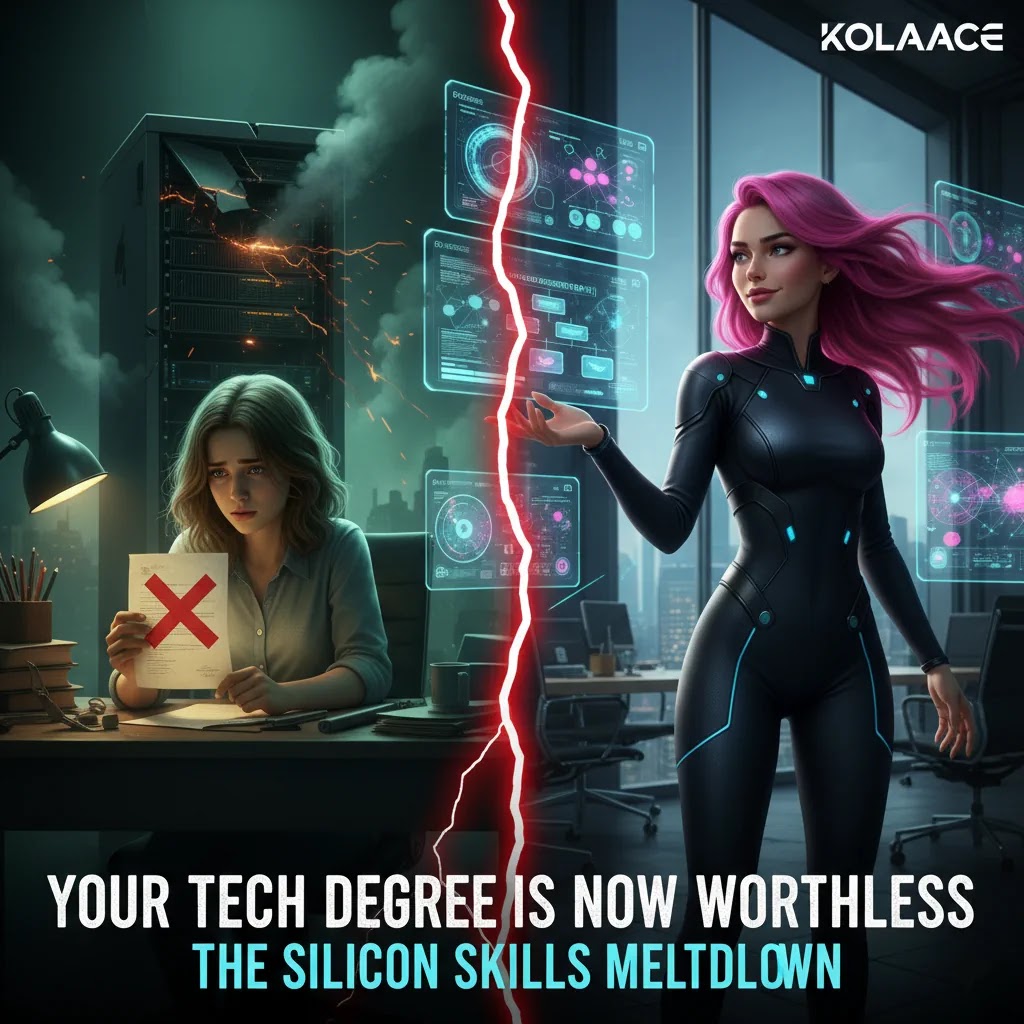
If you completed a tech degree expecting a stable, high paying job, the current market may feel confusing. Companies are hiring, but many graduates are still struggling to clear interviews or prove their value. This gap is not about intelligence. It is about relevance.
The hiring landscape in 2026 has changed faster than most academic systems. Employers are no longer impressed by degrees alone. They want professionals who can design systems, automate workflows, and work alongside AI effectively. If your skillset is limited to manual coding, you are competing with machines that already do it faster.
1. Understanding the 2026 Skill Shift
The biggest misunderstanding today is that coding equals value. In reality, coding has become a smaller part of the overall workflow. The focus has shifted to designing, validating, and scaling intelligent systems.
What Changed in Practical Terms
- Execution is automated: AI tools can write, debug, and optimize code quickly
- Decision-making is critical: Humans are needed to guide systems and define logic
- Speed matters: Companies prefer faster outcomes over perfect manual work
- Business alignment: Technical work must connect directly to revenue or efficiency
In interviews, candidates who explain system thinking often outperform those who only demonstrate coding syntax. This is a clear signal of where the industry is moving.
Skill Evolution Snapshot
| Skill Area | Current Demand | Future Relevance |
|---|---|---|
| Manual Coding | Reducing | Low |
| Prompt Design | Strong | Moderate |
| System Orchestration | Very High | Critical |
2. Why Traditional Degrees Feel Outdated
Most degree programs still focus on theory, syntax, and structured assignments. While these are useful for fundamentals, they do not prepare students for dynamic, AI-assisted environments.
For example, many graduates can write code from scratch but struggle to integrate APIs, automate workflows, or deploy real-world systems. Employers notice this gap immediately.
Common Gaps Seen in Graduates
- Limited exposure to real production environments
- Weak understanding of system integration
- Little experience with automation tools
- Focus on theory instead of execution
3. Step by Step: How to Upgrade Your Skillset
Step 1: Learn System Thinking
Start viewing problems as workflows instead of isolated tasks. Understand how data flows, where automation fits, and how systems interact.
Step 2: Use AI as a Partner
Instead of competing with AI, learn how to guide it. Practice building projects where AI handles repetitive tasks while you focus on logic and validation.
Step 3: Build Real Projects
Create systems that solve actual problems. For example, an automated lead generation tool or a content pipeline. These projects demonstrate practical value.
Step 4: Focus on Outcomes
Always connect your work to measurable results. Time saved, cost reduced, or revenue generated. This is what employers care about.
Step 5: Document Your Work
Maintain a portfolio showing how your systems work. Clear documentation builds credibility and trust.
4. Real-World Scenarios
- A freelancer automates client onboarding and reduces manual effort by half
- A startup uses AI workflows to handle customer support efficiently
- A developer builds internal tools that improve team productivity
These examples show that value comes from solving problems, not just writing code.
5. Pros and Cons of the New Skill Economy
Advantages
- Faster career growth for adaptable professionals
- More opportunities for independent work
- Higher demand for practical skills
Challenges
- Continuous learning required
- Uncertainty for those relying only on degrees
- Rapid changes in tools and workflows
6. Who Should Adapt Immediately
High Priority
- Recent graduates entering the job market
- Developers with only basic coding experience
- Professionals looking to switch roles
Lower Urgency
- Experienced engineers already working on system design
- Specialists in niche technical domains
7. Best Practices to Stay Relevant
- Focus on learning by building, not just reading
- Stay updated with industry tools and workflows
- Network with professionals working on real projects
- Continuously refine your problem-solving approach
Shift toward skill-based hiring
8. Final Takeaway
Your tech degree is not useless, but it is incomplete on its own. It gives you a foundation, not a finished skillset.
The professionals who succeed in 2026 are those who adapt quickly, build real systems, and focus on measurable outcomes. If you upgrade your approach now, you can turn the current disruption into an opportunity.
Career Survival FAQ
Is a tech degree still useful in 2026?
+
What should I learn first to stay competitive?
+
Can non-coders succeed in this environment?
+
How do I prove my skills to employers?
+