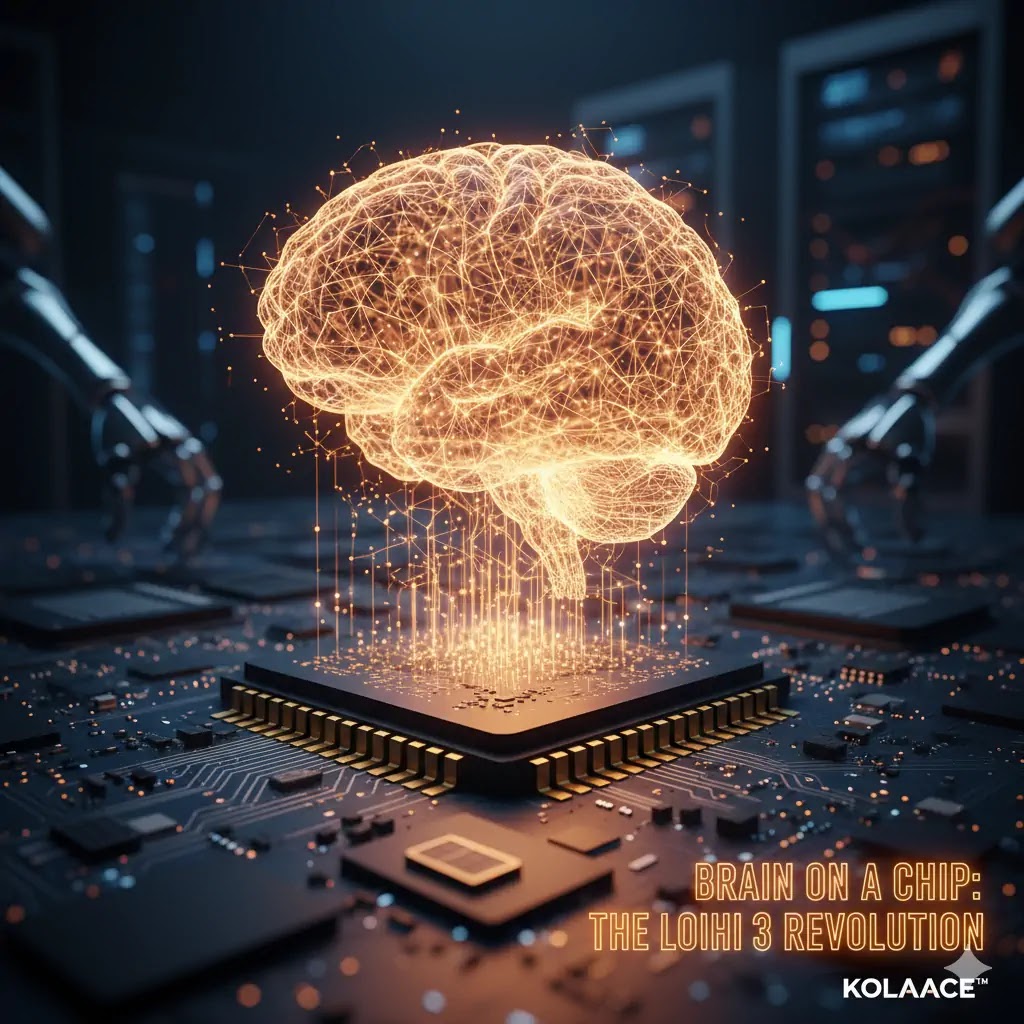
The “brute force” era of AI—defined by massive, power-hungry data centers—is facing a fundamental challenger in February 2026. The Neuromorphic Computing market has officially reached a $2.23 billion valuation this month, signaling the transition of brain-inspired silicon from the lab to the production line. Leading this charge is the commercial debut of Intel’s Loihi 3, a processor that doesn’t just execute code; it mimics the spiking neural networks of the human brain to achieve unprecedented efficiency in Agentic AI applications.
1. Intel Loihi 3: 8 Million Neurons on 4nm
Released in Q1 2026, Loihi 3 is a technical marvel fabricated on a cutting-edge 4nm process. It features 8 million digital neurons and 64 billion synapses—an 8x density increase over its predecessor. Unlike traditional chips that process frames of data, Loihi 3 uses 32-bit graded spikes. This allows it to “sleep” when no new data is present and “fire” only when a change is detected, making it perfect for the real-time perception required in Vertical City autonomous systems.
2. The 1,000x Efficiency Milestone
In 2026, the primary advantage of neuromorphic hardware is the Power-to-Intelligence ratio. While a standard GPU module may pull 300W for real-time object detection, Loihi 3 performs the same task at just 1.2W. This 1,000x efficiency gain is enabling the first generation of untethered robots—such as the ANYmal D Neuro—to operate for 72 hours on a single charge. This level of battery longevity is a prerequisite for the decentralized green energy logistics of the future.
Architecture Battle: GPU vs. Neuromorphic (2026)
| Feature | Traditional GPU | Neuromorphic (Loihi 3) |
|---|---|---|
| Compute Model | Frame-based (Continuous) | Event-based (Spiking) |
| Peak Power Draw | 300W+ | ~1.2W |
| Data Security | Cloud-dependent | On-Chip Learning |
3. Beyond 2026: Toward a $16B Market
The roadmap for neuromorphic computing is aggressive. From its $2.23 billion base in 2026, the market is projected to reach $16.15 billion by 2034. The expansion is driven by the integration of these chips into next-gen EV sensors and wearable medical diagnostics. Because these chips can learn “on the fly” without needing to re-sync with a central server, they offer a level of privacy and speed that traditional silicon simply cannot match.
Neuromorphic Market Valuation ($ Billions)
KOLAACE™ Verdict
The future of AI is not just about being “smarter”—it’s about being “sustainably smart.” Neuromorphic computing is the bridge between human-like cognitive speed and ultra-low power consumption. As we deploy these chips into Edge AI ecosystems, we are finally building machines that can truly live and learn in our world. Stay tuned to KOLAACE.com for the next chip revolution.