Imagine waking up, checking your phone, and noticing that a business you set up months ago has completed orders, answered customer queries, and delivered digital products to buyers in different time zones, all while you were asleep. Earlier, reaching this level of freedom needed a large team and serious investment. Now, things have changed completely. By 2026, the digital economy allows even a single person to run a profitable business using smart software.
The real secret of modern wealth creation is not working longer hours. It is about building systems that can scale. At the center of these systems are powerful AI tools designed to handle tasks on their own. Whether you want to earn some extra income or build a full-time online business, learning how to use these tools has become a key financial skill. This guide breaks down the top five AI tools you need to create a reliable automated income system this year.
Basic Concepts: Understanding AI Automated Income Systems
Before jumping into specific tools, it is important to understand what an automated income system actually means. In simple terms, it is a setup where your product or service is delivered and payments are collected with very little daily effort from you.
Artificial intelligence works as the engine behind this setup. Instead of hiring people to write emails, design creatives, or respond to customer queries, you use AI programs, often called agents, to handle these repetitive tasks. Your role slowly shifts from doing the work to designing and managing the system.
To understand how these systems connect with broader business strategies, you can explore how to start a business with AI automation, which gives a strong foundation for digital entrepreneurs.
The Core Explanation: The Shift from Assistants to Agents
A few years ago, AI worked mainly as an assistant. You would give a prompt, and it would create a draft that still needed editing, formatting, and publishing. It saved time but still required manual effort.
In 2026, things are different. We are now in the phase of agent-based AI. These tools do not just help, they take action. You assign a goal, and the system figures out how to complete it. It can connect with your website, social media, and even payment systems. It can run campaigns, track results, and improve its own performance using real-time data.
Understanding this shift is important. When you start using tools where autonomous AI agents are the future of technology, you begin to see real leverage in digital business.
How It Works: The Step-by-Step Blueprint
Building an automated system needs a clear approach. You cannot just install a tool and expect instant income. Here is how the process usually works:
Step 1: Identify the Market Gap
Every successful system solves a real problem. Decide what value you want to offer. It could be selling knowledge through courses, offering software services, or even curating useful products.
Step 2: Select Your Core AI Tools
Once your idea is clear, choose the AI tools that will handle content creation, marketing, and sales. Think of this as building your digital team.
Step 3: Build the Integration Architecture
Your tools must work together. When a lead is generated, it should automatically move to the sales system and then to the payment gateway. Proper API connections are the backbone of this setup.
Step 4: Launch and Feed the System
After setup, launch your system and drive initial traffic. This can be done using paid ads or SEO-based content.
Step 5: Monitor and Optimize
Your daily work becomes simple. Check analytics, identify weak points, and improve your prompts or strategy to get better results.
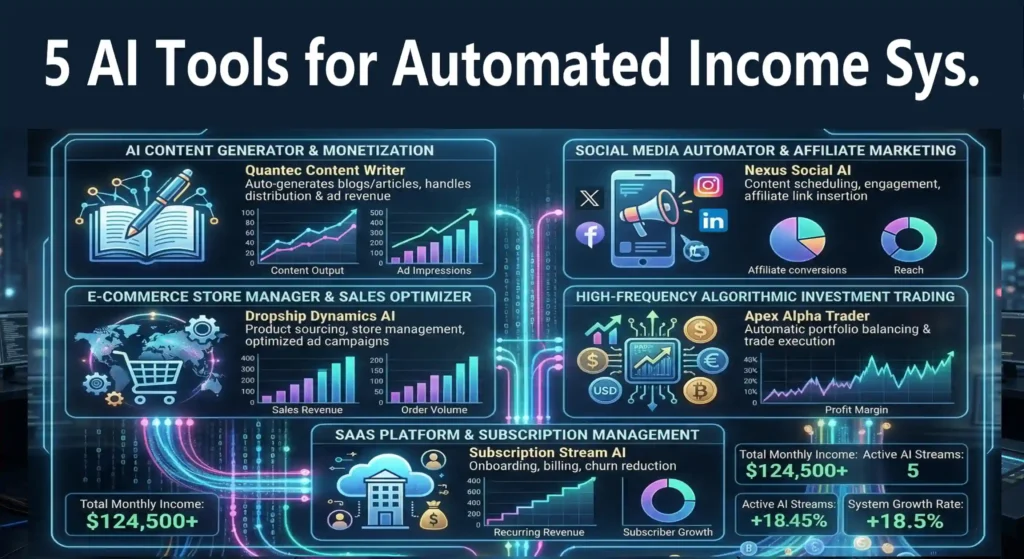
The Top 5 AI Tools for Building Your Automated Income System
There are thousands of tools available, but only a few are truly useful for building automated income. Here are the most important categories for 2026.
1. Autonomous Content Generation Engines
Traffic is essential for any online business. Content engines help you generate blog posts, images, and even publish them automatically.
These tools use advanced language models to create content that sounds natural and performs well on search engines. For example, many Indian creators now run niche blogs that post daily articles without writing everything manually. Over time, this builds steady organic traffic.
2. Agentic E-Commerce and Dropshipping Managers
If you are entering e-commerce, these tools handle everything from product discovery to delivery. If you are exploring a smart store automation blueprint, this category is essential.
They scan supplier databases, pick trending products, create listings, and adjust pricing automatically. When someone places an order, the system forwards it directly to the supplier without your involvement.
3. Conversational AI Sales Closers
Modern AI chat systems go far beyond basic FAQs. They act like trained salespeople.
They can talk to visitors in real time, understand their needs, answer questions, and guide them toward making a purchase. For example, many small Indian businesses now use WhatsApp-based AI chat systems to handle customer queries even at midnight.
4. Predictive Traffic and Social Media Schedulers
Instead of guessing what content might work, these tools analyze data and suggest what your audience wants.
They can take one long article or video and turn it into multiple short posts for different platforms. They also schedule posts at the best time for engagement, saving a lot of effort.
5. API-Driven Financial Wallets and Yield Generators
After earning money, managing it smartly is important. Tools like decentralized API wallets automate financial management.
They can split income for taxes, pay expenses, and even invest profits automatically. This helps maintain discipline without manual tracking.
Features and Benefits: The Power of AI Leverage
- Infinite Scalability: A human can handle limited tasks. An AI system can manage thousands of interactions at the same time without slowing down.
- Drastic Cost Reduction: The subscription cost of the 10 best AI automation tools for small businesses is much lower than hiring employees.
- Geographic and Temporal Freedom: Your system runs 24/7. It does not stop for weekends, holidays, or location changes.
Real-World Use Cases: Automated Income in Action
To understand the impact, let us look at practical examples.
Consider Alex, a developer who started selling digital courses. He used AI to generate tutorials and added a chat-based sales system on his website. Now, when someone visits his page, the AI answers their questions and sells the course automatically. Alex only checks performance once a week.
Another example is Marcus, who entered e-commerce. He used AI tools to find trending products, create listings, and run ads. The system handles everything from product selection to delivery. He does not manage inventory at all.
In India, many small sellers are doing something similar on platforms like Shopify and WhatsApp, using automation to handle daily operations.
Comparison Table: AI Income Tools vs. Traditional Business Software
| Feature | Traditional Business Software (2020) | Agentic AI Income Tools (2026) |
|---|---|---|
| Core Function | Supports human work such as documents and spreadsheets. | Completes tasks automatically based on defined goals. |
| Learning Curve | Needs manual setup and training. | Improves automatically using data and interaction. |
| Customer Interaction | Basic forms and fixed response systems. | Real-time conversations with understanding and persuasion. |
| Data Processing | Requires human effort to find insights. | Uses predictive analysis to highlight opportunities instantly. |
| System Integration | Needs manual API setup and regular maintenance. | Handles connections smoothly with minimal intervention. |
Security, Risks, and Challenges
While the advantages are strong, there are risks you should not ignore.
Platform Dependency Risk
If your income depends on a single tool, you are at risk. If that tool changes pricing or shuts down, your income is affected. Always control your core assets like domain and email list.
Data Privacy and Compliance
AI tools process user data. You must ensure they follow privacy laws. Use trusted tools with clear data policies and encryption.
The “Set and Forget” Fallacy
Automation does not mean zero work forever. Systems need monitoring. APIs can break, trends can change, and performance can drop if ignored.
Best Practices for Managing Your AI Tools
- Start Small and Scale Up: Begin with one process. Once stable, add more automation gradually.
- Implement Human-in-the-Loop Safeguards: For critical actions like refunds or major changes, keep a final approval step.
- Diversify Your Tech Stack: Use multiple tools and open systems where possible so you can switch if needed.
Advanced Concepts: Multi-Agent Workflows
For advanced setups, multiple AI agents can work together as a system.
For example, one agent collects market data, another designs the product, and a third handles marketing. Each performs a specific role, and together they create a complete workflow. This setup works like a small company managed by software.
Learning this approach is important for deploying autonomous business workflows.
Future Trends: What to Expect Beyond 2026
In the coming years, building these systems will become even easier. You may just describe your idea, and AI will handle everything from setup to launch.
Also, AI monetization models will focus more on personalization. Websites will adjust content, design, and pricing based on each visitor, improving conversion rates significantly.
Conclusion
The digital world in 2026 offers huge opportunities for those ready to adapt. By using the right AI tools such as content engines, e-commerce managers, sales chat systems, traffic schedulers, and financial automation tools, you can build a system that runs efficiently on its own.
Creating high-cashflow digital assets is not about quick success. It requires planning, testing, and regular monitoring. But once set up properly, it allows you to separate your time from your income. Start small, stay consistent, and gradually build your automated system.