
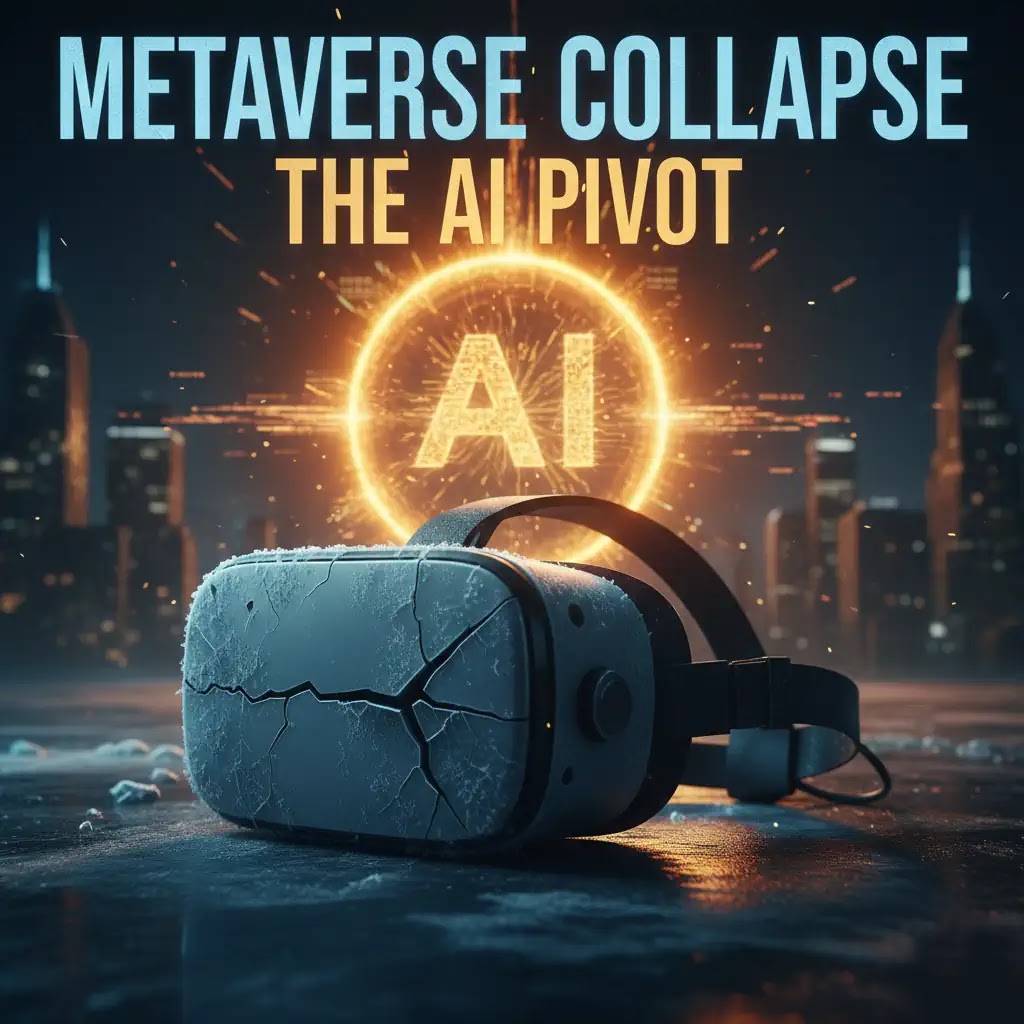
Just a couple of years ago, businesses were rushing to buy virtual land, build VR showrooms, and invest in “metaverse-first” strategies. Fast forward to 2026, and many of those projects are either paused, scaled down, or quietly shut.
This shift is not random. It is the result of hard financial realities, user behavior, and a major pivot toward Artificial Intelligence and practical spatial computing. If you are an investor, developer, or business owner, understanding this transition is critical before making your next move.
I. What Really Happened to the Metaverse Boom
The early metaverse vision promised a fully immersive digital world where people would work, shop, and socialize. But in practice, adoption lagged behind expectations. High costs, limited use cases, and user fatigue slowed growth.
One of the strongest indicators is the financial performance of major players. Meta’s Reality Labs division reported massive losses, forcing budget cuts and strategic changes. Apple’s premium headset also struggled due to pricing and usability concerns.
Why the Momentum Slowed Down
- Unclear everyday value: Most users did not find a strong reason to use VR daily.
- Hardware friction: Weight, battery, and comfort issues limited session time.
- High pricing barrier: Premium devices remained out of reach for mass adoption.
- Content gap: Lack of must-use apps reduced repeat engagement.
II. The Big Pivot: AI and Practical Spatial Computing
Instead of building fully virtual worlds, tech companies are now focusing on tools that enhance real life. This is where AI-powered glasses and spatial computing come into play.
For example, lightweight smart glasses can translate languages, capture moments, assist with navigation, and even provide real-time insights using AI. These features solve real problems, which is why adoption is growing faster compared to VR headsets.
What Changed Strategically
- Shift from virtual worlds to real-world augmentation
- Focus on daily usability instead of novelty experiences
- Integration of AI assistants into wearable devices
- Lower hardware complexity and better accessibility
III. Where the Market Still Works: Real Use Cases
While consumer VR slowed, some sectors are quietly growing and delivering measurable ROI. These are not hype-driven use cases but problem-solving applications.
High-Value Use Cases
- Industrial training: Workers learn complex tasks safely in simulated environments
- Healthcare: Surgeons practice procedures before real operations
- Retail: AR helps customers visualize products before buying
- Remote support: Experts guide technicians using AR overlays
In real-world testing, businesses using VR for training reported reduced errors and faster onboarding. This is where the technology proves its value.
| Segment | Reality Check | 2026 Direction |
|---|---|---|
| Consumer VR | Low engagement | Declining interest |
| AI Glasses | Emerging category | Rapid growth |
| Enterprise XR | Proven ROI | Scaling adoption |
IV. Step by Step: How Businesses Should Approach This Shift
If you are planning to invest in immersive tech, avoid chasing trends blindly. Use a structured approach.
Step 1: Define the Problem
Start with a real business problem. Training cost, customer experience, or remote operations.
Step 2: Choose the Right Tech
Do not default to VR. In many cases, AR or AI tools are more practical and cost-effective.
Step 3: Start Small
Run a pilot project. Measure engagement, efficiency, and ROI before scaling.
Step 4: Focus on User Comfort
Adoption depends heavily on ease of use. If the device feels uncomfortable, users will abandon it quickly.
Step 5: Integrate with Existing Systems
Ensure your solution connects with current workflows instead of replacing everything.
V. Pros and Cons of the Current Market Shift
Advantages
- More practical and user-friendly innovations
- Faster ROI in enterprise use cases
- Better alignment with real-world needs
Challenges
- Uncertainty for early metaverse investors
- Fragmented ecosystem
- Hardware still evolving
VI. Who Should Invest Now and Who Should Wait
Good Fit
- Businesses with training-heavy operations
- Healthcare and manufacturing sectors
- Companies exploring AI-driven customer experiences
Better to Wait
- Small businesses without clear use cases
- Those expecting quick profits from virtual real estate
- Projects based purely on hype
VII. Best Practices to Stay Ahead
- Prioritize usability over hype
- Track AI integration trends closely
- Invest in content, not just hardware
- Focus on measurable outcomes
Investment Shift Trend
AI driven spatial technologies are attracting more capital compared to traditional VR platforms.
VIII. Final Takeaway
The so-called metaverse collapse is not the end of immersive technology. It is a correction phase. The focus is shifting from ambitious virtual worlds to practical tools that improve real life.
For businesses and creators, this is actually a better opportunity. Instead of chasing trends, you can now build solutions that deliver real value and sustainable growth.
Frequently Asked Questions (FAQ)
