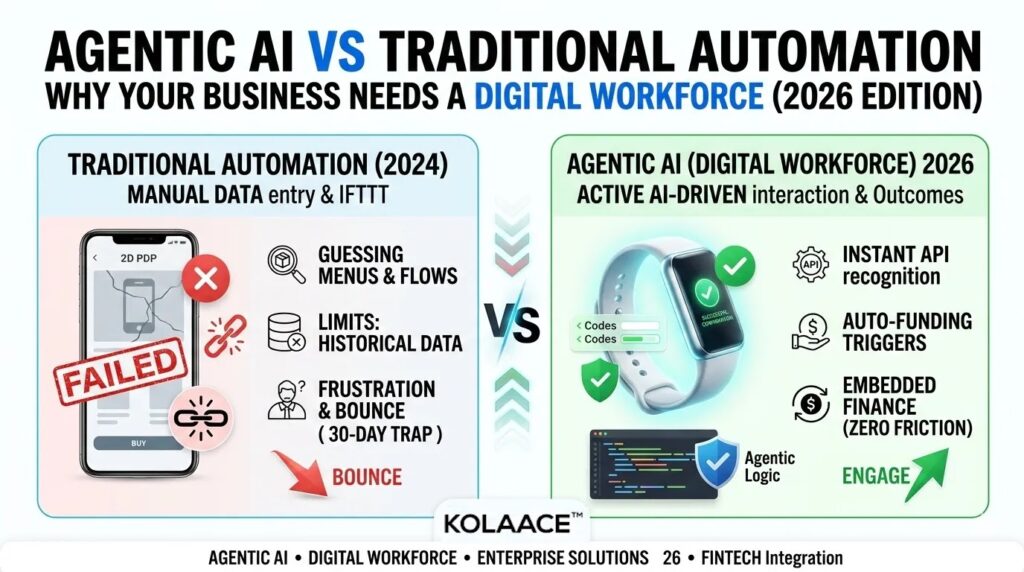
The year 2026 marks the official end of “Brittle Automation.” We’ve all been there: a minor change in a website’s UI breaks your scraping bot, or an unexpected customer query causes your chatbot to loop endlessly. These are the failures of Traditional Automation—systems that are fast but fundamentally “dumb.”
Today, the competitive edge belongs to organizations that deploy Agentic AI. These systems represent a fundamental shift from reactive programming to autonomous reasoning. They don’t just alert you to a problem; they diagnose the root cause and execute a fix before you even log in for your morning coffee.
The Structural Difference: Rules vs. Reasoning
To understand why your business needs a digital workforce, you must understand the “Intelligence Gap” between legacy systems and modern agents.
| Feature | Traditional Automation (RPA) | Agentic AI (Digital Workforce) |
|---|---|---|
| Decision Logic | Deterministic (IF/THEN) | Probabilistic & Reasoning-based |
| Exception Handling | Requires manual intervention | Self-corrects and adapts |
| Learning Ability | Static (Must be updated) | Continuous through feedback |
| Primary Goal | Perform a task | Achieve an outcome |
Market Growth: The Surge of Multi-Agent Systems
By the end of 2026, Gartner predicts that 40% of enterprise applications will have task-specific AI agents embedded natively. This is no longer a pilot project; it is the new operational standard.
Agentic AI Enterprise Adoption (2024-2026)
*Data shows the % of enterprise apps utilizing autonomous task agents.*
Why “Traditional Automation” is Failing in 2026
Traditional Robotic Process Automation (RPA) was built for a world where inputs were predictable. In 2026, inputs are dynamic. Between real-time social sentiment, fluctuating supply chain costs, and shifting regulatory (MiCA/IT Rules) landscapes, a static “if-then” rule is a liability.
If a supplier changes their invoice format, a traditional bot fails. An Agentic AI agent, however, uses visual reasoning to locate the necessary data, realizes there is a discrepancy, and emails the supplier for clarification—all without human oversight.
The Benefits of a “Digital Workforce”
- 24/7 Cognitive Capacity: Agents don’t sleep, but unlike bots, they can “think” through problems that occur at 3 AM.
- Linear Scalability: Scaling a traditional team requires hiring; scaling a digital workforce requires spinning up more agent instances on your preferred AI model.
- Strategic Re-allocation: Employees move from “doing the work” to “directing the work.” Your team becomes a squad of Agent Managers.
Conclusion: The Path to Density
The goal of the 2026 business is not just to be “big,” but to be “dense.” This means having a small, high-powered nucleus of humans directing a massive, autonomous fleet of AI agents. By moving from traditional automation to an agentic digital workforce, you reduce your technical debt and increase your innovation velocity.
Ready to secure your digital future? Ensure your agents are operating on quantum-secure frameworks to protect your autonomous workflows from the next generation of cyber threats.