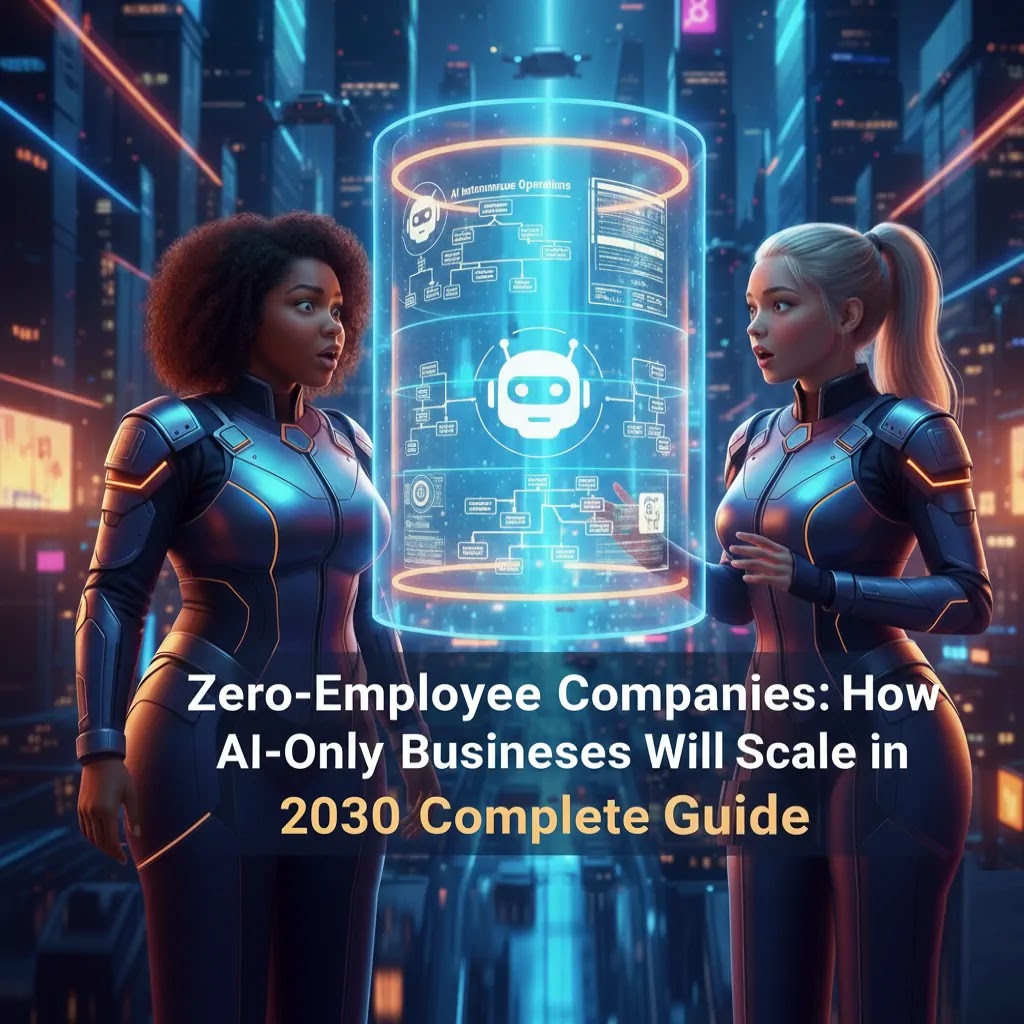
The Autonomous Business Framework
- The Shift: Founders are moving from managing people to managing systems.
- Architecture: Built on an advanced AI automation tech stack.
- Efficiency: Operating costs stay low because AI handles repetitive and data-heavy tasks.
- Outcome: Scalable income streams powered by an AI-Powered Personal Empire.
Why Zero-Employee Companies Are Gaining Momentum
Many business owners hit the same ceiling. Growth slows down because hiring, training, and managing teams becomes complex and expensive. Even profitable businesses struggle with consistency when operations depend heavily on people.
This is where AI-only companies change the model. Instead of scaling through hiring, they scale through systems. These systems are designed once, then improved continuously using data.
In practical terms, this means:
- No dependency on large teams for daily operations
- Faster decision making based on real-time data
- Ability to operate 24 by 7 without interruption
For example, a solo entrepreneur running an online store can automate product updates, customer support, ad campaigns, and even order tracking. The business continues to run even when the owner is not actively working.
Traditional vs. AI-Only Business Model
*A realistic comparison based on operational behavior, not hype.
| Metric | Traditional (Human-Led) | Zero-Employee (AI-Led) |
|---|---|---|
| Overhead Cost | High due to salaries and infrastructure | Low due to APIs and cloud tools |
| Scaling Speed | Slow, depends on hiring | Fast, systems scale instantly |
| Operational Uptime | Limited working hours | Continuous operation |
| Management Focus | People management | System optimization |
The 5 Layers of an AI-Only Company
After working with automation systems, one pattern becomes clear. Successful AI-only businesses are not random setups. They follow a structured architecture.
- 1. Strategy Layer: Tools that analyze market demand, competitors, and trends to guide decisions.
- 2. Traffic Engine: SEO, content, and ads powered by AI monetization models.
- 3. Conversion System: Chatbots, landing pages, and funnels that turn visitors into customers.
- 4. Operations Layer: Automation that handles delivery, onboarding, and support workflows.
- 5. Finance Layer: Systems for tracking revenue, expenses, and cash flow insights.
Rise of AI-Driven Businesses
Estimated share of startups operating with minimal or zero employees.
Step by Step: How to Build a Zero-Employee Business
This model works best when implemented gradually. Trying to automate everything at once often leads to confusion.
- Identify repetitive tasks: Start with areas like customer support or lead generation.
- Choose reliable tools: Focus on platforms that integrate easily with each other.
- Create clear workflows: Define what should happen at each step.
- Test and refine: Monitor outputs and fix weak points.
- Scale successful systems: Once stable, expand automation to other parts of the business.
Real Use Cases That Work Today
Digital Products Business
Creators are selling courses, templates, and digital downloads using automated funnels, email systems, and AI support tools.
Affiliate Marketing Sites
Content creation, SEO optimization, and monetization can be handled by AI workflows, reducing manual effort significantly.
Local Lead Generation
Websites that generate leads for services like plumbing or repair can run almost entirely on automated systems.
Pros and Cons of Zero-Employee Companies
Advantages
- Very low operational cost
- High scalability without hiring delays
- Consistent output quality when systems are well designed
- Freedom from daily management tasks
Limitations
- Initial setup requires time and experimentation
- Dependence on tool reliability and integrations
- Limited handling of complex human interactions
Who Should Use This Model
- Solo founders who want to scale without building large teams
- Online businesses focused on digital products or services
- Entrepreneurs comfortable with technology and systems thinking
Who Should Avoid Full Automation
- Businesses that rely heavily on personal trust and relationships
- Industries requiring strict manual verification
- Companies without clearly defined workflows
Best Practices for Sustainable Growth
- Maintain human oversight for important decisions
- Regularly audit system performance
- Focus on high-quality data inputs
- Keep improving workflows based on results
The strongest businesses in the coming years will not be those with the biggest teams, but those with the most efficient systems.
Conclusion
Zero-employee companies are not about removing humans completely. They are about redesigning how work gets done. When systems handle execution, founders can focus on strategy, creativity, and growth.
The opportunity is real, but it requires careful planning. Start with small automation wins, build reliable workflows, and scale gradually.
Frequently Asked Questions
AI can handle most operational tasks, but human guidance is still needed for strategy and major decisions.
Poor system design and low-quality data can lead to incorrect decisions and inefficiencies.
Basic automation can be set up in weeks, but a fully optimized system may take several months.
Yes, but beginners should start small and learn step by step instead of trying full automation immediately.