
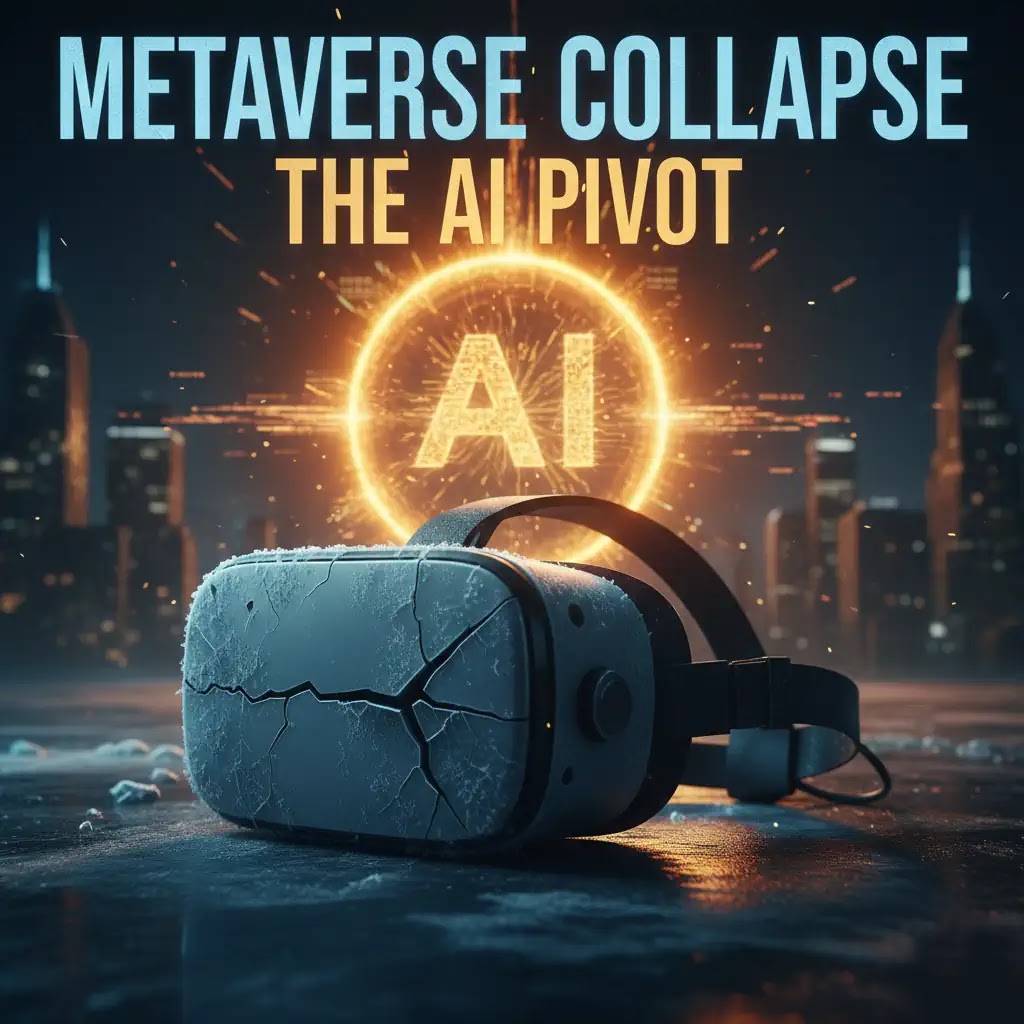
By late February 2026, the exuberant “Metaverse Gold Rush” of the early 2020s has officially frozen over. What was once hailed as the next frontier of the internet is now facing a brutal “VR/AR Winter.” Major players are slashing budgets, halting production, and pivoting their narratives toward Artificial Intelligence and Spatial Computing.
The numbers are stark. Meta’s Reality Labs, the division responsible for the Quest headsets and Horizon Worlds, reportedly faced a staggering $19.19 billion loss in 2025, leading to an official 30% budget cut for the 2026 fiscal year. Meanwhile, Apple has significantly scaled back its ambitious Vision Pro roadmap following a 95% plunge in advertising spend and a Q4 2025 shipment estimate of just 45,000 units.
I. The Big Tech Retreat: From “Metaverse” to “Personal Superintelligence”
The pivot is most visible at Meta. During the January 2026 Earnings Call, the word “Metaverse” was conspicuously absent. Instead, CEO Mark Zuckerberg introduced the concept of “Personal Superintelligence,” delivered through lightweight, AI-powered smart glasses like the Ray-Ban Meta series. These wearables, which captured unprecedented demand in 2025, represent a shift from fully immersive VR to practical, everyday AR.
Apple’s Vision Pro has also faced a reality check. Despite the launch of an M5-powered refresh in late 2025, the $3,499 price tag and “form factor fatigue” have limited its reach to high-end enterprise niches. Reports indicate that Apple’s focus has shifted toward a more affordable ($2,000) model and AI-enabled eyewear that integrates more seamlessly with the iPhone ecosystem.
Key Factors Driving the 2026 VR/AR Winter:
- High Entry Costs: Premium headsets remain out of reach for the average consumer.
- Hardware Limitations: Weight, battery life, and “tethering” issues continue to hinder long-form adoption.
- The AI Vacuum: Venture capital and corporate resources have been aggressively diverted toward Generative AI and Large Language Models.
- App Ecosystem Stagnation: Developers are hesitant to invest in platforms with small, fragmented user bases.
II. Market Data: The Shift in Investment Focus
While consumer VR is struggling, the Industrial Metaverse and Enterprise XR are showing resilient growth. Companies are finding massive ROI in VR-based surgery simulations, remote industrial troubleshooting, and high-efficiency workforce training.
VR/AR Market Performance Comparison (2024-2026)
| Segment | 2024 Status | 2026 Status (Current) |
|---|---|---|
| Consumer VR Headsets | Moderate Growth (Quest 3) | Stagnant / Declining |
| AI Smart Glasses | Niche / Experimental | High Demand / Growth |
| Enterprise Training | Early Pilots | Full Operational Deployment |
III. Visualizing the Growth: The “Winter” vs. The “Spring”
The divergence in investment between traditional Metaverse platforms and AI-integrated spatial computing is the defining trend of 2026. While hardware shipments for VR have cooled, the software ecosystem for AR-guided retail and healthcare is flourishing.
Venture Capital Inflow: VR vs. AI (2024-2026)
*Dark Purple: AI-integrated Spatial Tech | Light Purple: Pure-Play VR/Metaverse.*
IV. Conclusion: Surviving the Winter
The 2026 Metaverse Investment Collapse serves as a vital market correction. By shedding the unrealistic expectations of a fully virtual existence, the industry is forced to innovate in ways that provide immediate value. Whether through WebXR democratizing immersive content or AI-driven smart glasses becoming the new smartphone interface, the “Spring” of spatial computing will likely be more grounded, profitable, and pervasive than the Metaverse ever was. KOLAACE™ will continue to track these seismic shifts in the digital economy.