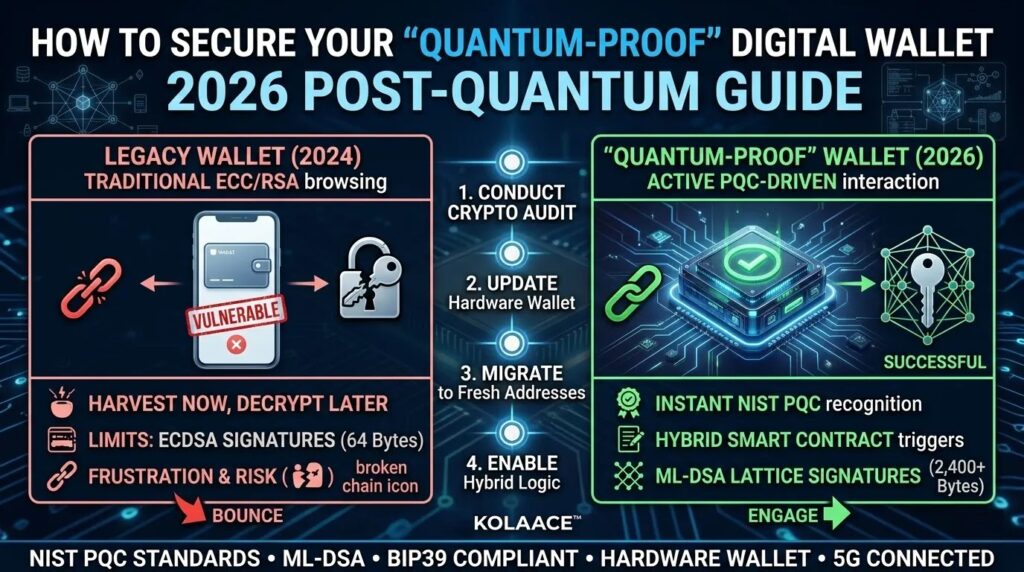
By March 2026, the threat of quantum computing has moved from science fiction to a “Board-Level Risk.” Traditional wallets relying on ECDSA (Elliptic Curve Digital Signature Algorithm) are now considered legacy systems. Much like biometric security revolutionized identity, Post-Quantum Cryptography (PQC) is revolutionizing asset preservation.
The 2026 landscape is defined by the transition to NIST-approved algorithms. If your wallet doesn’t support ML-DSA (Module-Lattice-Based Digital Signature Algorithm), your private keys are theoretically vulnerable to Shor’s algorithm, which can derive a private key from a public key in seconds.
Legacy vs. Quantum-Resistant Cryptography (2026)
The shift to PQC involves a trade-off: Security for Size. Quantum-resistant signatures are significantly larger than legacy ones, leading to higher “gas fees” but absolute mathematical resilience.
| Metric | Legacy (ECDSA/RSA) | PQC (ML-DSA/Dilithium) |
|---|---|---|
| Quantum Resilience | Zero (Broken) | High (Lattice-Based) |
| Signature Size | ~64 Bytes | 2,400+ Bytes |
| Verification Speed | Microseconds | Milliseconds |
Market Growth: The “Quantum-Ready” Infrastructure
In 2026, the adoption of “Quantum-Ready” mobile and hardware wallets has spiked as regulators mandate PQC-capable products for critical financial infrastructure.
PQC Wallet Adoption Forecast (2024-2026)
*Percentage of institutional wallets supporting NIST PQC standards.*
Step-by-Step: Securing Your Assets Against Quantum
1. Conduct a “Cryptographic Inventory”
Identify where your assets are. In 2026, older addresses are “at risk.” Use an AI-driven audit tool to scan your portfolio for Legacy Address Types (P2PKH, P2WPKH).
2. Migrate to a NIST-Compliant Hardware Wallet
By Q1 2026, manufacturers like Ledger and Trezor have shipped “Quantum Ready” firmware. These devices support:
- FIPS 203 (ML-KEM): For secure key encapsulation.
- FIPS 204 (ML-DSA): The primary replacement for lattice-based signatures.
Just as you might buy a fraction of an asset, diversify your keys.
3. Avoid Address Reuse (The “Fresh Address” Rule)
- Every time you send funds, move the remaining balance to a fresh, unused address.
- New addresses only store a hash, which is Quantum-Resistant even in 2026.
4. Enable “Hybrid Logic” in Smart Contracts
Ensure your smart contracts use Hybrid Signatures. This combines legacy ECDSA with PQC signatures, ensuring backward compatibility while providing a “Quantum Safety Net.”
Conclusion: The Era of Post-Quantum Sovereignty
Securing your digital wallet in 2026 requires Quantum Agility—the ability to rotate assets into new standards. By migrating to ML-DSA signatures and practicing strict address hygiene, you can protect your financial sovereignty.