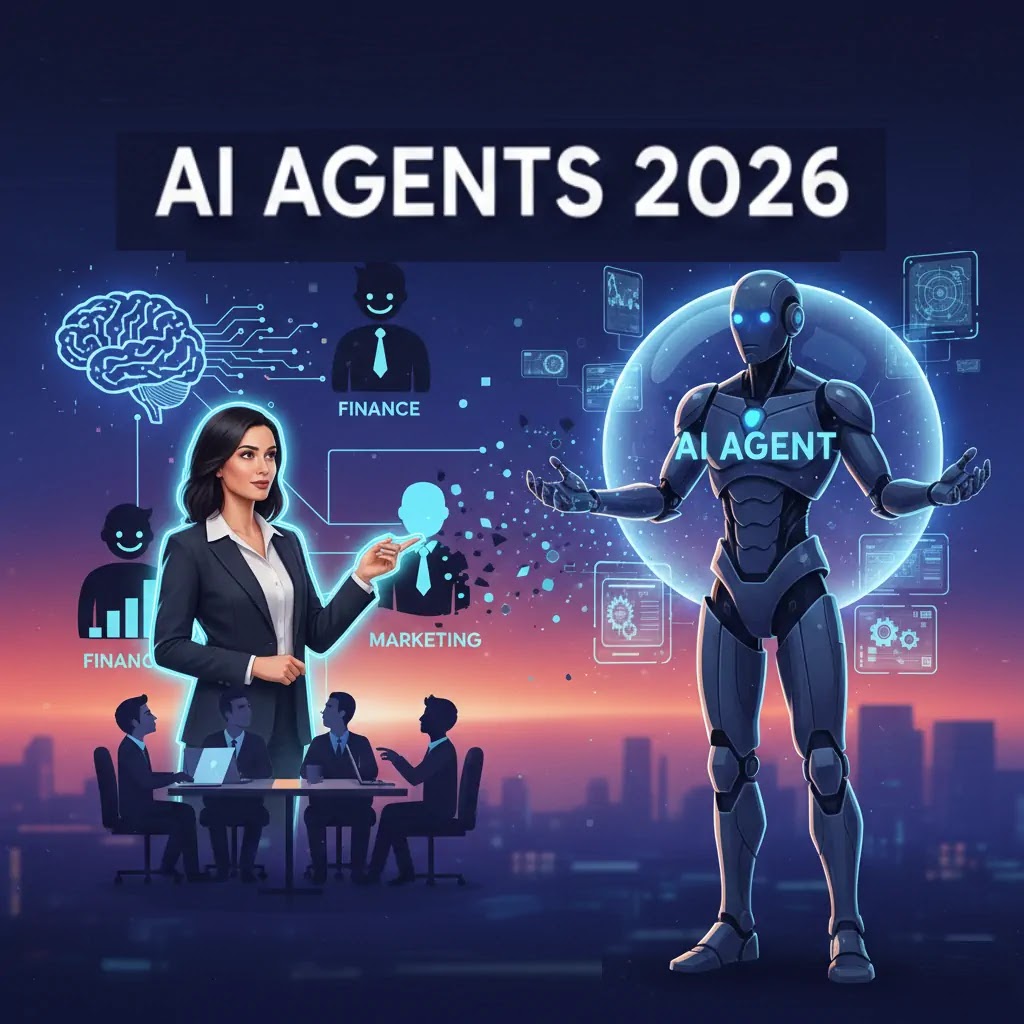
AI Agents 2026: How Autonomous Systems Will Replace Business Departments
The Autonomous Agent Era
- The Core Shift: Transitioning from manual tools to “digital employees” that think and execute.
- Efficiency Stack: Leverages an advanced AI automation tech stack.
- Scale: Agents operate 24/7, enabling a Zero-Employee Company model.
- Outcome: Instant data processing and self-optimizing revenue loops.
2026 marks the tipping point from simple automation to fully autonomous AI agents. Instead of hiring entire departments, forward-thinking companies are deploying intelligent agents capable of making decisions, executing workflows, and optimizing performance—without human supervision.
Department Evolution: Human vs. AI Agent
*Projected efficiency gains per department by 2026.
| Department | Manual Workflow | AI Agent Transformation |
|---|---|---|
| Customer Support | Human-Led Tickets | Instant 24/7 Resolution |
| Marketing | Campaign Testing | Autonomous SEO & Ad Scaling |
| Sales | Lead Prospecting | Self-Closing Lead Funnels |
| Finance | Manual Reporting | Predictive Cash Flow Optimization |
The Architecture of an Autonomous Department
In 2026, business units transform from groups of people into Multi-Agent Systems (MAS) that communicate via shared dashboards:
- Perception Layer: Agents scan market trends, competitor prices, and social signals.
- Reasoning Layer: LLMs process data to make strategic “Go/No-Go” decisions.
- Execution Layer: API integrations allow agents to publish content, buy ads, or process refunds.
- Optimization Layer: Reinforcement learning improves results every 24 hours.
AI Agent Adoption Rate (2024–2030)
Percentage of SMB operations managed by autonomous agents.
How to Orchestrate Your Intelligence Stack
For founders, success no longer comes from doing the work, but from building the Human-AI orchestration layer. You provide the vision; the agents provide the execution.
“The enterprise of 2026 will not be built around employees—it will be built around intelligent systems. Moving from hiring departments to deploying agents is the ultimate leverage.”
Frequently Asked Questions
While API costs exist, they are a fraction of the cost of a full salary, benefits, and office space for an entire department.
Customer Support and Marketing are typically the first to transition due to the high volume of digital data and repetitive decision loops.