For years, humanoid robots looked impressive in demos but failed to deliver consistent real world value. Most systems moved slowly, required expensive programming, and struggled with unpredictable environments. In 2026, that situation is changing rapidly.
The combination of advanced AI models, cheaper robotics hardware, better sensors, and edge computing has created what many researchers now call the Physical AI era. Machines are no longer limited to following fixed instructions. They can observe, reason, adapt, and perform tasks in dynamic environments.
Factories, warehouses, hospitals, and logistics companies are now testing humanoid robots outside controlled labs. What makes this moment important is not just the hardware itself, but the intelligence layer behind it.
As we observed in the rise of Agentic AI, modern AI systems are becoming capable of autonomous decision making. Physical AI extends that capability into the real world through robotics, machine vision, and action based reasoning.
1. What is Physical AI and Why Does It Matter?
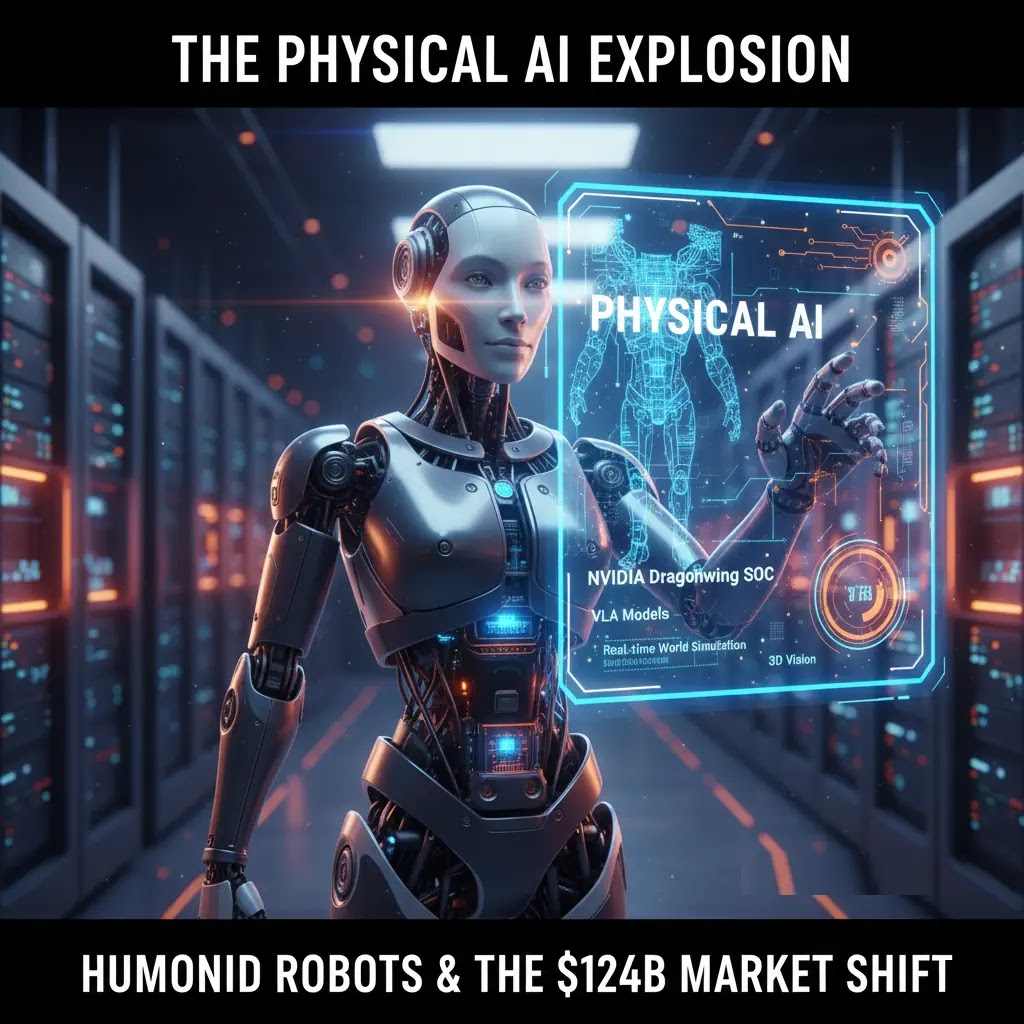
Physical AI refers to artificial intelligence systems that can interact with the physical world through robots, machines, sensors, and autonomous systems. Instead of only generating text or analyzing data, these systems can take real actions.
Earlier robotics systems depended heavily on fixed programming. Engineers had to define almost every movement and response manually. That approach worked in controlled environments but failed when situations changed unexpectedly.
Modern Physical AI systems combine:
- Computer vision for environmental awareness
- Large AI models for reasoning and planning
- Sensor fusion for movement and balance
- Real time edge computing
- Natural language understanding
- Autonomous decision making
This allows a humanoid robot to understand instructions like a human assistant instead of following rigid code paths.
For example, a warehouse robot can now recognize misplaced packages, adjust routes around obstacles, and learn repetitive workflows after observing workers.
2. The VLA Revolution: Teaching Instead of Programming
The most important breakthrough behind modern humanoid robotics is the rise of Vision Language Action models, commonly called VLA models.
Traditional robots required precise instructions for every action. Even small changes in environment often caused failures. VLA systems work differently. They learn from visual information, human demonstrations, and language prompts.
In practical terms, this means businesses can train robots faster without building complex custom software for every workflow.
Real World Example
Imagine a logistics center where workers sort packages manually. Earlier automation systems required fixed conveyor setups and carefully structured movement patterns.
With VLA powered robotics, a humanoid machine can observe how workers organize parcels, understand spoken instructions, and repeat tasks with minimal manual coding.
This is especially valuable in industries where workflows change frequently.
Manufacturing units in India, Southeast Asia, and Eastern Europe are showing growing interest because labor shortages and rising operational costs are creating pressure to automate repetitive tasks.
This progress is also linked to improvements in AI hardware performance, edge computing, and low latency networking.
3. NVIDIA vs. Qualcomm: The Silicon Battle Behind Humanoid Robotics
The software revolution in robotics would not be possible without major hardware improvements. Robotics companies now need compact chips capable of processing AI workloads locally with minimal delay.
Two companies are currently attracting the most attention in this space.
NVIDIA and Jetson Thor
NVIDIA continues to dominate high performance robotics development through its Jetson platform. The Jetson Thor architecture is optimized for simulation, computer vision, and advanced world modeling.
Researchers prefer these systems because they handle massive AI workloads efficiently.
Qualcomm and Dragonwing IQ10
Qualcomm is approaching the market differently. Its Dragonwing IQ10 Series focuses on power efficient edge AI for practical deployment.
This matters because businesses care about:
- Battery efficiency
- Heat management
- Lower operating costs
- Scalable deployment
- Compact hardware integration
The growing competition between chipmakers is reducing robotics costs faster than many analysts expected.
Only a few years ago, advanced humanoid robots cost hundreds of thousands of dollars. In 2026, several commercial systems are approaching price ranges below $30,000 for industrial deployments.
2026 Robotics Silicon: Battle for the Brain
| Feature | NVIDIA Jetson Thor | Qualcomm Dragonwing IQ10 |
|---|---|---|
| AI Performance | 1,200 FP4 TFLOPS | 700 TOPS NPU |
| Core Architecture | Blackwell Based GPU | 18 Core Oryon CPU |
| Primary Strength | Advanced Simulation | Power Efficient Edge AI |
| Best Use Case | Research Labs | Commercial Deployment |
4. Where Humanoid Robots Are Already Being Used
The public often imagines humanoid robots as futuristic assistants, but most early deployments are happening in industrial and operational environments.
Warehouse Operations
Logistics companies are testing robots for repetitive tasks such as package movement, shelf inspection, and inventory handling.
Unlike fixed robotic arms, humanoid robots can navigate spaces designed for humans.
Manufacturing Plants
Factories are using Physical AI systems for:
- Material transport
- Machine inspection
- Quality control
- Dangerous environment handling
Healthcare Assistance
Some hospitals are exploring robots for support tasks such as transporting equipment, monitoring patients, and assisting staff during repetitive workflows.
Retail and Hospitality
Customer service robots are improving slowly, though fully autonomous retail interaction still faces challenges due to unpredictable human behavior.
5. Market Analysis: Why Investors Are Watching Physical AI
The humanoid robotics market is attracting serious attention because businesses now see measurable operational value instead of experimental hype.
Several factors are accelerating adoption:
- Labor shortages in manufacturing and logistics
- Pressure to automate repetitive workflows
- Falling hardware costs
- Improved AI reasoning capabilities
- Growing demand for 24/7 operational systems
Businesses testing early deployments are focusing less on replacing humans entirely and more on increasing productivity in difficult or repetitive environments.
That distinction is important because many successful deployments involve collaboration between workers and AI systems instead of full automation.
Humanoid Robotics Market Value (2025 to 2035 Forecast)
6. Advantages and Limitations of Humanoid Robots
Major Advantages
- Can operate in human designed environments
- Reduce repetitive labor workload
- Improve operational consistency
- Enable continuous operations
- Improve dangerous task handling
Current Limitations
- Battery life remains limited
- Complex environments still create failures
- Maintenance costs can be high
- Full autonomy is not yet reliable
- Regulatory and workplace safety concerns remain unresolved
Despite the excitement, many robotics companies are still in early deployment phases. Businesses expecting fully human level robots today may be disappointed.
7. Best Practices for Businesses Exploring Physical AI
Companies interested in robotics adoption should avoid rushing into expensive deployments without evaluating operational fit.
Recommended Strategy
- Start with repetitive operational tasks
- Focus on measurable productivity gains
- Test small pilot programs first
- Prioritize safety and monitoring systems
- Train employees alongside automation systems
Businesses that treat robotics as a practical productivity tool instead of a marketing trend are more likely to achieve long term value.
Industries expected to benefit most over the next five years include logistics, industrial manufacturing, warehouse automation, and infrastructure maintenance.
8. Frequently Asked Questions
Why is 2026 considered important for humanoid robotics?
2026 marks a major transition from research focused robotics toward practical commercial testing powered by modern AI systems.
What are VLA models in robotics?
Vision Language Action models allow robots to learn tasks using visual understanding, language instructions, and real world interaction instead of rigid programming.
Are humanoid robots replacing human workers?
Most current deployments focus on assisting workers and automating repetitive tasks rather than replacing entire workforces.
Which industries are adopting Physical AI fastest?
Logistics, manufacturing, warehouse operations, and industrial automation sectors are currently moving the fastest.
What is the biggest challenge for humanoid robots today?
Reliability in unpredictable environments remains one of the biggest technical challenges for real world deployment.
KOLAACE™ Verdict
Physical AI is no longer limited to research labs or viral demonstrations. The combination of advanced AI reasoning, edge computing, better sensors, and cheaper robotics hardware is creating commercially useful humanoid systems for the first time at meaningful scale.
The biggest opportunities may not come from consumer robots but from industrial environments where repetitive tasks, labor shortages, and operational efficiency matter most. Companies building AI infrastructure, robotics hardware, edge computing platforms, and automation software are positioned to benefit as this market matures throughout the next decade.