Many Shopify stores struggle with the same issue in 2026. Traffic may be growing, product photography may look polished, and ads may be working, but conversions still feel lower than expected. In most cases, the problem is not pricing. It is product confidence.
Online shoppers still cannot touch products, test dimensions, or understand how something will look in real life. Static product pages force customers to imagine the experience themselves, and that uncertainty leads to hesitation, abandoned carts, and expensive returns.
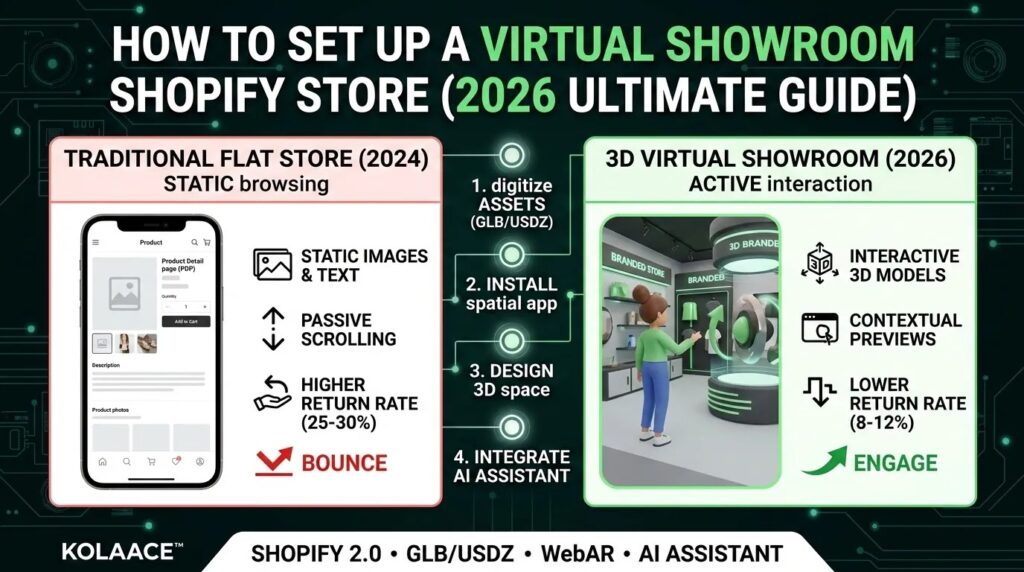
A virtual showroom changes this completely. Instead of scrolling through flat images, customers can walk through a digital environment, interact with products, zoom into details, and preview items in realistic settings. For categories like furniture, fashion, home decor, and electronics, this creates a much stronger buying experience.
After reviewing modern Shopify stores using 3D commerce tools, one pattern consistently appears. Stores that focus on immersive product visualization usually see better engagement, stronger trust signals, and higher purchase intent compared to traditional catalog style stores.
What Is a Virtual Showroom for Shopify
A virtual showroom is a digital shopping environment integrated into your Shopify store. It uses 3D product models, augmented reality, spatial navigation, or interactive product viewers to help customers experience products more naturally.
Unlike a standard product page, a virtual showroom encourages exploration. Users can move between collections, rotate products, interact with hotspots, and sometimes even test products inside their own room using AR.
In practical ecommerce terms, this helps solve several major problems:
- Customers understand product size and proportions better
- Visual products feel more premium and trustworthy
- Buyers spend longer interacting with products
- Return rates often decrease because expectations are clearer
- Small brands can compete with larger ecommerce stores visually
This approach is especially useful for businesses selling:
- Furniture and interior decor
- Luxury or premium products
- Fashion and accessories
- Consumer electronics
- Customizable products
Why Virtual Showrooms Perform Better Than Standard Product Pages
| Feature | Traditional Shopify Store | Virtual Showroom Experience |
|---|---|---|
| Product Interaction | Scrolling through images | Interactive product exploration |
| Customer Confidence | Moderate | Higher due to realistic visualization |
| Time on Site | Shorter sessions | Longer engagement sessions |
| Product Understanding | Limited | Better scale and detail perception |
| Return Risk | Higher uncertainty | Lower due to visual clarity |
One important insight many store owners overlook is that virtual showrooms are not just visual upgrades. They directly support customer decision making.
For example, a customer shopping for a sofa often wants answers to practical questions:
- Will this fit in a small apartment?
- Does the fabric look premium?
- Will the color match my wall paint?
- How large is the seating area?
A standard image gallery rarely answers these questions properly. A showroom experience can.
Step by Step Guide to Building a Shopify Virtual Showroom
1. Start With the Right Products
Do not attempt to convert your entire catalog immediately. Most successful stores begin with a small collection of high margin or visually important products.
Focus first on products where visualization strongly influences buying decisions:
- Living room furniture
- Designer lighting
- Sneakers and fashion items
- Gaming setups
- Premium accessories
This keeps costs manageable while allowing you to test customer behavior before scaling.
2. Create High Quality 3D Product Models
Your showroom quality depends heavily on the quality of your 3D assets. Poor models immediately reduce trust.
There are two common ways to create product models:
- Photogrammetry, where multiple photos are converted into a 3D object
- Professional 3D modeling using Blender or commercial design tools
For Shopify stores, optimized GLB and USDZ files are commonly used because they work well with mobile AR experiences.
During testing, one issue appears repeatedly. Store owners upload extremely heavy files that slow down loading speeds. Keep textures compressed and simplify geometry where possible.
- Avoid unnecessary polygon detail
- Compress texture files carefully
- Use mobile optimized assets
- Test on average smartphones, not only flagship devices
3. Choose a Shopify Compatible Showroom Tool
Not every business needs a full metaverse style environment. The right setup depends on your goals.
Most Shopify virtual showroom solutions fall into three categories:
- 3D product viewers for rotating and zooming products
- AR placement tools for room visualization
- Full virtual showroom builders with navigation and interaction
Small businesses should prioritize simplicity and performance instead of flashy visual effects. A fast, smooth experience usually converts better than an overloaded showroom with complicated controls.
4. Design the Showroom Like a Real Store
This is where many ecommerce brands make expensive mistakes. They focus only on technology and ignore customer flow.
Think about how customers move inside a physical retail store:
- Best selling products appear first
- Categories are organized logically
- Navigation feels intuitive
- Featured products receive visual emphasis
Your digital showroom should follow the same logic.
One effective approach for furniture stores is building room based layouts:
- Living room section
- Bedroom collection
- Home office setup
- Compact apartment solutions
This helps customers imagine products in real environments rather than isolated product cards.
5. Add Interactive Shopping Features
Interactivity is what transforms a virtual showroom from a simple 3D demo into a sales tool.
Useful interaction elements include:
- Instant add to cart buttons
- Clickable hotspots with specifications
- Material and color switching
- Zoom and rotate controls
- Live inventory visibility
- AR room placement previews
One useful ecommerce strategy is allowing users to compare multiple variations directly inside the showroom. For example, shoppers can instantly switch between leather and fabric sofa finishes without opening separate product pages.
6. Optimize for Mobile Performance
Many virtual showroom projects fail because the experience performs poorly on mobile devices.
In reality, most Shopify traffic still comes from smartphones. If your showroom stutters or loads slowly, users leave quickly.
To improve performance:
- Enable lazy loading for 3D assets
- Reduce unnecessary animations
- Use compressed texture maps
- Prioritize fast loading above visual complexity
- Test on slower internet connections
Store owners often underestimate how important loading speed is for SEO and conversions. Even immersive experiences must feel lightweight.
7. Integrate AI Assistance and Product Guidance
AI assisted shopping is becoming increasingly important for immersive commerce.
Inside a virtual showroom, AI can help users:
- Find products faster
- Compare materials
- Get sizing recommendations
- Receive room styling suggestions
- Navigate large catalogs efficiently
For example, a customer could ask for a compact dining table suitable for a small apartment and instantly see filtered recommendations inside the showroom environment.
Real World Business Use Cases
Furniture and Interior Brands
Furniture businesses benefit the most from immersive visualization because dimensions and placement matter heavily.
Customers can preview sofas, tables, or storage units in their room before buying. This reduces sizing confusion and improves buyer confidence.
Fashion and Apparel Stores
Fashion brands use virtual showrooms for lookbooks, outfit combinations, and digital try on experiences. This encourages cross selling and helps users explore complete collections.
Luxury Product Sellers
Premium brands often use showroom experiences to create exclusivity. Interactive environments make products feel more valuable than static catalog pages.
Electronics and Gaming Stores
Interactive product demos work extremely well for gaming setups, audio systems, and premium electronics where design and functionality influence purchasing decisions.
Small Business Advantage
Smaller Shopify stores can use virtual showrooms strategically instead of competing purely on advertising budgets.
A visually memorable shopping experience often creates stronger word of mouth marketing and better social sharing. In some niches, this can outperform expensive paid campaigns.
Pros and Cons of Virtual Showrooms
Advantages
- Improves product understanding significantly
- Creates stronger customer engagement
- Helps premium products stand out
- Can reduce product returns
- Supports immersive mobile shopping experiences
- Builds modern brand perception
Limitations
- Initial setup requires planning and testing
- 3D asset creation can take time
- Poor optimization may slow your store
- Not every low cost product category benefits equally
- Older mobile devices may struggle with complex scenes
The most important takeaway is that virtual showrooms should support sales goals, not distract from them. A fast and practical experience almost always performs better than a visually overloaded one.
Best Practices for Long Term Success
- Start with your best selling products before scaling
- Track analytics like interaction time and conversion rate
- Use customer feedback to improve navigation
- Keep loading times fast on mobile devices
- Update product models regularly
- Test checkout flow carefully inside immersive experiences
- Focus on usability more than visual effects
One practical recommendation is to monitor where users leave the showroom experience. Many Shopify stores discover that simplifying navigation increases conversions more effectively than adding more visual features.
Who Should Use a Shopify Virtual Showroom
Best for:
- Furniture and home decor stores
- Brands selling visually premium products
- Businesses with high product return rates
- Fashion and lifestyle brands
- Stores targeting younger digital audiences
May not be ideal for:
- Very low cost commodity products
- Stores with extremely limited technical resources
- Businesses that cannot optimize mobile performance properly
For many brands, beginning with lightweight AR previews or 3D viewers is often a smarter first step than building a full immersive environment immediately.
Conclusion
Virtual showrooms are becoming a practical ecommerce strategy rather than an experimental feature. Customers increasingly expect richer product experiences, especially in categories where visual confidence strongly influences purchases.
For Shopify store owners, the biggest opportunity is not simply adding 3D technology. It is improving product understanding, reducing uncertainty, and making online shopping feel more natural.
Stores that focus on performance, usability, and realistic customer behavior usually achieve the best results. Start small, optimize carefully, and build an experience that genuinely helps customers make faster and more confident buying decisions.
Frequently Asked Questions