In 2026, the boundary between “consumer” and “enterprise” AI has vanished. With the release of the NVIDIA RTX 50-series, featuring the Blackwell architecture, local AI performance has jumped by over 2.5x. But with great power comes great requirements. While older cards struggle with 8-bit models, the new era of FP4 quantization and 32GB VRAM is now the “minimum spec” for frontier AI applications.
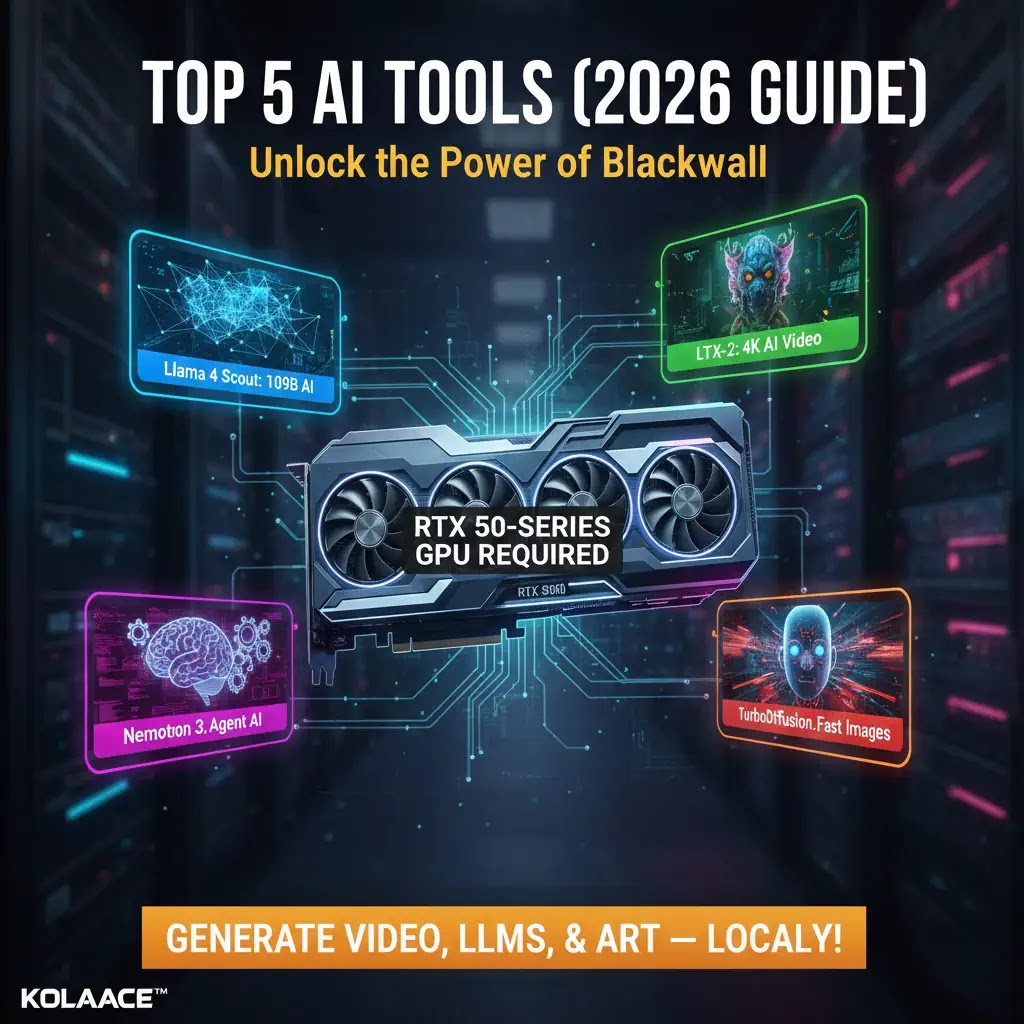
If you’ve recently upgraded your rig based on our NVIDIA 2026 Roadmap, it’s time to see what your 5th-Gen Tensor Cores can actually do. Here are the top 5 AI tools that practically require a Blackwell GPU to run effectively.
1. Llama 4 Scout (109B MoE Model)
Meta’s Llama 4 is the “headline act” of 2026. Specifically, the Scout variant uses a Mixture of Experts (MoE) architecture that demands massive VRAM for high-speed inference. While you can technically run it on older hardware, only the RTX 5090’s 32GB GDDR7 memory provides the headroom to run the quantized Q4 versions with a comfortable context window (128K+ tokens).
- Why Blackwell? Uses NVFP4 quantization to cut memory usage by 70% without losing reasoning quality.
- Performance: 45+ tokens/sec on RTX 5090 vs. ~30 on the previous generation.
2. LTX-2: Cinematic 4K AI Video Generator
The “Sora-Killer” for local machines has arrived. LTX-2 by Lightricks is an open-source audio-video foundation model that generates up to 20 seconds of synchronized 4K content at 50fps. This isn’t just a “slideshow”—it’s a production-ready cinematic tool.
Running LTX-2 at 4K resolution requires the extreme bandwidth of GDDR7 (1,792 GB/s) found in the Blackwell series. On older GDDR6X cards, the “Time to First Frame” is often three times longer, making iterative creative work impossible.
3. NVIDIA ACE: Autonomous Game Characters
If you are a developer or a modder, NVIDIA ACE (Avatar Cloud Engine) is the future. It allows game characters to perceive, plan, and act autonomously. In 2026, ACE has moved from the cloud to your local desktop.
To run the Audio2Face 3D NIM and the local LLM reasoning engine simultaneously while also playing a game like Cyberpunk 2077, you need the massive 3,352 AI TOPS of a 50-series card. Anything less will result in “brain lag” for your NPCs.
Market Growth: Local AI TOPS (Performance Trend)
The jump from Ada to Blackwell is the largest AI performance leap in GPU history.
4. TurboDiffusion (Wan 2.2 Optimized)
While standard Stable Diffusion runs on almost anything, TurboDiffusion is a new acceleration technology for the Wan 2.2 model family. It can generate 720p cinematic videos in under 40 seconds—down from 4,500 seconds on unoptimized setups.
| Model | RTX 4090 Speed | RTX 5090 Speed |
|---|---|---|
| Wan 2.2 (720p) | ~9 Minutes | ~4 Minutes |
| Wan 2.2 + Turbo | ~120 Seconds | ~40 Seconds |
5. Nemotron 3 Nano (Agentic AI Toolkit)
NVIDIA’s Nemotron 3 Nano is a 32B parameter model optimized specifically for Agentic AI—software that doesn’t just chat, but executes tasks (like organizing your files or coding a website). To use its massive 1-million token context window, the card must be able to swap data in and out of memory at lightspeed.
This tool is the ultimate “productivity booster” for 2026, allowing you to feed it your entire project directory or an entire book for real-time analysis.
— KOLAACE™ AI Labs
Conclusion: Is the RTX 50-Series Necessary?
For gaming? Maybe not yet. But for AI Sovereignty—the ability to run the world’s most powerful intelligence tools without a subscription and with total privacy—the RTX 50-series is the only way forward. As we move closer to 2027, the gap between “Blackwell owners” and everyone else will only continue to grow.