Behind every high-frame-rate game and every complex AI model lies a hidden hero: Video Memory (VRAM). As we move into 2026 and 2027, a massive “Memory War” is breaking out between two different technologies: HBM4 (High Bandwidth Memory 4) and GDDR7 (Graphics Double Data Rate 7).
While the RTX 5090 vs 6090 debate often focuses on chip speed, the memory type determines how fast data can actually reach the processor. If the memory is too slow, even the fastest GPU in the world will “stutter.” In this guide, we will explore why HBM4 is the “AI King” and why GDDR7 remains the “Gaming Champion.”
I. Technical Breakdown: The Architecture of Speed
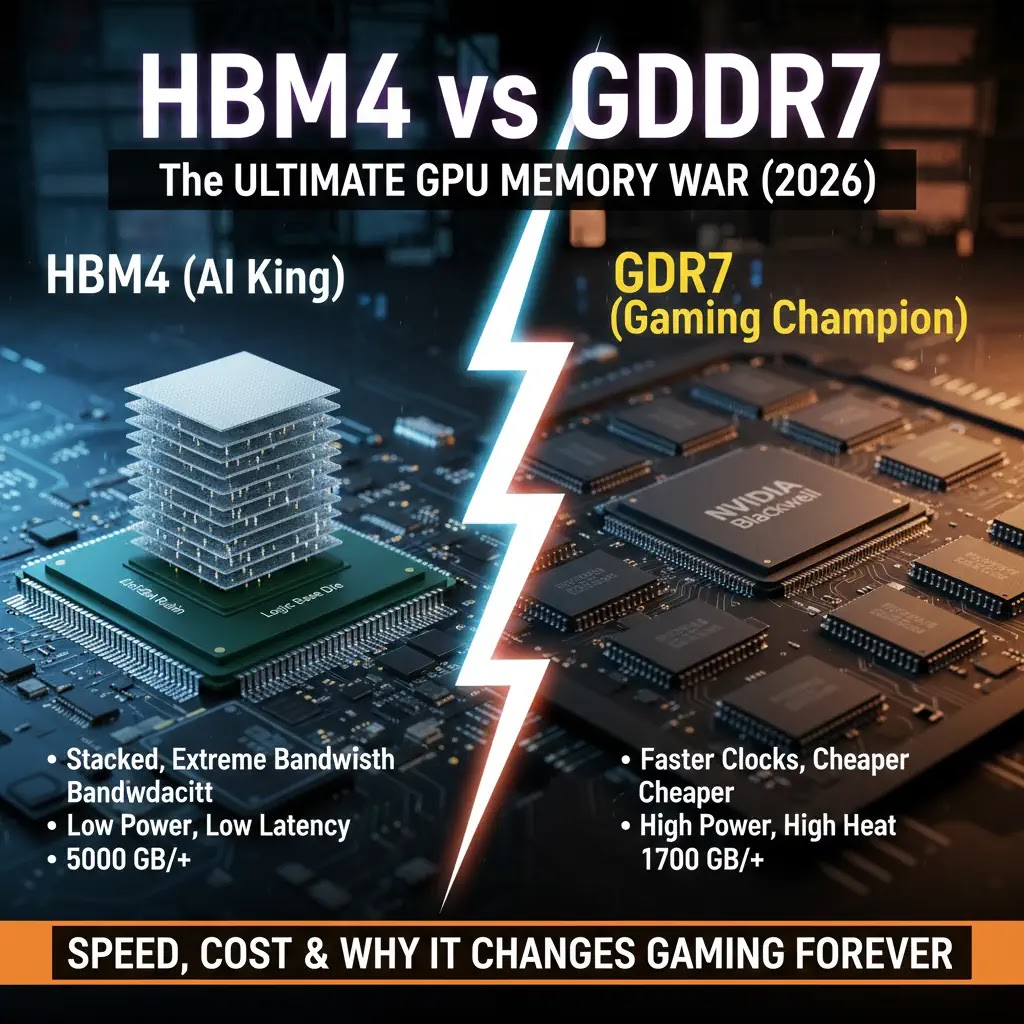
The main difference between HBM4 and GDDR7 is how they are physically built. GDDR7 is like a series of very fast trucks driving on a narrow highway. HBM4 is like a skyscraper where the floors are connected by thousands of ultra-fast elevators.
| Specification | GDDR7 (Blackwell Era) | HBM4 (Rubin Era) |
|---|---|---|
| Bus Width | 32-bit (per chip) | 2048-bit (per stack) |
| Max Bandwidth | Up to 1.5 – 2.0 TB/s | Up to 11+ TB/s |
| Power Efficiency | High (High Clocks) | Extreme (Ultra Efficient) |
| Physical Location | On the PCB (Next to GPU) | On the GPU Die (Stacked) |
II. Why GDDR7 Wins for Gaming
If HBM4 is faster, why aren’t all gaming cards using it? The answer is Cost and Complexity. As mentioned in our look at NVIDIA’s 2026 roadmap, GDDR7 is much cheaper to mass-produce. It doesn’t require “Silicon Interposers” or expensive stacking technology.
For a gamer at 4K resolution, GDDR7 provides more than enough bandwidth (the speed at which data moves) to handle high-resolution textures without the $2,000+ price tag associated with HBM-based AI cards.
Market Growth: VRAM Bandwidth Trends (GB/s)
HBM4 is entering a league of its own, primarily to serve the trillion-parameter AI models of 2027.
III. HBM4: The Secret Weapon for AI and Future Workstations
HBM4 introduces a “Logic Base Die.” For the first time, the memory isn’t just a storage unit; it has its own “brain.” This allows the memory to perform small calculations before the data even reaches the GPU. This is critical for Agentic AI and real-time reasoning tasks that will become common by 2027.
Pros of HBM4:
- Power Saving: It uses 40% less power than HBM3e while being twice as fast.
- High Capacity: Single stacks can reach 64GB, meaning a GPU could have 512GB of VRAM.
- Low Latency: Because it is physically on the GPU chip, data moves almost instantly.
IV. The “Zero-Sum Game”: How HBM4 Affects Your PC Build
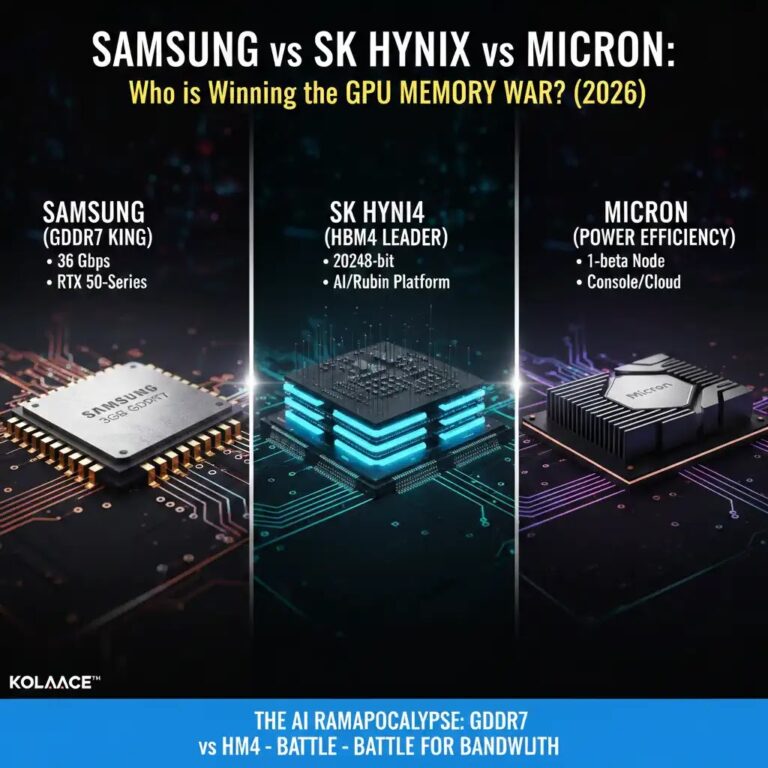
Even if you don’t buy an HBM4 card, this memory war affects you. Memory giants like Samsung and SK Hynix only have a limited amount of silicon. Because HBM4 is so profitable, they are focusing their factories on it, leaving less space for the DDR5 and GDDR7 memory used in home PCs. This is why GPU prices are expected to stay high throughout 2026.
— KOLAACE™ Supply Chain Analysis
V. Final Thoughts: Which One Should You Care About?
For 99% of gamers, GDDR7 is the future you will actually use. It will power the RTX 50-series and likely the mid-range RTX 60-series. However, HBM4 is the technology that will drive the AI revolution, making NPCs in games smarter and creative tools faster than ever before.