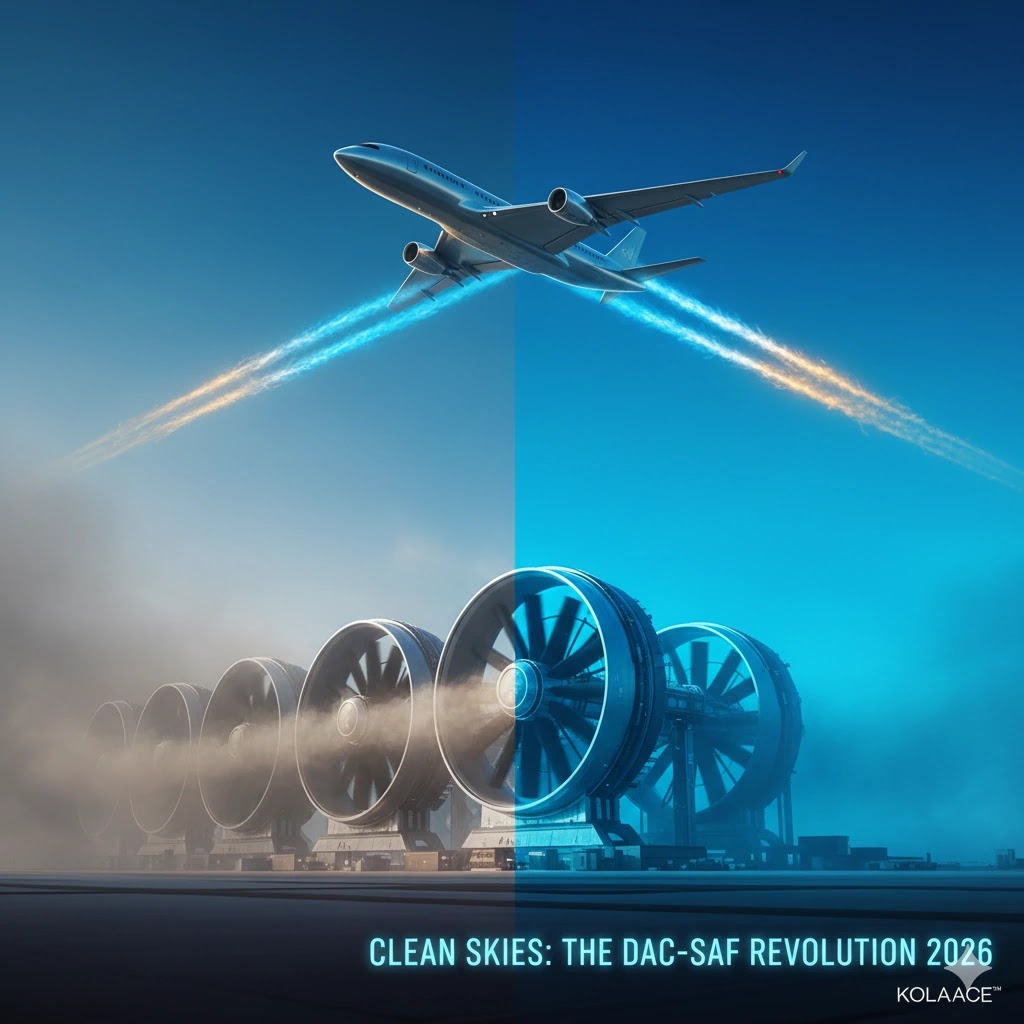
Airlines are under pressure from two sides in 2026. Governments want lower emissions, while travelers and investors increasingly expect cleaner aviation strategies. Traditional carbon offsets are no longer enough for large aviation groups trying to prove measurable environmental progress. This is why Direct Air Capture, also called DAC, has become one of the most discussed climate technologies in the energy sector.
Instead of only reducing future emissions, DAC systems actively pull existing CO2 from the atmosphere and reuse it as industrial feedstock. In aviation, that captured carbon is now being converted into Sustainable Aviation Fuel, commonly known as SAF or synthetic e-fuel. The idea sounds futuristic, but several pilot plants and commercial facilities are already scaling operations.
By February 2026, the global SAF market has crossed $4.02 billion. Much of this momentum comes from airlines preparing for stricter emissions reporting, carbon taxation frameworks, and long term fuel diversification. In practical terms, the industry is trying to reduce dependence on fossil jet fuel without redesigning every aircraft engine currently in service.
What Direct Air Capture Actually Does
Many readers confuse Direct Air Capture with normal industrial carbon capture. The difference is important. Traditional carbon capture usually traps emissions directly from factories or power plants before they enter the atmosphere. DAC works differently. It removes CO2 that is already present in ambient air.
Large fans pull air through chemical filters that selectively absorb carbon dioxide molecules. Once collected, the CO2 is heated and separated for storage or industrial use. In aviation fuel production, this captured carbon is combined with green hydrogen to create synthetic hydrocarbons that behave similarly to conventional jet fuel.
The reason this matters is simple. Airlines can continue using existing aircraft fleets while gradually lowering net emissions. That makes adoption faster compared to completely redesigning engines or replacing global airport infrastructure.
Why Airlines Are Interested in DAC Fuel
- Existing aircraft engines require minimal modification.
- Fuel logistics systems already support liquid fuels.
- Long distance aviation remains difficult to electrify.
- Governments increasingly reward lower lifecycle emissions.
- Corporate ESG reporting now affects investor confidence.
Several aviation analysts also point out that DAC fuel can help stabilize future energy security. Airlines relying only on fossil imports remain vulnerable to geopolitical supply shocks and carbon penalties.
1. Megaton Scale DAC Facilities Are Changing the Industry
The biggest transition in 2026 is scale. Earlier DAC systems were often criticized for being too expensive and too small to matter commercially. That criticism is starting to weaken as larger facilities move from experimental status into industrial deployment.
The Stratos facility is frequently referenced because it demonstrates how carbon removal can operate at megaton scale. These facilities capture atmospheric CO2 continuously and feed it into synthetic fuel manufacturing pipelines.
One practical insight many reports overlook is that location matters more than most people expect. DAC facilities require three critical things:
- Reliable renewable energy supply
- Strong industrial transport infrastructure
- Affordable long term storage or conversion capability
Regions with abundant solar or wind resources have a major advantage. Areas already investing in green hydrogen logistics networks are especially well positioned because hydrogen is necessary for synthetic fuel production.
From an operational perspective, DAC facilities behave more like chemical plants than traditional environmental projects. That shift is attracting engineering firms, infrastructure investors, and industrial automation companies rather than only climate startups.
Real World Use Cases Emerging in 2026
Several aviation hubs are testing blended SAF integration for:
- Long haul commercial flights
- Cargo aviation routes
- Military logistics operations
- Corporate aviation fleets
- Government sustainability pilot programs
Air cargo operators are particularly interested because they face increasing pressure from multinational clients demanding lower carbon supply chains.
2. AI Driven Carbon to Fuel Synthesis
Capturing CO2 is only half the challenge. Converting it into reliable aviation fuel requires extremely precise chemical engineering. In 2026, much of that optimization is being handled by AI assisted reactor systems.
Advanced process control systems monitor:
- Temperature stability
- Catalyst efficiency
- Molecular purity
- Hydrogen flow balance
- Energy consumption per fuel batch
These autonomous systems are increasingly powered by Agentic AI models capable of making real time adjustments inside industrial environments.
One interesting operational advantage is predictive maintenance. Fuel synthesis facilities contain expensive components that can cause major downtime if failures go unnoticed. AI systems now detect abnormal performance patterns early, helping operators avoid shutdowns.
This matters financially because SAF production remains expensive compared to fossil jet fuel. Any improvement in efficiency directly affects profitability.
Fuel Metrics: Fossil Jet vs. DAC Synthetic Fuel
| Metric | Fossil Jet A-1 | DAC-SAF (E-Fuel) |
|---|---|---|
| Net Carbon Impact | High Lifecycle Emissions | Lower Net Emissions Cycle |
| Engine Compatibility | Existing Standard | Compatible With Existing Fleets |
| Fuel Source | Crude Oil Extraction | Captured Atmospheric CO2 |
| Regulatory Position | Increasing Carbon Pressure | Supported by ESG Incentives |
3. Why Small Businesses Should Watch This Industry
Many people assume DAC only matters to billion dollar airlines. In reality, an entire secondary economy is forming around carbon removal and synthetic fuel infrastructure.
Small and mid sized businesses are already finding opportunities in:
- Industrial sensor manufacturing
- Heat exchange systems
- Renewable energy integration
- Carbon accounting software
- Pipeline monitoring tools
- Environmental auditing services
- AI process optimization platforms
Engineering consultancies and energy startups are particularly active because DAC projects require long term operational support. Businesses that understand energy analytics, industrial automation, or carbon compliance may see strong demand growth over the next decade.
There is also a branding angle. Companies increasingly use measurable carbon reduction partnerships to strengthen investor trust and improve ESG reporting credibility.
4. Advantages and Challenges of Direct Air Capture
Key Advantages
- Can reduce atmospheric carbon already released.
- Supports aviation without replacing aircraft fleets.
- Creates new industrial and energy investment opportunities.
- Works alongside renewable energy systems.
- Improves long term carbon compliance readiness.
Current Challenges
- Production costs are still relatively high.
- Facilities require large energy inputs.
- Infrastructure expansion takes years.
- Global regulations remain inconsistent.
- Greenwashing concerns still exist in some markets.
One important reality is that DAC is not a magical replacement for emissions reduction. Most climate experts see it as one tool within a broader transition strategy.
5. Scaling Toward a $40B Aviation Fuel Market
The growth forecasts behind Sustainable Aviation Fuel are attracting global attention. Analysts expect the market to move from $4.02 billion in 2026 toward nearly $40.09 billion by 2034.
Several forces are accelerating this shift:
- Mandatory emissions disclosure requirements
- International aviation carbon frameworks
- Corporate sustainability commitments
- Pressure from institutional investors
- Expansion of renewable hydrogen production
Future urban transport systems, including Vertical Cities, are expected to depend heavily on cleaner aviation corridors and smarter energy infrastructure.
Technologies such as solid-state battery banks may also improve grid balancing for large DAC facilities, helping stabilize renewable energy supply during peak operational periods.
Global Sustainable Aviation Fuel Market ($ Billions)
Best Practices for Evaluating DAC and SAF Companies
Investors and business leaders should look beyond marketing claims when evaluating this industry.
Important Factors to Analyze
- Energy source quality and reliability
- Verified lifecycle emissions data
- Long term storage and transport capability
- Industrial scalability
- Regulatory compliance transparency
- Third party auditing standards
Companies with measurable reporting systems and realistic deployment strategies tend to attract stronger institutional confidence compared to firms relying only on future projections.
Frequently Asked Questions
Is Direct Air Capture the same as carbon offsetting?
No. Traditional offsets often focus on preventing emissions indirectly, while DAC physically removes CO2 already present in the atmosphere.
Can DAC fuel fully replace fossil jet fuel?
Not immediately. Current production volumes are still limited, but synthetic fuel adoption is increasing steadily in commercial aviation.
Why is green hydrogen important for DAC fuel?
Captured CO2 must be combined with hydrogen to create synthetic hydrocarbons suitable for aviation fuel production. Clean hydrogen improves the overall emissions profile.
Will DAC reduce airline ticket prices?
In the short term, SAF remains more expensive than fossil fuel. However, larger production scale and regulatory incentives may gradually improve affordability.
Which industries benefit besides aviation?
Carbon capture infrastructure can also support shipping, industrial manufacturing, chemical production, energy storage, and ESG analytics services.
Final Verdict
Direct Air Capture is evolving from a niche climate experiment into a serious industrial sector with long term strategic value. The biggest shift in 2026 is not only technological. It is economic. Governments, airlines, infrastructure firms, and investors are starting to treat atmospheric carbon as a reusable resource instead of permanent waste.
Although challenges around energy demand and cost still exist, DAC powered Sustainable Aviation Fuel offers one of the few realistic pathways for reducing emissions in long distance aviation without rebuilding the global flight ecosystem from scratch.
For readers tracking future energy systems, carbon infrastructure, and industrial climate technology, this sector deserves close attention. Continue following KOLAACE Sustainability for deeper analysis on emerging clean technology trends.