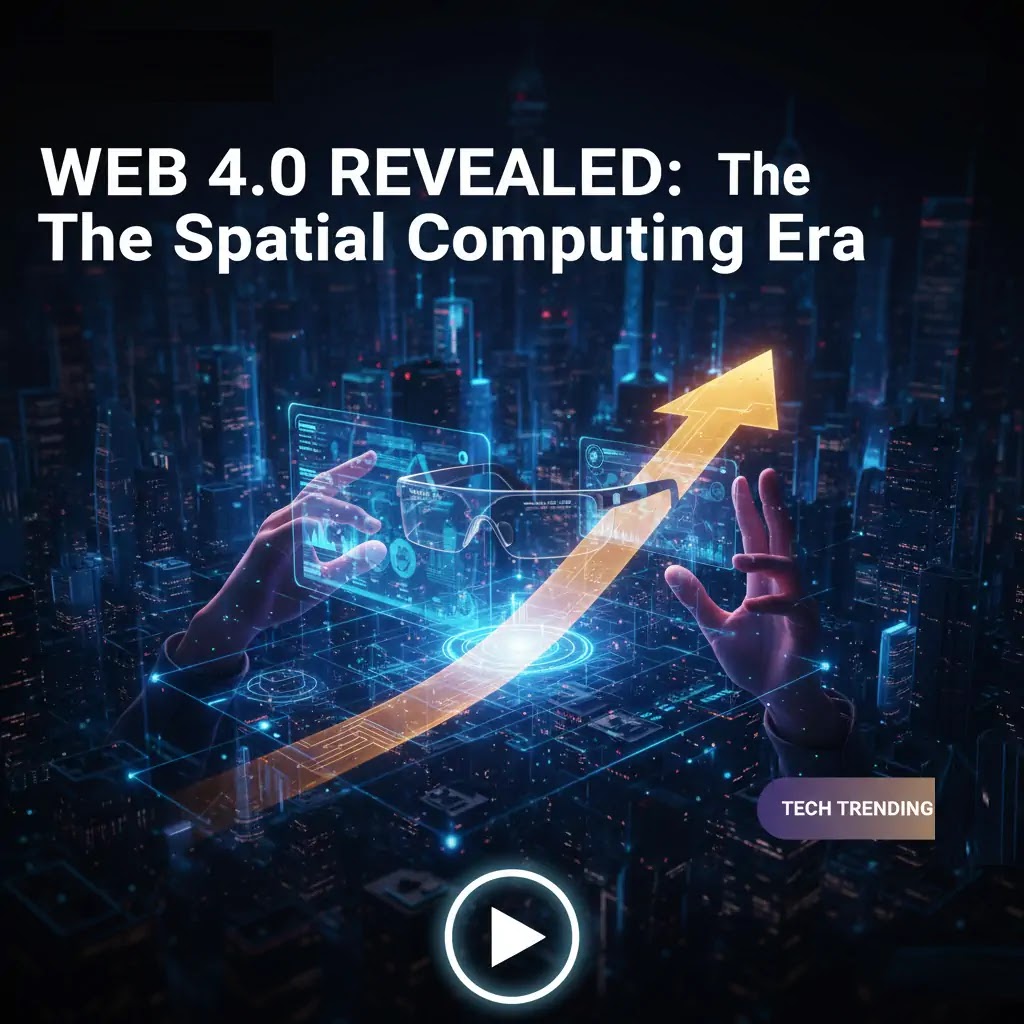
The internet is entering another major transformation. For years, people interacted with the web through keyboards, touchscreens, and mobile apps. In 2026, that model is rapidly evolving into a more immersive environment where digital experiences blend directly into physical space. This shift is widely referred to as Web 4.0, and at the center of it is spatial computing.
For businesses, creators, educators, and investors, this is not just another tech trend. It changes how people discover products, learn skills, communicate, and even work remotely. Companies that understand this transition early are positioning themselves for the next phase of digital growth.
Strategic Insight: Web 4.0 is shifting the internet from a flat screen experience into an environment-based experience where AI, augmented reality, and spatial interfaces work together in real time.
What is Web 4.0 and Why Does it Matter?
Web 4.0 represents the next stage of internet interaction where digital systems understand physical surroundings, human behavior, and contextual information more intelligently. Unlike earlier web generations that focused mainly on websites or mobile applications, Web 4.0 combines artificial intelligence, augmented reality, machine learning, wearable devices, and spatial computing into one connected ecosystem.
In practical terms, this means users no longer need to constantly switch between screens and apps. Instead, digital information appears naturally within their environment through smart glasses, mixed reality devices, voice systems, and AI-powered assistants.
For example, a technician repairing industrial equipment can see live visual instructions projected directly onto a machine. A student learning biology can interact with a 3D heart model floating above a desk. A furniture store can allow customers to place virtual products inside their living room before making a purchase.
This level of interaction is what makes spatial computing one of the most important technology shifts of the decade.
Understanding Spatial Computing in Simple Terms
Spatial computing allows devices to understand the physical world around them and respond intelligently. Instead of treating users as people sitting behind screens, the system recognizes movement, location, gestures, objects, and environmental context.
Modern spatial systems use technologies such as:
- Computer vision
- 3D mapping
- Gesture tracking
- Voice recognition
- Eye tracking
- AI-powered contextual understanding
- Augmented and mixed reality interfaces
These systems work together to create immersive digital experiences that feel more natural than traditional software interfaces.
Real World Example
Imagine a small manufacturing workshop in India. Instead of hiring an expensive external trainer, workers wear lightweight AR glasses that display live repair instructions directly on machinery. The system can identify the equipment, detect errors, and guide the user step by step visually.
This reduces downtime, improves learning speed, and helps small businesses operate more efficiently without large training costs.
Natural Interaction
Users interact using gestures, voice, eye movement, and physical positioning instead of relying only on keyboards and touchscreens.
Context Awareness
AI systems understand surroundings and provide relevant information based on location, activity, and user behavior in real time.
The Rise of Contextual AI in Web 4.0
One of the biggest breakthroughs in the Web 4.0 era is contextual AI. Earlier AI systems mainly responded to typed prompts or direct commands. Modern AI systems can now understand what users are doing, where they are, and what information may help them instantly.
This creates faster decision-making and smoother digital experiences. Instead of searching manually for instructions or data, information appears exactly when needed.
For example:
- A medical student can receive interactive anatomy guidance while studying physical models
- An architect can visualize building designs directly on construction sites
- A retail customer can receive personalized product recommendations while walking through a store
- A warehouse worker can see optimized picking routes projected in real time
From a productivity standpoint, this reduces friction between information and action. Businesses adopting contextual AI are often seeing improvements in training efficiency, customer engagement, and operational speed.
Industry Observation: Companies entering the spatial computing market early are focusing heavily on productivity tools, immersive education, remote collaboration, and real-time visualization systems.
How Businesses are Monetizing the Spatial Layer
Just as businesses moved from physical stores to websites during the internet boom, many companies are now preparing for the spatial internet economy. The goal is to build digital experiences that exist inside real-world environments.
This has created entirely new business categories and monetization opportunities.
1. Virtual Storefronts
Brands are developing immersive 3D shopping experiences where customers can browse products through augmented reality instead of static web pages.
2. Digital Air Rights
High-traffic physical locations are becoming valuable digital advertising spaces. Businesses can place virtual billboards, branded experiences, or interactive content inside AR environments.
3. Spatial Education Platforms
Educational companies are building immersive learning environments that improve engagement compared to traditional video-based learning systems.
4. Remote Collaboration Tools
Teams working across countries can collaborate inside virtual workspaces where designs, presentations, and prototypes appear in shared 3D environments.
5. Interactive Real Estate Experiences
Property developers now offer immersive walkthroughs where buyers can explore buildings remotely before construction is completed.
Why Small Businesses Should Pay Attention
Many people assume spatial computing only benefits large technology companies. In reality, smaller businesses may gain significant advantages because immersive tools reduce communication gaps and improve customer interaction.
For example, a local furniture business can allow customers to preview products inside their homes using augmented reality. A coaching institute can create interactive science demonstrations instead of relying only on textbooks. A repair workshop can use visual AI guidance to train new employees faster.
The businesses likely to benefit most include:
- Education and training companies
- Real estate firms
- E-commerce brands
- Healthcare providers
- Industrial manufacturing businesses
- Interior design companies
- Tourism and hospitality businesses
As hardware becomes cheaper and more accessible, adoption is expected to expand rapidly beyond early technology adopters.
Pros and Challenges of the Web 4.0 Era
Advantages
- More immersive digital experiences
- Faster learning and training systems
- Improved remote collaboration
- Better visualization for businesses and customers
- Context-aware AI support
- New digital business opportunities
Challenges
- Privacy and data collection concerns
- High hardware costs during early adoption
- Need for better digital infrastructure
- Potential information overload
- Regulatory uncertainty around immersive advertising
- Technical learning curve for businesses
Best Practices for Entering the Spatial Computing Market
Businesses and creators interested in Web 4.0 should focus on practical adoption rather than hype-driven experimentation.
- Start with simple augmented reality experiences before building large immersive systems
- Focus on solving real customer problems
- Prioritize usability over flashy visuals
- Use AI to improve workflow efficiency
- Study user interaction behavior carefully
- Build cross-platform experiences whenever possible
- Protect customer privacy and data transparency
Businesses that combine practical functionality with immersive experiences are more likely to succeed long term.
Who Should Explore Opportunities in Web 4.0?
The Web 4.0 ecosystem is creating opportunities for multiple industries and skill sets.
- Developers building AR and VR applications
- Educators creating immersive learning content
- Designers specializing in 3D interfaces
- Businesses improving customer experiences
- Investors tracking next-generation technology sectors
- Creators producing interactive digital assets
- Entrepreneurs building AI-powered productivity tools
People who understand how AI, spatial interfaces, and immersive environments connect together will likely have a major advantage in the coming years.
Conclusion
Web 4.0 is transforming the internet from a screen-based experience into a spatial and context-aware environment. The combination of artificial intelligence, augmented reality, and immersive computing is reshaping how people work, learn, shop, and interact digitally.
While the technology is still evolving, the direction is becoming increasingly clear. Businesses that adapt early and focus on practical value creation may benefit significantly as spatial computing becomes more mainstream. The future internet is not limited to phones and laptops anymore. It is gradually becoming part of the physical world around us.
Follow our blog for more insights on AI, digital business trends, spatial computing, and the future of technology.
Frequently Asked Questions
What is the difference between Web 3.0 and Web 4.0?
Web 3.0 mainly focused on decentralization and blockchain-based ownership. Web 4.0 expands further by combining AI, spatial computing, and immersive real-world interaction.
What devices are used in spatial computing?
Spatial computing systems typically use AR glasses, mixed reality headsets, sensors, cameras, wearable devices, and AI-powered software interfaces.
Can small businesses benefit from Web 4.0?
Yes. Small businesses can use augmented reality, immersive customer experiences, and AI-driven training systems to improve engagement and efficiency.
Is Web 4.0 already active in 2026?
Many early Web 4.0 technologies are already being used in education, healthcare, manufacturing, retail, and remote collaboration environments.
What skills are valuable in the spatial computing industry?
Skills related to AI, 3D design, augmented reality development, user experience design, machine learning, and immersive content creation are becoming increasingly valuable.