
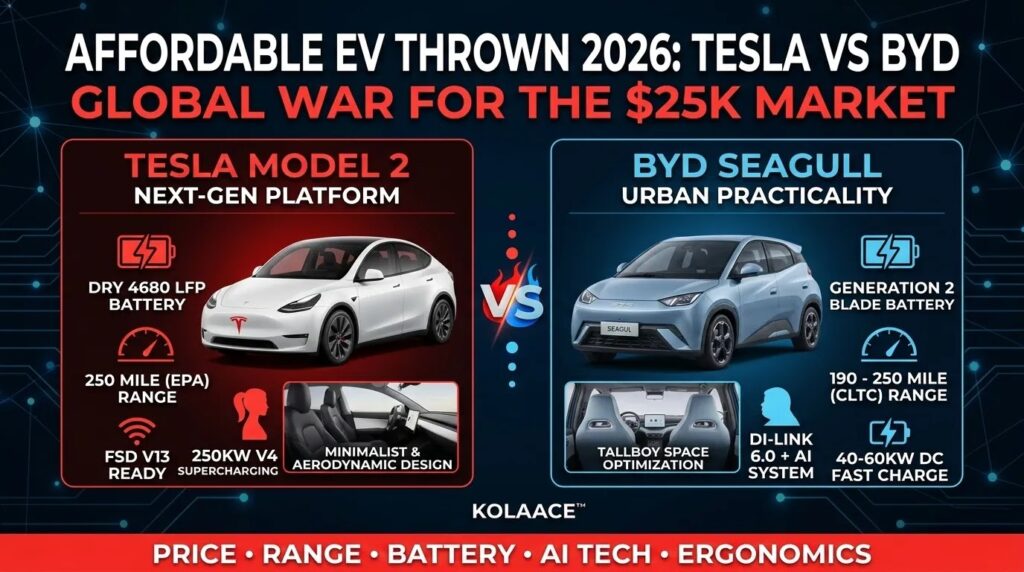
Affordable electric cars are no longer a niche category. In 2026, they are becoming the main battleground for global automakers. Buyers are not just comparing range or acceleration anymore. They are calculating charging costs, battery durability, resale value, and whether an EV can realistically replace a petrol car for daily life.
That is why the comparison between the Tesla Model 2 and the BYD Seagull 2026 matters so much. These two vehicles target completely different philosophies. Tesla is pushing software-driven mobility with a premium ecosystem at a lower price point. BYD is aggressively focusing on mass adoption by making EV ownership affordable for ordinary commuters.
After reviewing early specifications, market trends, and practical urban driving scenarios, one thing becomes clear. The real competition is not just about performance. It is about which company understands first-time EV buyers better.
For buyers moving from petrol or diesel vehicles, this guide breaks down what actually matters in day-to-day ownership, not just marketing claims.
Quick Comparison: Tesla Model 2 vs BYD Seagull 2026
On paper, both vehicles look competitive. In real-world ownership, the experience will feel very different depending on your budget, driving habits, and charging access.
| Feature | Tesla Model 2 (Expected) | BYD Seagull 2026 |
|---|---|---|
| Estimated Price | $24,990 to $28,000 | $12,000 to $16,000 |
| Driving Range | Up to 400 km | 300 to 400 km |
| Charging Ecosystem | Advanced fast charging support | Basic to moderate fast charging |
| Battery Technology | High density lithium pack | Blade Battery safety focus |
| Interior Experience | Minimalist and software centric | Functional and practical |
| Ideal Buyer | Tech-focused drivers | Budget conscious commuters |
For many buyers, the biggest surprise is how close these cars are in usable daily range despite the major price difference.
Why This EV Battle Matters Globally
For years, affordable EV buyers had limited choices. Premium electric cars offered better technology but remained expensive. Budget EVs often compromised heavily on quality, charging speed, or software reliability.
That gap is now shrinking.
Tesla wants to make advanced EV technology accessible to mainstream users. BYD wants to dominate global markets through aggressive pricing and manufacturing efficiency. Both strategies could reshape the automotive industry over the next five years.
- In Europe, affordability and energy costs are influencing EV decisions heavily
- In India and Southeast Asia, compact city-friendly EVs are gaining traction
- In urban areas worldwide, buyers prioritize low running costs over luxury features
Real World Driving Experience
City Driving and Daily Commutes
In crowded cities, compact size and efficiency matter more than raw speed. Based on early expectations, the BYD Seagull is likely to appeal strongly to urban commuters.
- Easier parking in dense traffic areas
- Lower upfront ownership cost
- Simple controls and predictable performance
- Efficient energy use during stop-and-go driving
For office commuters or delivery-based small businesses, the lower operational cost could become the deciding factor.
Highway and Long Distance Driving
This is where Tesla may maintain a stronger advantage.
- Better charging network integration
- More advanced route planning software
- Potentially smoother long-distance battery management
- Faster charging turnaround times
Drivers who regularly travel between cities may value convenience more than the initial purchase price.
Technology and Software Comparison
Tesla Model 2 Technology Focus
Tesla treats its cars almost like smartphones on wheels. Software updates continuously improve features, efficiency, and user experience over time.
Expected strengths include:
- Advanced navigation intelligence
- Better app ecosystem integration
- AI-assisted driving features
- Predictive battery optimization
For tech enthusiasts, this creates a futuristic ownership experience that feels dynamic instead of static.
BYD Seagull Technology Focus
BYD follows a different strategy. Instead of emphasizing experimental features, it prioritizes reliability, battery safety, and affordability.
Its Blade Battery system has gained attention because of thermal stability and long-term durability. For many mainstream buyers, dependable performance matters more than advanced automation features.
- Simple and intuitive infotainment systems
- Lower maintenance complexity
- Focus on battery longevity
- Practical ownership costs
Ownership Costs and Maintenance Reality
Many first-time EV buyers focus too much on sticker price and ignore total ownership cost.
From a practical perspective, buyers should compare:
- Charging expenses per kilometer
- Battery warranty coverage
- Service center availability
- Insurance costs
- Resale value after 5 years
The BYD Seagull may deliver one of the lowest cost-per-kilometer experiences in the affordable EV segment. Tesla, however, could hold stronger resale value because of brand positioning and software ecosystem demand.
Estimated Ownership Focus
*Illustrative comparison based on expected ownership priorities in 2026.
Which EV Makes More Sense for Small Businesses
Affordable EVs are becoming attractive for small business owners, especially those operating delivery fleets, ride-sharing services, or local transportation businesses.
Why BYD Seagull Fits Business Fleets
- Lower purchase cost reduces financial risk
- Lower charging expenses improve margins
- Compact design works well in cities
- Simple systems reduce downtime
Why Tesla Model 2 Could Appeal to Premium Services
- Strong customer perception
- Better software integration
- Advanced navigation and automation
- Potential long-distance efficiency advantages
For many small businesses, profitability matters more than premium branding. That gives BYD a strong opportunity in developing markets.
Pros and Cons
Tesla Model 2
- Pros: Advanced software ecosystem, likely faster charging, premium brand perception, better highway usability
- Cons: Higher entry price, potentially expensive repairs, heavy reliance on charging infrastructure quality
BYD Seagull 2026
- Pros: Extremely affordable, efficient for city driving, practical battery design, low running costs
- Cons: Simpler software experience, slower charging speeds, fewer premium features
Who Should Buy Which EV
Tesla Model 2 is ideal if:
- You prioritize technology and future software features
- You travel long distances regularly
- You want a premium EV ecosystem experience
- You are comfortable paying more upfront
BYD Seagull is ideal if:
- You want maximum value for money
- You mainly drive inside cities
- You are buying your first electric vehicle
- You care more about practicality than advanced features
Best Buying Tips Before Choosing an Affordable EV
- Check whether fast charging stations are available near your home or office
- Calculate monthly charging cost compared to your current fuel expense
- Understand battery warranty terms carefully
- Test the infotainment system and driving comfort before buying
- Do not choose features you will rarely use in daily driving
- Compare insurance and servicing costs, not just the purchase price
One common mistake among first-time EV buyers is focusing only on range numbers. In reality, charging convenience and ownership costs affect satisfaction much more over time.
Final Verdict: Budget Champion vs Tech Champion
The Tesla Model 2 and BYD Seagull represent two completely different visions for the future of electric mobility.
Tesla is trying to make advanced EV technology more accessible while maintaining a premium software-driven experience. BYD is trying to make electric mobility affordable enough for mass adoption worldwide.
For buyers who want the lowest possible ownership cost and mainly drive in cities, the BYD Seagull could become one of the most practical EVs of 2026.
For drivers who care deeply about software, charging convenience, and future-ready features, Tesla Model 2 may justify its higher price.
The most important takeaway is simple. The best EV is not the one with the most features. It is the one that fits your real driving habits, charging access, and long-term budget.
Frequently Asked Questions
